In short
- A framework that names levels but not links leaves every project supporting every objective.
- Link each KPI to the delivery item it depends on, so its forecast moves with the plan.
- Treat a target change as a governed decision, recorded against what changed.
The strategy house hangs in the boardroom. A vision at the top, three pillars, nine objectives and twenty-seven KPIs, each with a target for the end of the plan. It took a quarter of workshops to agree, and it is a good piece of work.
A year later the board asks a plain question: which projects move the customer objective, and are they on track? The strategy office takes two weeks to answer. An analyst maps the portfolio to the objectives in a spreadsheet, and half the projects turn out to be tagged to "all objectives". The KPIs live in one system, the projects in another, and the only thing that connects them is the analyst.
The framework described the strategy well. It said nothing about how the strategy stays attached to the work.
What goes wrong
Most strategy execution frameworks are a set of levels with names: vision, objectives, KPIs, initiatives, projects, sometimes OKRs between them. The levels are rarely the problem. The links between the levels are, and they fail in predictable ways.
The links are labels, so everything supports everything. At planning time each project is tagged to the objectives it serves. Tags are cheap, so projects collect several, and a portfolio where every project supports three objectives cannot tell the board which work matters to which target.
KPIs and plans run on different clocks. KPI readings arrive quarterly. Project plans change weekly. When a milestone that a KPI depends on slips, nothing moves the KPI forecast, because the KPI does not know the milestone exists. The target looks reachable until the reading that shows it is not.
Each level measures progress its own way. Projects report percentage complete, initiatives report a colour, objectives report a KPI. Nobody can roll one into the next, so each level is reviewed on its own and the strategy is never seen whole.
Targets change in slides. A target is lowered after a bad quarter in a steering committee, and the new number appears in the next pack. Nobody records who decided, why, or what else should have moved with it. Two years in, nobody can reconstruct how the plan got to where it is.
What good looks like
A strategy execution framework that holds is a framework of links, each with an owner and a rule. Five of them do most of the work.
Link each objective to targets someone owns
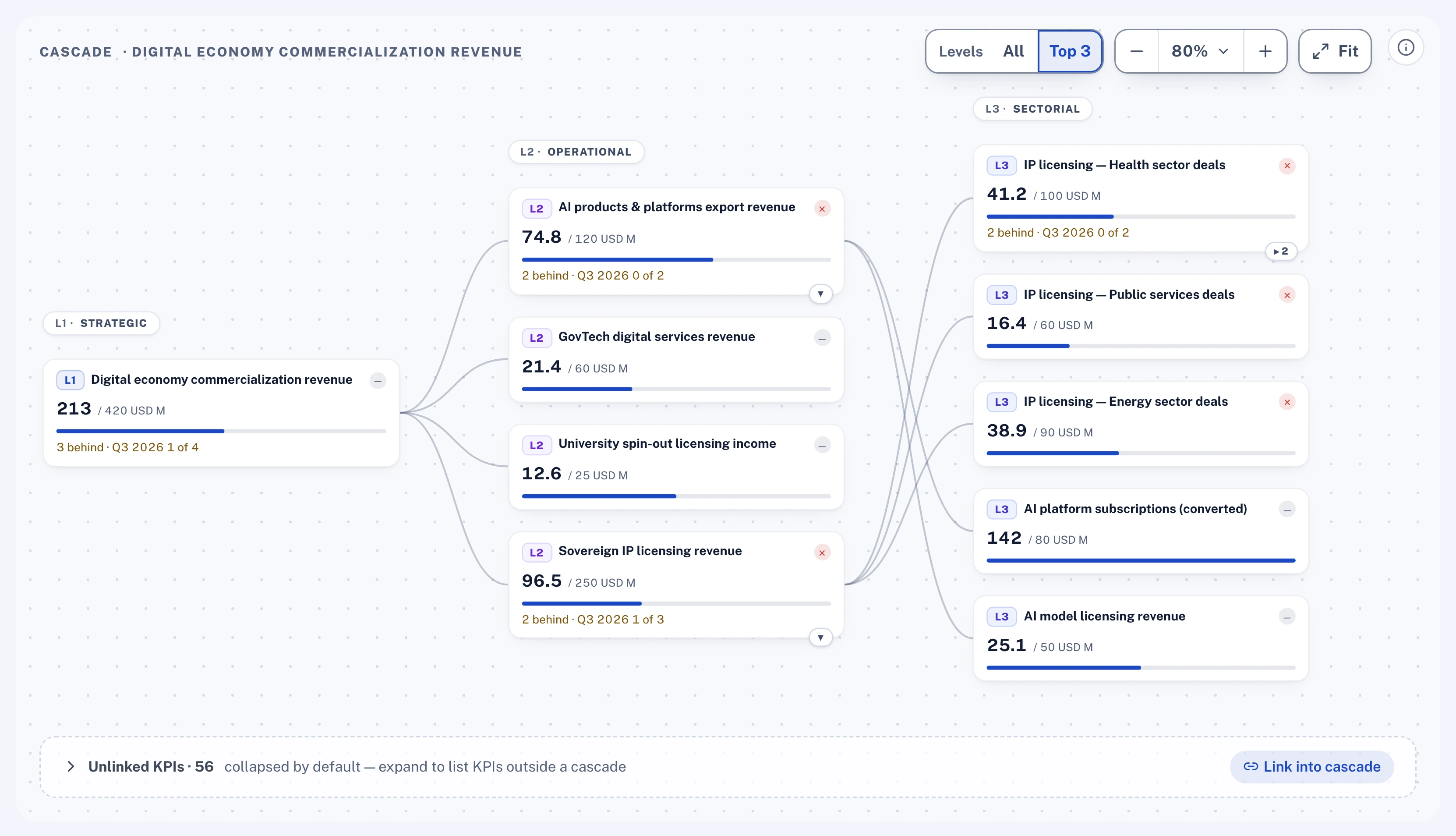
Every objective needs one or more KPIs with a baseline, a target, a date and a named owner. An objective without a measured target is a statement of intent. Cascade the targets down as far as the work requires, so a team can see the number its own work is meant to move. I wrote about cascades that survive a bad quarter in KPI cascades that hold.
Give each initiative one primary objective
An initiative may help several objectives, but it should answer to one. That single primary link is what lets the strategy office say which work serves which target, and it forces the honest conversation at planning time about what the initiative is for.
Roll projects up by a rule everyone can read
Projects, activities and tasks should roll up into their initiative by a stated rule, with weights that are written down. Then initiative progress is a calculation, not a colour someone chose, and a question about an initiative can be answered by walking down to the work.
Link each KPI to the work it depends on
This is the link most frameworks leave out. For each KPI, name the delivery item its progress depends on: the milestone, activity or task that has to land. Then the KPI's forecast can move on the day the plan moves. A KPI due in June that depends on a milestone now planned for August is at risk today, not when the June reading arrives.
In Lodestar, pillars, initiatives, projects, activities, tasks and sub-tasks sit in one live model and progress rolls up through every level. Any KPI can be linked to one delivery item; a milestone KPI is done when that item is done, and reads At risk as soon as the item is planned to finish after the KPI's due date. Each level sees the same information, entered once at the level where the work is done, so the team, the strategy office and the board are never looking at different numbers.
Send target changes back as decisions
When a target has to change, change it through a route: who proposed it, who approved it, why, and which initiatives and KPIs move with it. The record of those decisions is the strategy's history, and it is what lets a new executive understand the plan they inherit. More on giving changes a route is in governance is a workflow.
Review the links, not only the levels
Most strategy reviews walk the levels: the objectives, then the KPIs, then the portfolio. Add one question that walks the links instead. Which KPIs now have a forecast that differs from their target because of a change in the plan beneath them? The answer is a short list, and each item on it is a decision the review should take: protect the work, change the target, or accept the miss. The detail of running such reviews is in business reviews that change something.
Questions for your next review
- For each of our objectives, which initiatives answer to it first, and which only claim to help?
- For our five most important KPIs, which milestone or task does each depend on?
- If one of those milestones slipped today, when would the KPI forecast show it?
- Which targets changed in the last year, and where is the record of who decided and why?
A strategy execution framework is only as strong as the links between its levels. Name the links, give each an owner, and the levels look after themselves.

Hany is a strategy and transformation executive with a technical background in software and AI. He has advised C-suites at a top-three strategy consulting firm (MBB) and independently, and has run transformation programmes of more than USD 1 billion.
Connect on LinkedIn