In short
- A committee calendar is slower than the work, so decisions move to email unless there is a route.
- Set the route by kind of change and by value, with a deadline and a stand-in on every step.
- The person who asks for a change must never be among those who approve it.
The governance framework runs to forty pages. It has a diagram of three committees, their terms of reference, and a RACI with every cell filled. The board approved it a year ago.
On a Monday a contractor asks for three more months and more money. By Wednesday the sponsor, the finance lead and the programme director have agreed it in an email thread. The steering committee meets in four weeks. When it does, the change is on the agenda as an item to note. The contractor has been working to the new date for a month, and the minute records that the committee approved it.
I do not blame anyone in that thread. The work could not wait four weeks, and the framework offered no other way to decide.
What goes wrong
A governance document describes bodies and roles. A change needs a path, and the document does not contain one.
The calendar is slower than the work. A committee meets monthly. Changes arrive weekly. Anything urgent is settled before the meeting, by whoever can be reached, and the meeting is left to confirm what has already happened.
There is no threshold. The RACI says who is accountable for the budget. It does not say who approves a change of USD 50,000 and who approves one of USD 5 million. So small changes queue for the committee and waste its time, or large ones are settled locally because small ones always were.
The requester is in the room. The sponsor who wants the change is often the most senior name on the thread. A reply of "approved" from that person closes the matter.
The record is written afterwards. The minute says the committee approved. The reasoning, the figures and the date of the real decision sit in three inboxes.
The committee has become a place where decisions are reported.
What good looks like
Governance exists where a change has a route. Building one takes a few decisions, and none of them needs a new committee.
Name the changes that need a decision
Write the list: a milestone date moves, a budget changes, a KPI target is restated, a project passes a stage, a project closes, a risk is closed. Governance is specific to the kind of change, so the list comes first.
Give each one a route, with a value on it
For each kind of change, state who approves, in what order, and above what value it goes higher. An example, with thresholds you would set yourself:
| Change | Who approves | Time allowed | If nobody acts |
|---|---|---|---|
| Milestone date moves | Programme manager | 3 working days | PMO director |
| Budget change below USD 250,000 | Sponsor, then finance lead | 5 working days | Finance director |
| Budget change of USD 250,000 or more | Finance director, then the steering committee | 10 working days | Committee chair |
| KPI target restated | Strategy office, then the steering committee | 10 working days | Committee chair |
Most of the delegation of authority is already written in a finance policy. The work is to join it to the changes a programme makes every week.
Put a deadline and a stand-in on every step
An approval with no deadline is a request to be chased. Give each step a number of days, a reminder, and a named person it passes to when the days run out. Name the delegate before the approver goes on leave, for a fixed period. Delegated authority should not be passed on a second time.
Keep the requester out of the approval
Whoever raises a change cannot be among those who approve it, however senior. If the sponsor wants the extension, the sponsor asks, and someone else decides.
Make the committee a step on the route
A committee can decide between meetings. The request reaches its members when it is raised, they vote, and a quorum settles it. The meeting then deals with the exceptions and with direction. The record is the request itself: what was asked, on what evidence, who approved, and when.
Expect the route to be worked around
A route with a threshold on it invites a few habits. Each one shows in the record.
Splitting under the line. A change of USD 400,000 arrives as two of USD 200,000, a week apart, each below the level that needs the committee. Add up the changes on the same contract over a period, and route on the total.
The standing delegate. A delegation set up for two weeks of leave is still in force a year later, and the senior approver has not seen a request since. Every delegation needs an end date, and the list of live delegations belongs in the review.
Approve first, raise later. The work starts on a verbal yes and the request is raised afterwards to tidy the record. Compare the date of the request with the date the contractor's revised programme took effect.
The step that never says no. A step that has returned nothing in a year is either unnecessary or unread. Count what each one has sent back, and remove the ones that only add waiting.
Put the route where the change is made
A route written in a policy depends on people recalling it at the moment they are busiest. It holds when raising the request is the only way to make the change, and the system that holds the plan will not accept the new date or the new budget any other way.
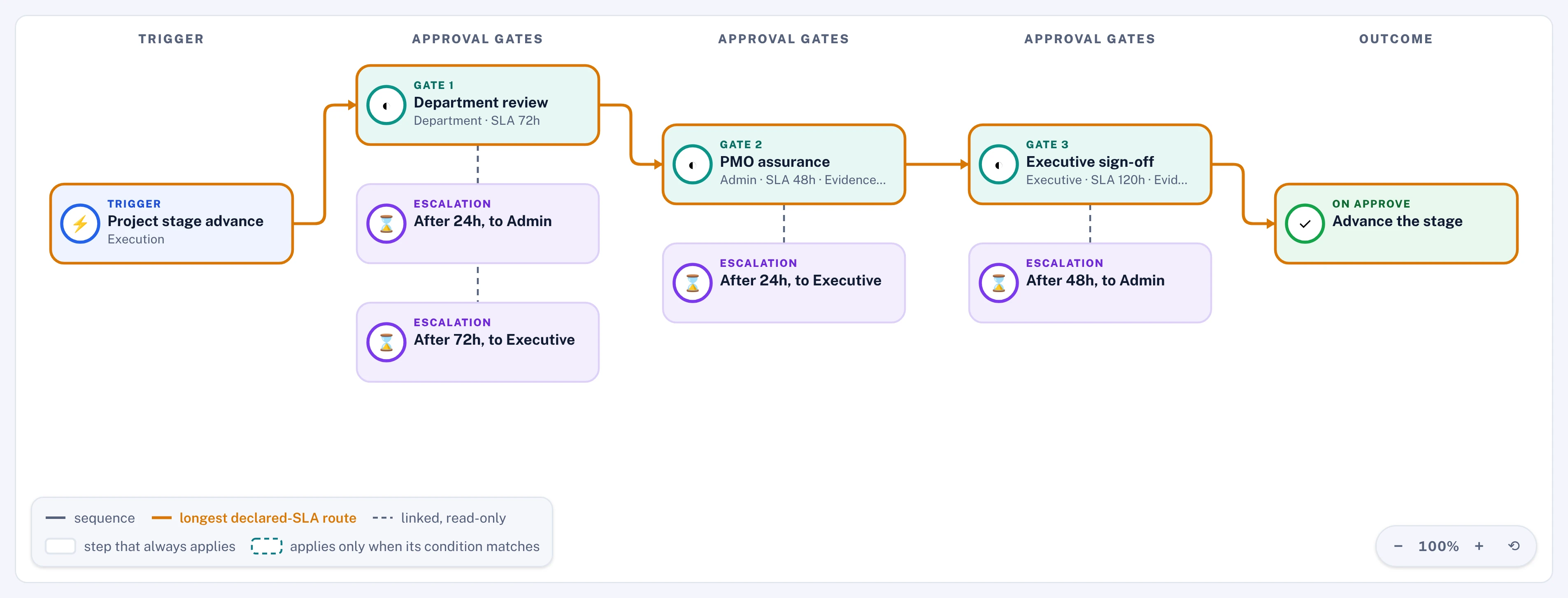
That is what Lodestar's Workflow Studio is for. An organisation sets the route for each kind of change: value thresholds, committees that decide by quorum, a deadline on every step and delegation that expires. The person who raises a request can never approve it, administrators included, and each request waits in one approvals queue with its route.
The same thinking applies to the evidence behind a completed milestone, which I wrote about in Green, and wrong, and to gate decisions, in stage gates that hold.
Questions for your next review
- Take the last five changes to a budget or a date. Where was each one decided, and how long before this committee saw it?
- At what value does a budget change move up a level, and is that written anywhere a project manager would look?
- When an approver is on leave, who decides in their place, and for how long?
- In the last quarter, how many changes were approved by the person who asked for them?
- If an auditor asked for the record of one decision, would we hand over the request or search for an email thread?
A committee is where a programme discusses its direction. The route is where each change is decided, and it is worth drawing before the next one arrives.

Hany is a strategy and transformation executive with a technical background in software and AI. He has advised C-suites at a top-three strategy consulting firm (MBB) and independently, and has run transformation programmes of more than USD 1 billion.
Connect on LinkedIn