In short
- Put the decisions the board owes on page one. Everything else supports them.
- Show what moved since the last pack, and the reason for each movement.
- An assistant may draft the words. The numbers come from the approved record, and a named person signs.
The board pack went out on Friday evening. It runs to a hundred and forty pages: a summary, a section per pillar, a page for every major project, the finance appendix and the risk register. The strategy office spent most of the fortnight before building it, copying figures from the dashboards into slides and reconciling the budget pages with finance.
At the meeting the chair asks what the board is being asked to decide. The answer is a budget increase on page ninety-six and a change of scope on page one hundred and twelve. Before either is reached, a director points out that programme progress on page four is not the figure she saw on the dashboard last week. The next twenty minutes go on working out which one is right.
This quarter there is a new question as well. The summary was drafted with an AI assistant, and it reads better than last quarter's. A director asks who checked the numbers in it. The room looks at the strategy office.
In the programmes I have worked in, the board pack is the most expensive document the office produces, and one of the least useful to the people it is written for. The fault is in how it is put together, and AI drafting has made that matter more.
What goes wrong
A long pack that does not help directors govern has five faults, and each makes the others worse.
The pack is laid out so that everyone appears. Every pillar and every department gets its pages, because leaving one out would be noticed. The decisions the board owes sit where the process puts them, often near the back under "for approval". A director who reads in page order reaches them last, and most tired.
Every number is copied, so every number can differ. The pack is rebuilt by hand from exports taken on different days. The dashboard has moved on since the export. Finance's pages come from finance's system, with its own cut-off. Two figures for the same thing make a director doubt both, and the meeting spends its scarcest time on reconciliation, which is the office's job, done in front of the board.
What moved is buried in what did not. The pack shows the state of the programme this quarter. Without last quarter's pack beside it, nobody can see which numbers changed, which targets were restated and which readings are missing. The board is asked to govern a change it cannot see.
No number leads back to evidence. A director who asks how the office knows a milestone is done gets a promise to come back with the answer. The figure was typed into a slide. The evidence behind it, if there is any, sits in a folder the board will never open.
AI drafting makes all of this more persuasive. An assistant can turn the pack into a fluent summary in minutes. If the numbers it reads were copied and never approved, the summary is wrong in better prose. A clumsy paragraph invites a question. A polished one discourages it. "Who stands behind this?" now has to be answered for every sentence, and a pack built by hand has no way to answer it.
The result is a pack that takes a fortnight to build and an hour to reconcile, and leaves the board's real decisions with the least of its attention.
What good looks like
These moves apply to a ministry's board, a utility's executive committee and a programme's sponsor group alike. None of them starts with a tool.
Open with the decisions the board owes
The first page lists every decision asked of the board at this meeting: what is being decided, the options, the recommendation, the cost of waiting and the person who owns it. Items for noting follow. A director who reads only page one should know what the meeting is for. Anything that needs no decision and has not changed belongs in an appendix.
Show the few numbers that moved, and why
Compare every headline figure with the pack the board saw last time. Lead with what moved past an agreed threshold, every target or baseline that was restated with the decision that allowed it, and every reading that is missing. Each movement carries one line from its owner on the cause. A handful of numbers that moved, each with its reason, gives a board more to govern with than a hundred pages that did not move.
Trace every number to approved evidence
Each figure in the pack should lead back to the record it came from, and that record should count only what someone other than the owner has approved. Work claimed and not yet approved is shown as a claim and held short of complete. When a director asks how we know, the answer in the meeting is the name of the approver and the document they signed. I set out the reasoning in Green, and wrong.
Let an assistant draft the words, and a person sign them
An assistant is good at reading a whole programme and drafting the summary a director needs. It should take its numbers from the approved record and never produce figures of its own. A named person reads the draft, edits it and signs it before the pack goes out. The board then knows who stands behind each sentence, and it is the same person who would have stood behind it before any assistant was involved.
A clumsy paragraph invites a question. A polished one discourages it.
Produce the pack from the live model, and keep what the board saw
If the pack and the dashboards come from the same calculation on the same data, they cannot disagree, and the fortnight of copying goes. The office's time moves to the decisions page and the narrative, which is where it was needed. Freeze the version the board received, so that next quarter's "what moved" has a fixed point to compare with.
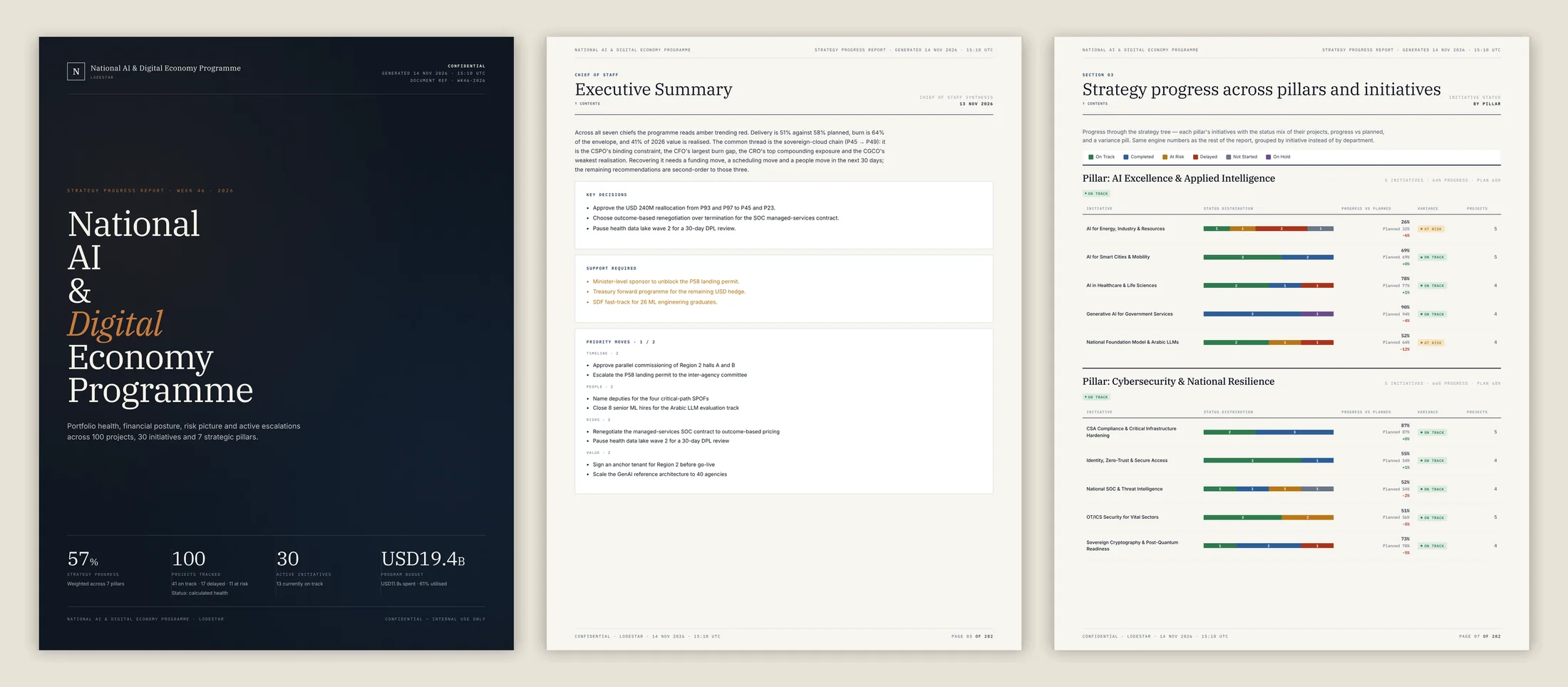
In Lodestar, the strategy progress report, the KPI scorecard and a one-page deep dive for every project are generated from the live model, through the same calculation as the dashboards. The reports export to PDF, PowerPoint and Word, and the deep dives to PDF and PowerPoint. The executive summary carries the decisions owed, drafted by the Polaris Chief of Staff and editable line by line before it goes out. More is on the reports page.
Questions for your next review
- What did the board decide at its last meeting, and on which pages of the pack were those decisions?
- Which figures in this pack differ from the dashboards, and why?
- Which numbers moved since the last pack, and which targets were restated?
- For the three largest completions reported, who approved the evidence?
- Which parts of this pack were drafted by an AI assistant, and who signed them?
A board pack exists to help directors decide, and to show them what they are relying on when they do. Put the decisions first and the evidence one step behind every number, and the pack grows shorter as it grows more useful.

Hany is a strategy and transformation executive with a technical background in software and AI. He has advised C-suites at a top-three strategy consulting firm (MBB) and independently, and has run transformation programmes of more than USD 1 billion.
Connect on LinkedIn