Know whether a funded project delivered the value it promised
Each project carries a benefits register beside its schedule and budget, with a target, a realised value and the KPI that evidences each benefit. Realised values can be accepted period by period through a review, and revenue and EBITDA roll up from project to programme against target.
What usually goes wrong
And what changes when it runs on one model.
Benefits are promised once
The business case states the value at approval and nobody opens it again.
Delivery is counted as success
The project closes on time and on budget, and the benefit is assumed.
The team has gone
By the time the value should appear, the people who promised it have moved on.
Realised value is self-reported
The number comes from the project that needs it to look good.
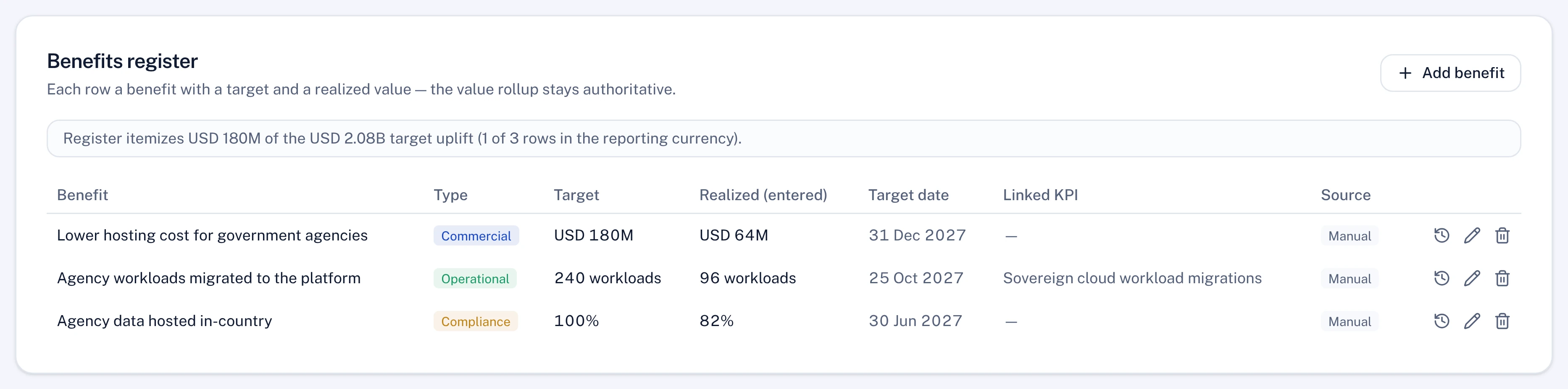
A benefits register on every project
Each benefit has a type, a target, a realised value, a unit and a target date, and can be linked to the KPI that evidences it. Benefits listed on an approved project charter arrive in the register with the charter recorded as their source.
- Six types, from commercial to risk reduction
- Linked KPI from the project or the programme
- Register total compared with the target uplift
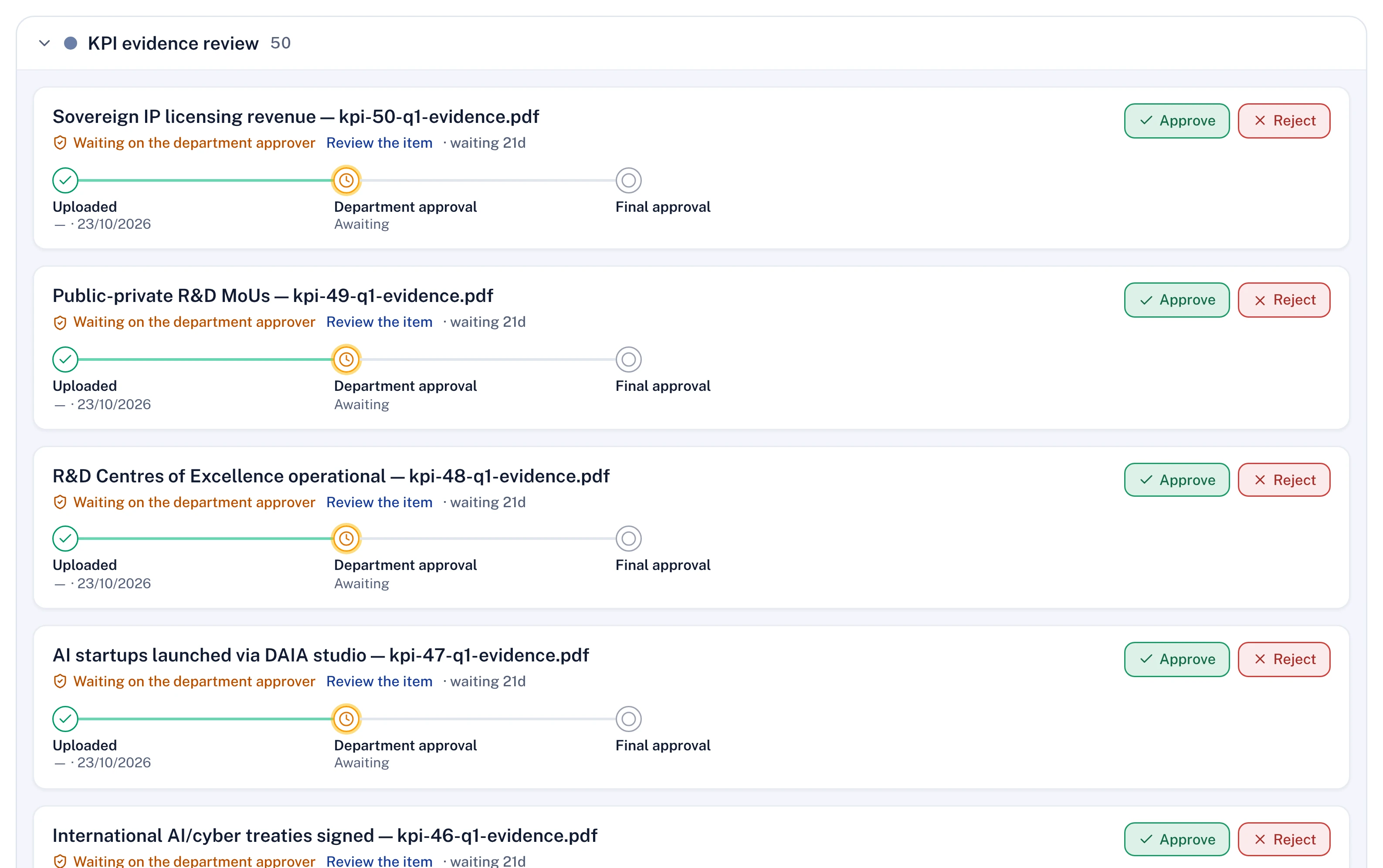
Realised values accepted, period by period
A review form can record the reviewed benefit values as accepted observations for a reporting period. When the form goes for approval, nothing is recorded until the final approver clears it.
- One accepted value per benefit and period
- A later review supersedes; the earlier one is kept
- Period or cumulative basis stated on each value
Benefits checked again when the project closes
The built-in closure form asks for the outcome, the lessons and the benefits realised against target, and the realised values are written to the register when the project closes. Closure can also require its own forms, handover activities and an approval.
- Realised against target, benefit by benefit
- Lessons added to the programme's lessons registry
- A standalone benefits review form, kept as a record
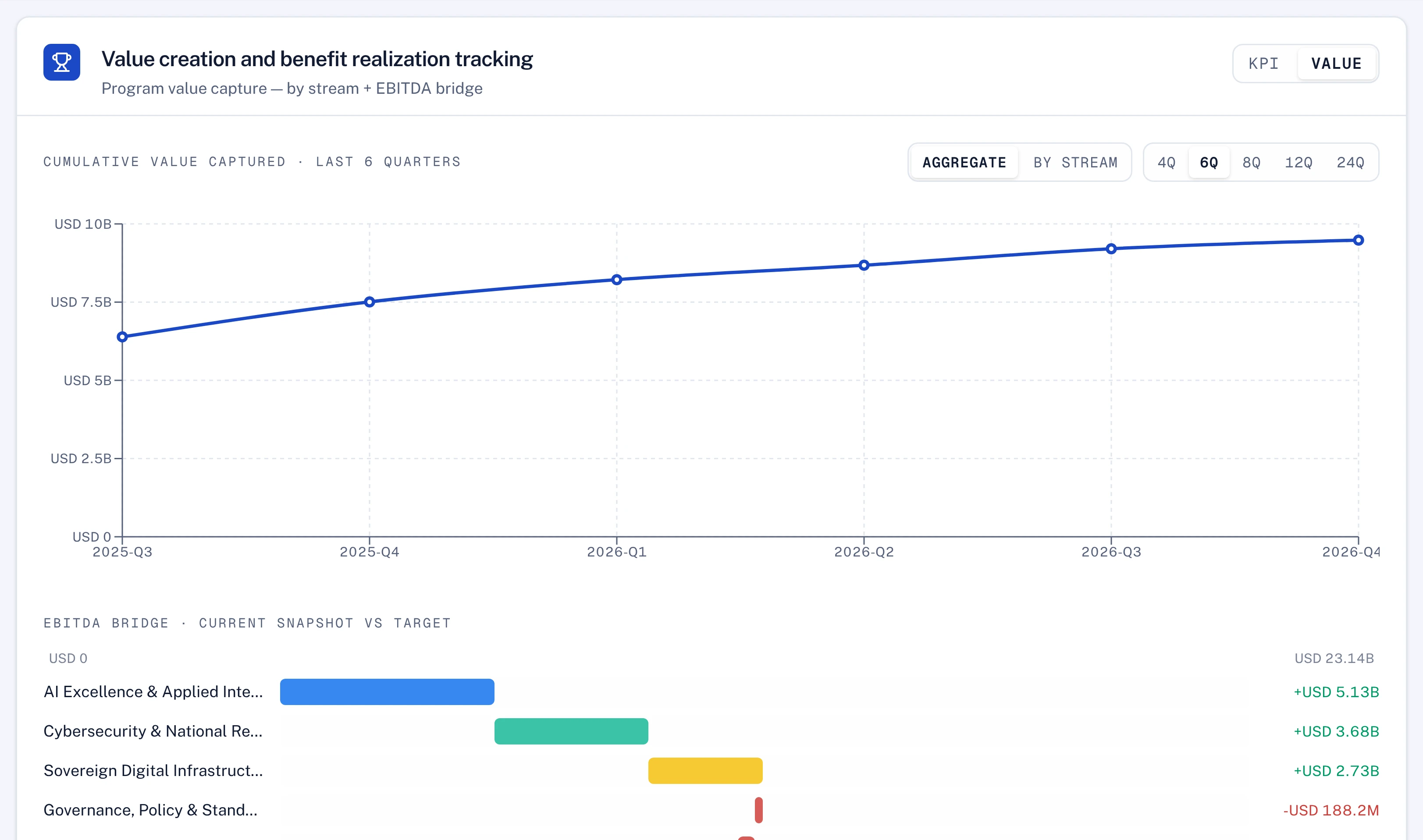
Value against target, from project to programme
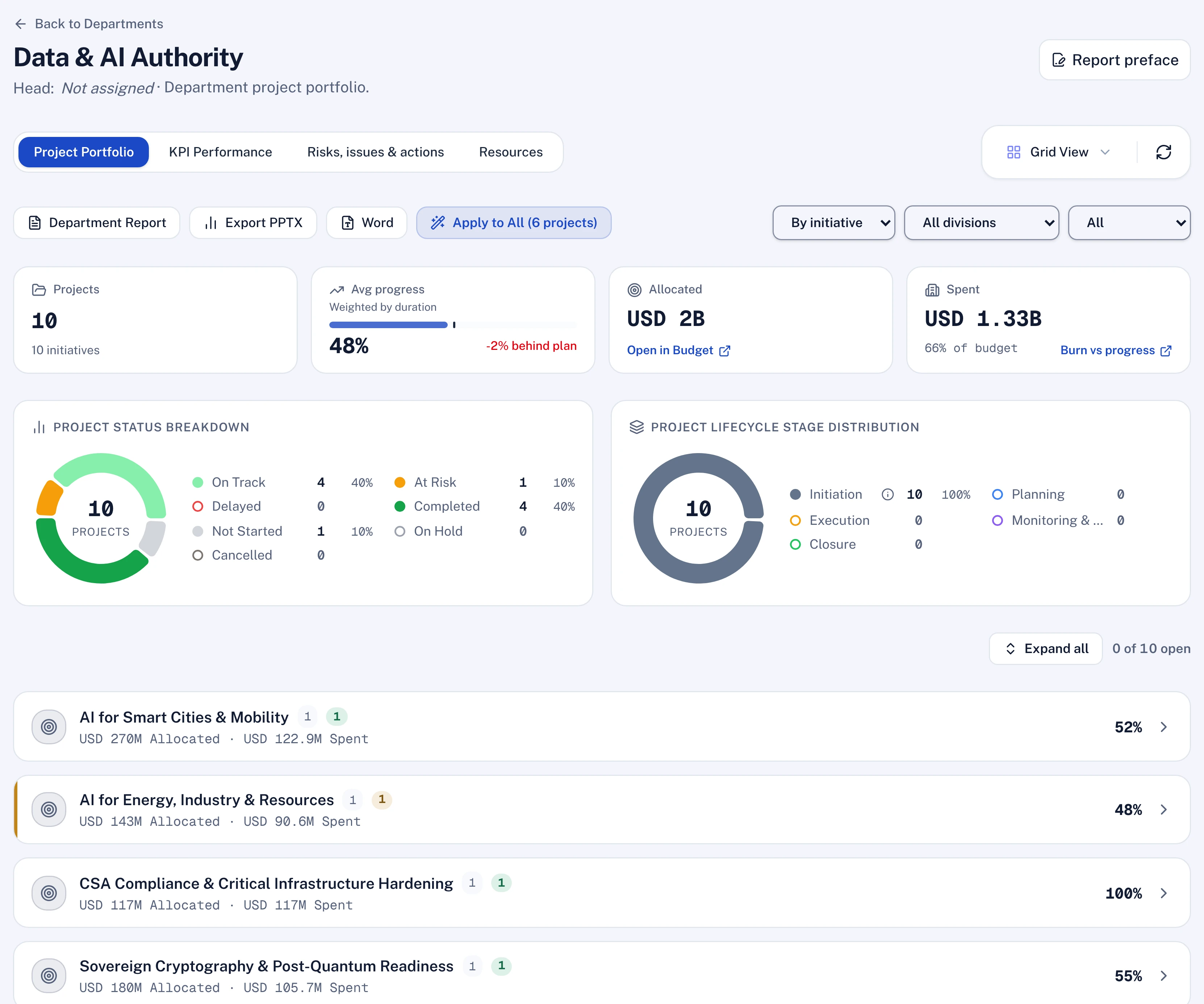
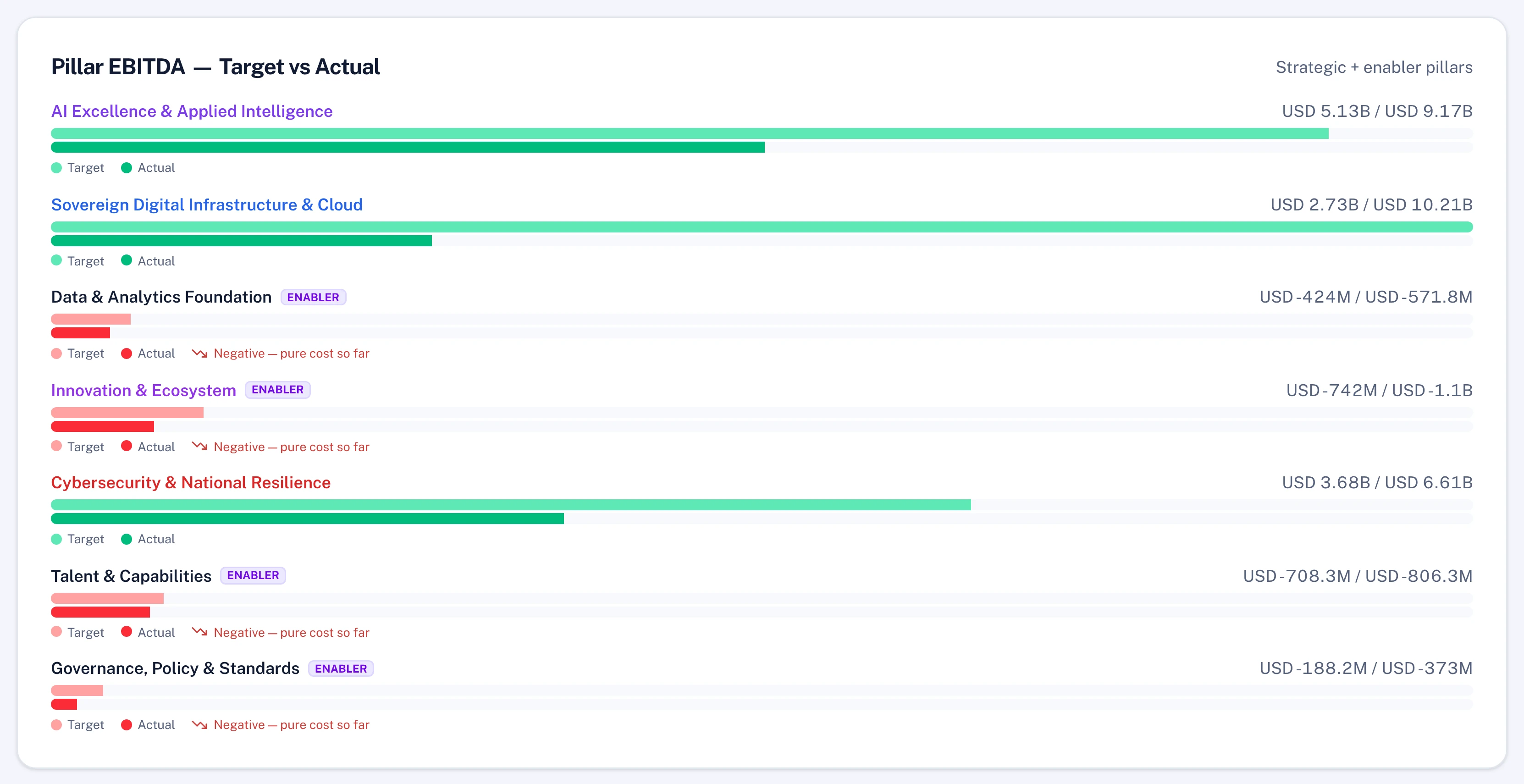
Each project carries a target revenue uplift and the revenue captured so far, with EBITDA as revenue less the project's total cost. The value view rolls these up by initiative and pillar, with enabler pillars shown as cost.
- Target and actual revenue and EBITDA
- Share of target captured at each level
- Cumulative value captured, quarter by quarter
What you get
Every item runs on the same engines the screens use.
Type, target, realised value, unit and target date for every benefit.
A benefit points at the KPI that evidences it, with that KPI's own readings.
Reviewed values recorded per period, with the history of what was accepted.
A benefit with accepted observations cannot be deleted from the register.
Revenue and EBITDA against target by project, initiative and pillar.
The register is shown only to people with financial access to the project.
Questions
Who decides that a benefit has been realised?
A reviewer records the values on a review form. When that form is routed for approval, the values are accepted only when the final approver clears it, and the person who raised the request can never decide it.
Does a benefit have to be financial?
No. Each benefit carries its own unit, so it can be an amount of money, a percentage or another measure. The six types are commercial, operational, strategic, compliance, customer and risk reduction.
What happens to benefits when the project closes?
The closure form records the benefits realised against target, and those values are written to the register. A standalone benefits review form records planned against realised for a review period.
Can an accepted value be corrected?
Yes, through a correction or a later review of the same period. The earlier value stays in the history, marked as withdrawn or superseded, with the later one marked current.
From the blog
Our founders on benefits realisation. More on this topic
Benefits the CFO can book: define value the way finance counts it
A benefit that finance does not recognise never reaches the accounts, however carefully the programme tracks it. Write each benefit as the line it will move, name a finance owner, agree the baseline with finance before approval, and report planned against realised after go-live.
The AI portfolio needs a baseline before go-live
AI pilots are funded as experiments, so nobody measures the work before the pilot starts and nobody owns the benefit. Govern them like any other investment: one register, a baseline taken before go-live, a named benefit owner, gates that ask for evidence, and a decision to stop.
Delivered, and no benefit: who owns the outcome after go-live
A project ends at go-live and its benefit starts there, after the team has gone. The benefit is measured only if it has an owner outside the project, a baseline taken before the work, and a KPI that someone already reports.