In short
- Write each benefit as the line in the accounts it will move, in finance's own terms.
- Name a finance owner beside the business owner, and have finance sign the baseline before approval.
- After go-live, keep what finance has accepted apart from what the programme expects.
The transformation director has the last slot in the quarterly finance review. Her slide is the benefits register: forty benefits, most of them green, and a realised total in bold at the bottom. The programme went live in the spring, and by its own count it is ahead of plan.
The chief financial officer asks one question. Where is it in the accounts? The cost centres that were meant to shrink are on budget. Headcount is where it was. Revenue is up, but prices rose in the same quarter. Nobody in the room can name the line in the management accounts where the bold total sits.
Nobody invented that total. It was written in the programme's language and checked by the programme, and finance was never asked to agree any of it. I think this is where a transformation's value is most often lost: after delivery, in the gap between the register and the ledger.
The earlier problem, a benefit with nobody to own it once the project team has gone, is the subject of Delivered, and no benefit. This post is about the step after that one: getting the benefit counted by the people who keep the books.
What goes wrong
A register that finance does not trust usually fails in four places, and the programme cannot see any of them from the inside.
The benefit is defined in the programme's words. "Efficiency gain", "productivity uplift", "cost avoided". Finance has a definition for every line it reports. A cash saving lowers a budget that was approved. A cost avoided lowers a forecast that was never approved. Time freed stays on the payroll until a post or a contract ends. A benefit that does not say which of these it is will be counted widely by the programme and narrowly by finance, and both will be measuring honestly.
The baseline belongs to the programme. The business case took its starting figure from a sample the programme chose, over a period the programme chose. Finance holds its own figure for the same cost, taken from the ledger, and the two rarely match. Every improvement measured from the programme's baseline can then be disputed by anyone holding the other one. In a finance review, that is everyone.
Nobody in finance owns the number. The register names a business owner, often the sponsor. Nobody in finance has agreed to recognise the benefit, and nobody has agreed to take it out of next year's budget. For a cost benefit, that second step is the one that matters. A saving that is never removed from a budget is usually spent again by the department that made it, and the organisation never sees it.
After go-live, the realised column is the programme's forecast. The people who wrote the plan update the realised figures, from their own sources, when they have time. Planned and realised are filled in by the same hands. Finance sees a column that moves when the team moves it.
The result is two accounts of the same programme. The register says the value is arriving. The ledger cannot find it. When costs come under pressure the ledger wins, and the transformation's value is written down to what finance can see, which may be very little of what was delivered.
What good looks like
Each of these moves is a conversation with finance, held earlier than usual. None of them needs a new system to start.
Write each benefit as the line it will move
For every benefit, name the place in the accounts where it lands: the cost centre whose budget falls, the revenue line that rises, the provision that is released. Say which kind of benefit it is, in finance's terms: cash saving, new revenue, cost avoided or capacity freed. Agree with finance, once for the whole programme, which kinds it will book and which it will only report. A benefit that cannot be pointed at a line is still worth writing down. Keep it in a section of its own, so that nobody adds it to the bookable total.
Name a finance owner beside the business owner
The business owner makes the change happen in operations. The finance owner, usually the finance business partner for that area, agrees the definition, agrees the baseline and accepts each realised figure. For a cost benefit, the finance owner also carries the saving into the next budget round. Every benefit gets two names, and neither of them comes from the project team.
Agree the baseline with finance before approval
Take the starting figure from the ledger wherever the ledger holds it, over a stated period and by a stated method. Have the finance owner sign it before the business case goes for approval. Where the ledger cannot give the number, say so, and agree the substitute measure in writing. Before approval, finance's questions shape the case. After approval, they can only judge it.
Track planned against realised on finance's calendar
Set the plan as a curve, period by period, and fix it once it is approved. After go-live, read the realised figure each period from the same source as the baseline, at the month-end or quarter close when finance is closing its own numbers. The finance owner accepts the figure or sends it back. An accepted figure stays as it was accepted. A correction is a new entry with its own acceptance. A shortfall is shown as a shortfall, beside the plan, in the pack the sponsor reads.
A cost saving becomes real on the day a budget falls.
Keep what finance accepted apart from what the programme expects
The register will always hold forecasts, and it should. Owners need somewhere to say what they expect. The fault is letting a forecast and an accepted figure share one column and one colour. Keep them apart: what the programme expects, and what finance has accepted, period by period, with the name of the person who accepted each figure.
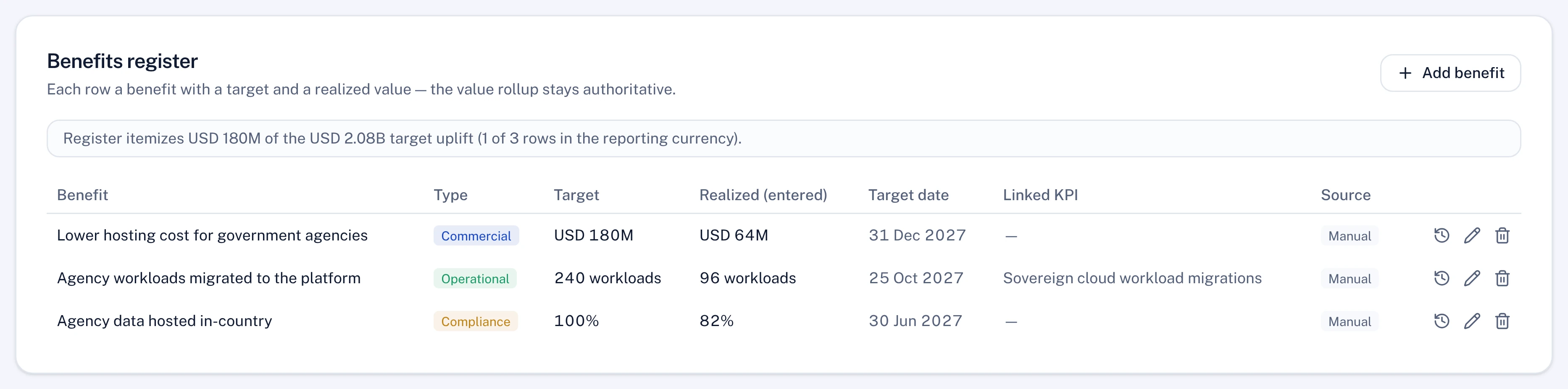
In Lodestar each project keeps a benefits register: every benefit with its type, a target, a realised value, a target date and, where one exists, the KPI that evidences it. Value tracking sets planned against realised. A benefits review can run as a form with its own approval route, and when the final approver clears it, the reviewed values are recorded as accepted for that period. A later review supersedes them and never edits them.
Questions for your next review
- For our five largest benefits, which line in the accounts will each one move, and does finance agree?
- Who in finance owns each benefit, and have they signed its baseline?
- Which benefits in the register are cash, and which are capacity or cost avoided?
- Of the realised value reported this quarter, how much has finance accepted?
- Which budgets were reduced in the last budget round because of a benefit we delivered?
A benefit is real to the organisation when it appears in the accounts. Bring finance in before approval, and after go-live the register and the ledger will tell the same story.

Mariia leads commercial and partnerships at Lodestar. Her background is Big Tech and Big Four consulting, where she led large-scale transformations. She holds an MBA from INSEAD.
More from Mariia