In short
- Name a benefit owner in the business, outside the project team, before the work starts.
- Take the baseline first. Without it, any later number can be claimed or dismissed.
- Treat closure as a decision with conditions, including who measures the benefit and when.
The closure report is two pages. Delivered on time, within budget, every deliverable accepted. The steering committee thanks the team, the project manager moves to the next programme, and the contractors' passes are cancelled on Friday.
The business case that funded the project promised something else: a lower cost to serve, or faster permits, or more customers using the digital channel. That number was due in the eighteen months after go-live. Nobody in the closing meeting asks who will be counting.
A year later someone preparing the next funding round goes looking for the result. The project folder is complete and says nothing about it. In the programmes I have worked in, this is an ordinary ending: finished, signed off, and never measured.
What goes wrong
A project and its benefit run on different clocks, and the organisation is built around the first one.
The benefit arrives after the team has gone. The project ends at go-live, or shortly after. The benefit starts there. The people who know what was built, and what it was meant to change, are reassigned before there is anything to measure.
Nobody owns the number. The project manager owned scope, time and cost, and delivered all three. The benefit depends on a business unit using what was delivered. If nobody in that unit was named as its owner, it belongs to no one.
There is no baseline. The business case said "reduce processing time by a third". A third of what, measured how, on which date? If nobody took the reading before the work started, any later number can be claimed as an improvement, or dismissed as one.
The benefit lives outside the reporting. It was written in a business case and tracked, if at all, in a sheet of its own. The KPIs the organisation reports every quarter carry on without it.
The figure was written to win funding. The benefit in the business case was set at the level needed to clear the investment hurdle, often by people who would never be asked to deliver it. Once the money is approved, nobody has a reason to look at that figure again, and the people who could test it have every reason to leave it alone.
The result is an organisation that knows to the dollar what it spent and cannot say what it bought.
What good looks like
None of this needs software to begin. It needs five things settled while the project still has a sponsor's attention.
Name a benefit owner outside the project
The owner is the person whose budget, service or revenue the benefit shows up in: the head of the contact centre, the director of licensing. They sign the benefit in the business case, and they are still in post after the project team has gone. A benefit owned by the project manager ends with the project.
Take the baseline before the work starts
Measure the number today, with the method you will use later, and write down the date. Do it before the first change reaches users. A baseline reconstructed afterwards is an estimate, and it will be argued over like one.
Tie the benefit to a KPI someone already reports
A benefit that needs its own data collection will stop being collected. Find the KPI the business already reports, or should, and state the benefit as a movement in it: from this value to that value, by this date. Then it appears in the cascade the leadership reads every quarter, with an owner and a definition.
Keep measuring after closure
Set the review dates when the project is approved, for example three, six and twelve months after go-live. Each review compares planned with realised and ends in a decision: carry on, correct, or accept the shortfall and say so.
Treat closure as a decision with conditions
Closing a project releases people and money, so it deserves the care of any other gate. The conditions are short: deliverables accepted, lessons written, the benefit owner confirmed, the first review date set. Someone other than the project manager approves it.
The project ends at go-live. The benefit starts there.
Expect the benefit to be claimed twice
Once benefits are tracked, they become worth claiming, and the claims need the same scrutiny as any other number.
Double counting. Three projects each claim the same saving in the contact centre, and each business case clears on it. Tie every benefit to one KPI and one owner. Where two projects move the same KPI, agree the split before either starts.
Attribution by assertion. The KPI moved, and the project claims all of it, though prices changed and a competitor left the market in the same period. Ask the owner to record what else changed. An honest "partly" is worth more than a full claim nobody believes.
The baseline that moves. After a poor first review, someone proposes a more representative baseline. A change to the baseline is a change to the target, and it needs the same approval.
Reviews that lapse. The six-month review is postponed twice and then forgotten. Put the review dates in the committee's own calendar when the project is approved, so that skipping one is a visible decision.
Keep the benefit in a record that outlives the project
A benefit written only in a business case is filed with the project. To be measured later it has to sit somewhere that is still open after closure, beside the numbers the leadership already reads.
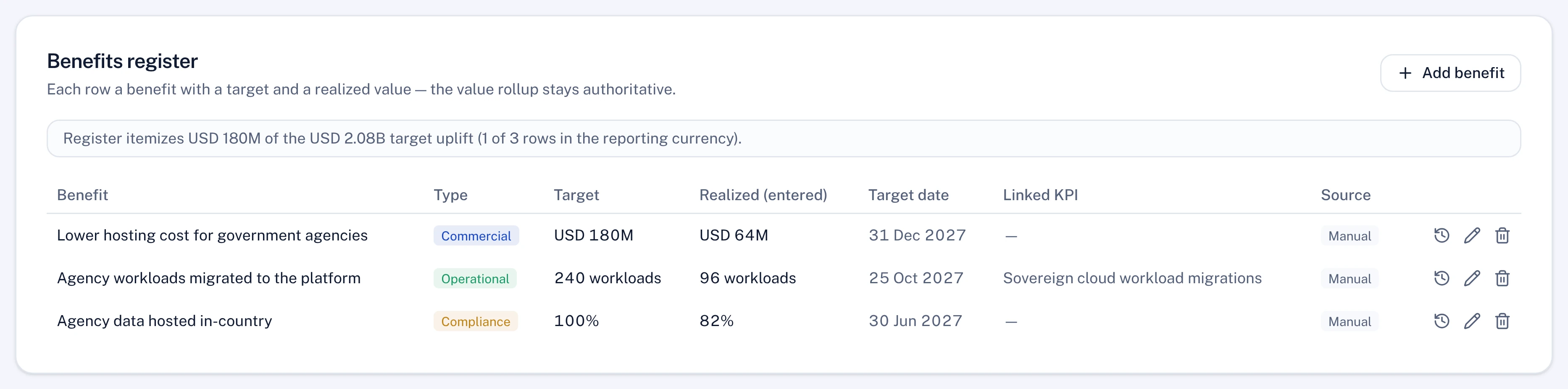
In Lodestar each project has a benefits register: every benefit with a target, a realised value, a target date and, where one exists, the KPI that evidences it. Value tracking then shows planned against realised, and the value captured quarter by quarter. Closing a project can require a form that states the benefits realised against target, and an approval from someone else.
Questions for your next review
- For the last five projects we closed, who owns each benefit today, and when did they last report it?
- For the projects now in delivery, where is the baseline, and on what date was it taken?
- Which benefits in our business cases are tied to a KPI we already report?
- What does our closure approval require, apart from accepted deliverables?
- When did this committee last look at a project a year after it closed?
Delivery is what a project is managed for, and the benefit is what it was funded for. Give the benefit an owner, a baseline and a date, and closure becomes the point where the measuring starts.

Hany is a strategy and transformation executive with a technical background in software and AI. He has advised C-suites at a top-three strategy consulting firm (MBB) and independently, and has run transformation programmes of more than USD 1 billion.
Connect on LinkedIn