In short
- Agree what evidence opens a gate before the stage begins, while nobody is under pressure to pass.
- A pass with conditions is only a pass if each condition has an owner and a date.
- Moving a project back a stage, and closing it, are decisions that need an approver too.
The gate review is booked for an hour. The project wants to move from design into build. The checklist has fourteen items and eleven are ticked. The contractor is mobilised for the first of the month. After forty minutes the chair says what everyone expected: approved, with conditions. Three conditions go into the minute, and the project moves to build the next morning.
Six months later the same project reaches its next gate. Nobody in the room can say whether the three conditions were met. Two of the people who set them have moved on.
I have also seen the gate skipped altogether, for the same reason. The date was fixed first, and the gate was asked to fit it.
What goes wrong
A gate is the one point where a programme can say no cheaply. After it, money is committed and people are hired. Four habits turn it into a ceremony.
The criteria are written at the gate. The checklist asks whether documents exist. Whether the project is ready is argued in the room, by the people who most want it to pass.
The cost of no falls on the chair, today. The cost of a wrong yes falls on someone else, months later. With a contractor waiting, any reasonable chair looks for a way to say yes.
"With conditions" is that way. It feels like control. But the conditions live in a minute, and the plan does not know about them. They have no owner, no date, and nobody is asked about them again.
The stage is a label anyone can change. When the date matters more, someone with edit rights moves the project forward and the gate is held later, as a formality. When a project turns out not to be ready, nobody moves it back, because there is no way to do that without a difficult conversation. It stays in build while the design is redone.
The same thing happens at the end. Projects are rarely closed. They fade, with an invoice unpaid, two risks open and nobody named to own what was delivered.
What good looks like
A gate holds when it is a decision with a record. Five rules get it there, and none of them needs more meetings.
State the criteria as evidence before the stage starts
At the start of design, write what will open the gate into build: the signed design, the approved budget, the land access letter, the test plan. Name documents and results. Agree the list while nobody is under pressure to pass. At the gate, the question is then whether the evidence is there.
Name who decides
One role or one committee holds the decision for each gate, and it is never the project's own manager. Give the decision a deadline. A gate that waits three weeks for a signature teaches teams to start the next stage without it.
Turn every condition into a tracked action
If the gate passes with conditions, each one becomes an action in the plan with an owner and a date. It appears on the project's page and in the next review. A condition not met by its date goes back to the person who set it. Three conditions in a minute are three things nobody will do.
Treat going back as a decision
Sometimes a project in build needs to return to design. That is a legitimate outcome, and it should take a reason and an approval, as the advance did. If going back is impossible, the record will say build while the team does design, and every report that reads the stage will be wrong.
Make closure a gate
Closing a project is the last decision about it. Before it closes, someone confirms the handover is done, the final documents are filed, and the open risks, issues and invoices have each been dealt with or accepted by name. Then the lessons are written down while people remember them.
Three conditions in a minute are three things nobody will do.
Expect the gate to be gamed
Once a gate can say no, people find ways to get a yes. Four are common, and each leaves a trace.
Evidence that exists and says nothing. The criteria ask for a risk register, and a register is filed with four generic rows. State what the evidence must show, and have the approver read it. "A test report listing every failed case" is harder to satisfy with a cover page.
The condition that rolls forward. A condition due in March is carried to the next gate, and then to the one after. When a condition passes its date, it returns to the authority who set it. That person extends it by name or moves the project back.
The stage split in two. To pass on time, the stage is redefined: build "phase one" starts while design "phase two" continues. Sometimes that is the right call. Then it is a change to the plan, and it is approved as one.
The gate held after the fact. Compare the date of each gate decision with the date spending on the next stage began. Where the spending comes first, the gate is a ceremony whatever the minute says.
Make the stage something only a decision can change
These rules hold when the stage of a project cannot be edited like a text field. If moving forward, moving back and closing each need a request, the record of where a project stands becomes a record of decisions.
Lodestar treats the stage that way. Advancing can require a gate approval, required forms and completed milestones, and the person who asks can never be the one who approves. A project cannot be advanced past a stage that has its own approval. Moving back takes a reason and, under the policy you set, someone else's approval. Closure can require its own forms and sign-off.
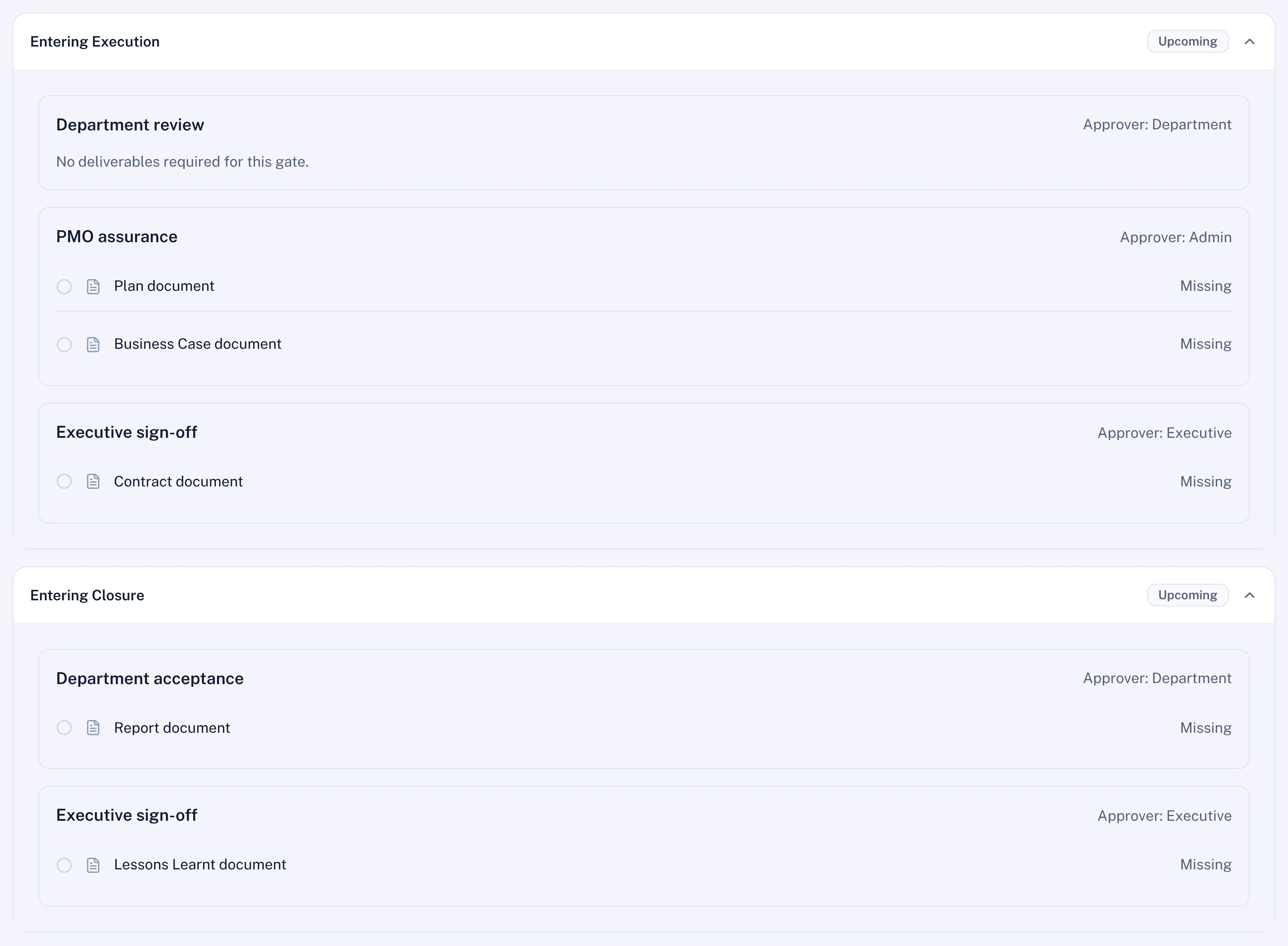
The evidence a gate asks for is the subject of Green, and wrong, and who approves it is covered in governance is a workflow.
Questions for your next review
- For the next gate on our largest project, what evidence opens it, and when was that list agreed?
- How many projects passed their last gate with conditions, and who can show the state of each condition today?
- Which projects are in a later stage than their last approved gate?
- When did we last move a project back a stage, and who approved it?
- How many finished projects are still open, and what is each one waiting for?
A gate is worth holding only if it can say no. Write down what yes requires, who says it and what happens to the conditions, and the hour in the room becomes a decision.

Hany is a strategy and transformation executive with a technical background in software and AI. He has advised C-suites at a top-three strategy consulting firm (MBB) and independently, and has run transformation programmes of more than USD 1 billion.
Connect on LinkedIn