In short
- Self-reported progress measures confidence. Only approved evidence measures completion.
- The person who makes a claim must never be the person who accepts it.
- A record that can be edited afterwards protects nobody. Freeze what was approved.
The steering committee meets on Thursday. On Tuesday the PMO sends its weekly request, and by Wednesday night forty project managers have each typed a percentage and picked a colour. The pack that reaches the committee shows thirty-four greens, five ambers and one red. Everyone in the room knows the red. Nobody asks about the greens.
Three months later two of those greens miss a date that had been green every week. No one lied. The form asked each owner how the project was going, and each owner answered with how they felt about it.
I have sat on both sides of that table. The pattern is the same in a ministry, a utility and a factory, and it has little to do with the people.
What goes wrong
A self-reported percentage has three weaknesses, and each one pushes in the same direction.
The owner grades their own work. A project manager who reports amber invites a meeting. One who reports green is left alone to fix the problem. Any sensible person learns which answer costs less.
The number has nothing behind it. "80% complete" might mean four of five deliverables accepted, or eighty percent of the budget spent, or that the hard part has not started. The pack shows the same bar for all three.
The record can be changed. Last month's status sits in a spreadsheet that someone will overwrite on Wednesday. When the date is missed, there is no way to show what was known, when, and by whom.
Put those together and the board is steering by a number that measures confidence, with no trace of how it was reached.
What good looks like
None of this needs software to begin. It needs four rules, applied to every number the board sees.
Say what proves it before the work starts
For each milestone, write down what will show it is done: the signed acceptance, the test report, the published policy. Agree it when the milestone is planned. A milestone with no named proof is a hope with a date.
Make the approver someone else
The person who claims completion cannot be the one who accepts it. That includes senior people and it includes the PMO. When the approver is absent, authority passes to a named delegate for a fixed period. It does not pass back to the claimant.
Count nothing until it is approved
A claim that is waiting for approval is a claim. Hold it just short of complete in every roll-up, so that a programme cannot reach its target on work nobody has checked. People will object that this makes the numbers look worse. It makes them look like what they are.
Freeze what was approved
Keep the exact file the approver saw, with the time and the name. If the document changes later, that is a new version with its own approval. A record you can edit is a record you will be asked to edit.
A milestone with no named proof is a hope with a date.
Expect the rule to be gamed
Any rule that decides a number will grow habits around it. Three are common enough to look for from the first month.
Parking under the line. Work sits at "nearly done" for weeks, because the last step is the one that needs someone else's approval.
Green with nothing behind it. A project reports on plan, and no report or evidence has been filed for a month.
Spend ahead of delivery. The budget is two-thirds gone and the approved progress is a third. The status column says on track.
None of these needs an accusation. Each is a pattern in the data, and a pattern can be listed for the review every cycle without anyone being singled out.
Build the rule in, so it does not depend on Wednesday night
A rule that relies on people remembering it will be kept by the careful teams and skipped by the stretched ones, which is the wrong way round. It has to live in the system that holds the plan.
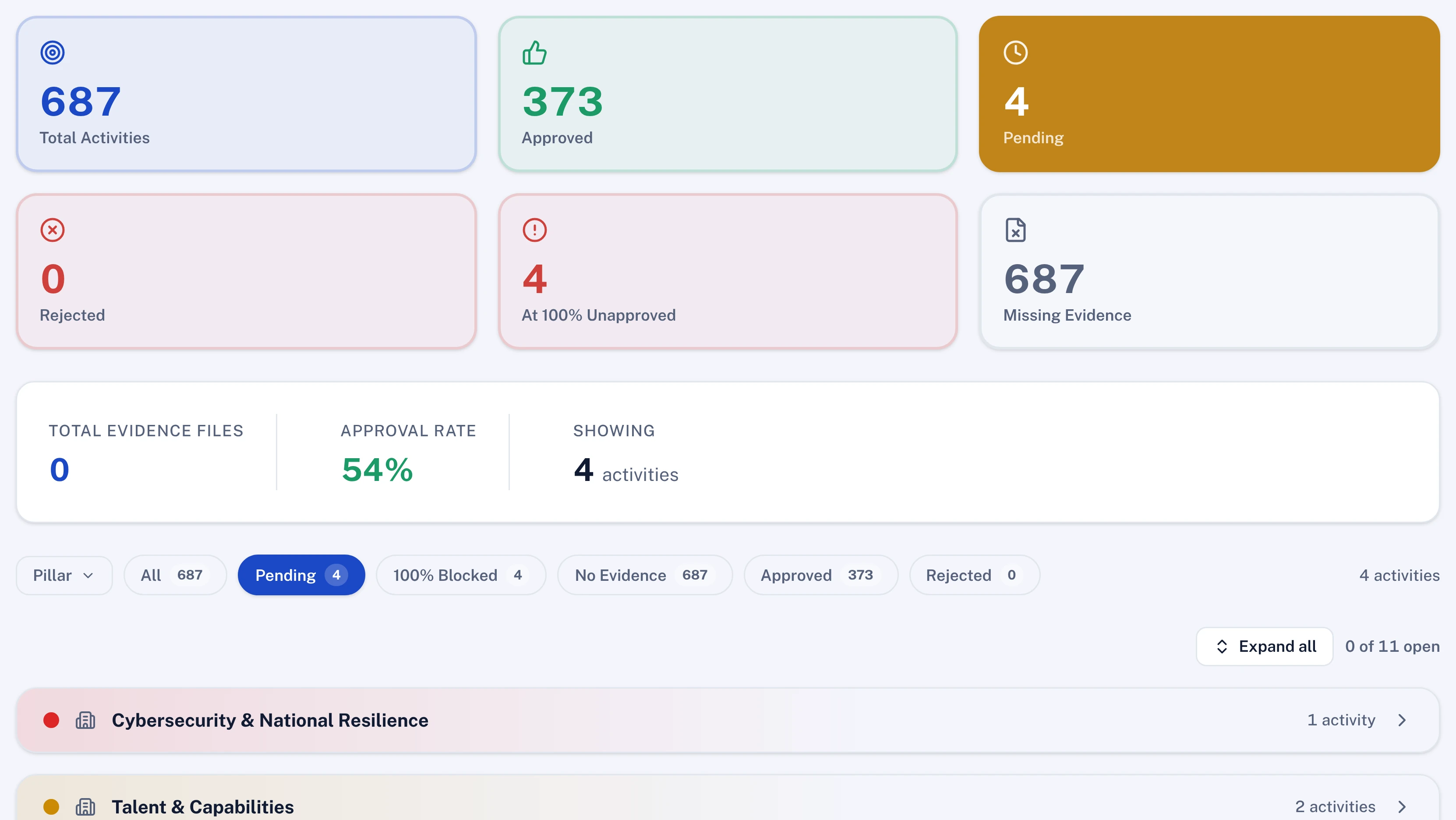
That is the idea Lodestar is built on. A milestone cannot be submitted as complete without the evidence its gate names, someone other than the owner approves it, and until then a claimed 100% counts as 95% in every roll-up. We call it the evidence spine.
The same thinking applies to who may approve what, which I come back to in governance is a workflow.
Questions for your next review
- For the five largest milestones due this quarter, what document will prove each one is done, and who agreed that in advance?
- Who accepted the last ten completions, and how many of them were accepted by the person who reported them?
- How much of the progress in this pack is waiting for someone's approval?
- If a date is missed in March, can we show what was reported in December and who signed it?
Evidence does not make a programme succeed. It makes the picture true early enough to act on, which is the only thing a status report was ever for.

Hany is a strategy and transformation executive with a technical background in software and AI. He has advised C-suites at a top-three strategy consulting firm (MBB) and independently, and has run transformation programmes of more than USD 1 billion.
Connect on LinkedIn