In short
- A portfolio approved against budget alone will be delivered by people nobody counted.
- Name the people who sit on every critical path, and plan for the month they are unavailable.
- Starting a project spends people's months. Decide each start at a gate, against capacity.
The portfolio board approves six new projects in one sitting. Each has a business case, a sponsor and a budget that fits the envelope. Nobody asks who will do the work, because the money question has already been answered.
Three months later the same eight names appear on the critical path of five of those projects. The data team is supporting four go-lives in one quarter. A department head tells the steering committee that her people are tired of change. The committee hears resistance. What it is looking at is arithmetic.
In the programmes I have worked in, fatigue tends to be treated as a communication problem and answered with more communication: another town hall, another change champion. Those have their place. They do not add hours to a month.
What goes wrong
Portfolio approval in most organisations runs on money. Budget is counted, held in one place and reconciled every month. People are counted somewhere else, if at all, and in a unit that hides the problem.
Approval is checked against money only. A project fits the budget envelope, so it is approved. The envelope says nothing about whether the finance team can run a system cutover in the same quarter as the year-end close.
Capacity is counted as a yearly headcount. "The department has forty people" is true all year. The pressure lands in particular months: a go-live, a year-end, a regulatory deadline. A team that looks comfortable on average can be far past its limit in March. Only a view by team and by month shows it.
The same experts are on everything. Every critical project wants the person who knows the old system, the one procurement lead who understands the framework, the architect everyone trusts. Plans give them a fifth of their time on each of five projects. That adds up to a full week on paper, and to a queue in practice, because each project needs them in the same fortnight. When one of them is ill or resigns, five projects slip together and nobody had drawn the link.
The day job is treated as free. The people delivering change are also running the operation. A plan that counts project allocations alone assumes the operation needs nobody. The first month-end proves otherwise, and the project work is what gives way.
Starting costs nothing at the board. Approval and start are treated as one act. A project approved in January starts in January, because waiting looks like delay. Every start draws on the same people, and nobody has decided which project should give way when they collide.
The result is felt as fatigue, so it is reported as fatigue. Underneath, people are being asked for more hours than the months contain, by a board that never saw the total.
What good looks like
The fix is to put people beside money at the moment the portfolio decides, and to keep them there. Five moves.
Approve against capacity by team and month
Before a project is approved, show the demand it places on each team, by role and by month, on top of what is already booked. If it pushes a team past its capacity in any month, the board sees that month and decides with it in view: find the people, move the start, or reduce what else that team carries. A project approved with a known overload has an owner for the overload.
Count the day job first
Put the operation's own load in before any project: the month-end and year-end, the peak season, the audit, the budget cycle. Agree it with the department head, who knows it better than any plan does. Capacity for change is what is left after that, and in some months it is close to nothing.
Name the people on every critical path
List the individuals who sit on the critical path of more than one project, and those who are the only holder of a role. For each, record one of three answers: a second person learning the work, a ranking of the projects that compete for them, or an accepted risk on the register with an owner. A key person with none of the three is a dependency nobody is managing.
Sequence instead of stacking
When two projects need the same team in the same quarter, choose an order. Give each a start month, in the minute, with the reason. A later start with the people a project needs is a plan. An earlier start on people it has to share is a hope. A board that sequences will be told it is slowing change down. Show it the stacked months first.
Treat start as a decision that consumes people
Separate approval from start. Approval puts a project in the queue with its money reserved. Start is a gate where the board confirms that the people it needs are free in the months it needs them. A project that cannot start yet gets a start month in the minute, so the wait is a decision with a date and the sponsor knows where they stand. The same logic applies to the next stage of a running project, which I come back to in stage gates that hold.
Approval reserves the money. Starting spends the people.
Watch the capacity view go stale
Allocations nobody updates. A plan made in January says who is on what. By April it describes a team that no longer exists. Refresh the allocations at each portfolio review, or the heatmap measures last quarter.
The urgent exception. One project is too important to wait for the start gate. Then the next one is. If the exceptions outnumber the gated starts, the gate has gone. Count them.
The overload that moves. A project is moved to clear one team's March, and lands on another team's April. Check every team the move touches, not only the one that complained.
Put people on the same page as money
The capacity question is asked only if the answer is in front of the board when it decides, on the same page as the budget and the progress.
In Lodestar, capacity is modelled per person per month against the demand each project places on each role, and shown as a heatmap by team and month. Each project lists the roles it still needs and how short it is at its worst week, and the people advisor names key-person risk on the critical path. What-If Studio shifts a project's window on a copy of the programme and lists who the move would push over capacity.
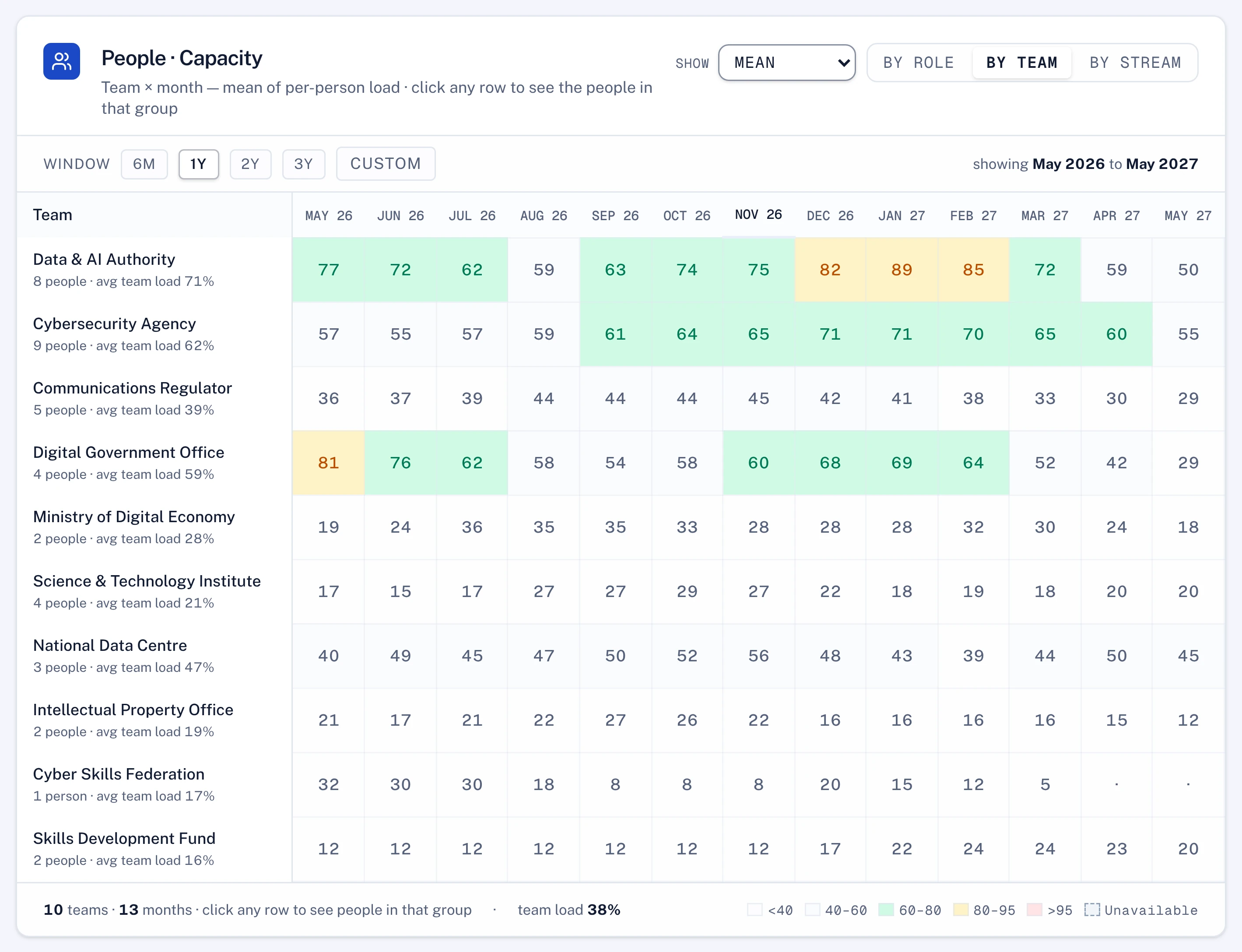
For how a portfolio review can make the sequencing decision rather than only report on it, see Portfolio reviews that decide something.
Questions for your next review
- For the projects we approve today, which teams do they need, in which months, and what is each team already carrying then?
- Who are the people on the critical path of more than one project, and what is our answer for each?
- Which month this year has the least capacity for change once the day job is counted?
- How many projects started this year without a decision that the people were free?
- When two projects last needed the same team at the same time, who decided the order?
People run out before money does, and they run out in particular months. A portfolio that approves against both can tell fatigue from resistance, and act on the one it actually has.

Hany is a strategy and transformation executive with a technical background in software and AI. He has advised C-suites at a top-three strategy consulting firm (MBB) and independently, and has run transformation programmes of more than USD 1 billion.
Connect on LinkedIn