In short
- Starting a project has a process. Stopping one usually has only an argument.
- Judge a portfolio review by what moved: money, people and dates.
- A stop needs a route, an approver and a record, like any other decision.
Every quarter the intake committee approves six or seven new proposals. Each one has a business case, a sponsor and a start date. In the same quarter the portfolio review looks at the projects already running and approves them again. A few get a new date. One gets a little more money. None of them ends.
After two years the list is half as long again. The budget is not. The best of the new projects start with half the team they asked for, because the people they need are still on work that was approved in a different year, for a reason nobody in the room can quite remember.
Ask that room which project should stop and the answers come back as reasons why not. The money already spent. The sponsor. The contractor. The announcement. Each reason is real. Together they mean the portfolio can only grow.
What goes wrong
Most portfolios have a careful route in and no route out. In the programmes I have worked in, that imbalance produces the same result whatever the sector, and it works through five habits.
Starting has a process. Stopping has an argument. A new project travels a form, a business case, a gate and a funding decision. Ending one has no form at all. Someone has to raise it in a meeting, unprompted, against a sponsor who is usually more senior than they are. Anything that needs a person to spend political capital happens rarely, and later than it should.
The stop test is written after the attachment. When the approval said nothing about what would make the project not worth finishing, that case has to be built later, by people who are by then critics of a colleague's judgement. The sponsor hears a verdict on themselves, and defends it. The same test written on the day of approval would have been a condition everyone agreed to.
The review asks whether the plan is on track. That is a question about execution, and most running projects can answer it with a revised plan. The question that would move money is a different one: knowing what we know now, would we approve this today, against what is waiting? Few review packs ask it, so re-approval becomes the default answer.
The pack shows the sunk cost and hides the opportunity cost. Spent to date is on every slide, so the room can see exactly what a stop would "waste". The proposal that cannot start, and the team it needs, appear nowhere. Continuing looks free because its cost sits on a different agenda.
A stop is recorded as a failure. When the closure report knows only "delivered" and "not delivered", an early stop goes down against the sponsor's name. So everyone prefers a slow fade: a project starved of people, never closed, still on the list. It draws less than it did, and still more than nothing.
What good looks like
None of these moves needs software. They need the route out to be designed with the same care as the route in.
Write the stop test into the approval
When a project is approved, write down two or three conditions under which it would no longer be worth continuing. A benefit assumption that fails its first measurement. A cost beyond an agreed band. A dependency not delivered by a named date. A need that the sponsor's own unit no longer has. The approver signs the stop test with the business case. On that day nobody is attached to the answer, so the test reads as a condition everyone agreed to.
Written at approval, a stop test is a condition. Written at the review, it is an accusation.
Ask the re-approval question out loud
At each portfolio review, take the projects that have met a stop condition, or come close, and ask the question in its plain form: would we approve this today? Put the queue beside it: the next three proposals, what they cost and the people they need. A project that continues should continue because the committee chose it over the alternatives, and the minute should say so.
Judge each review by what moved
After every review, count what changed: money reallocated, people moved between projects, projects paused or stopped, dates changed by decision. A review where nothing moved has re-approved the portfolio. That is sometimes right, and it should be rare. Report the count to the sponsor each quarter. How to run the meeting itself is in portfolio reviews that decide something. This count is how you tell whether it is working.
Give stopping a route
A stop should be a kind of decision with its own route, written down in advance like a budget change. Anyone can propose it, including the PMO and the project's own manager. Someone other than the proposer decides it, at a level set by the delegation of authority. The closure records the outcome, what happens to open contracts, risks and invoices, and where the freed money and people go. When stopping has a route, proposing a stop is an ordinary act, and nobody has to be brave to do it.
Count an early stop as a result
Record a stopped project as cancelled or superseded, with its reason and its lessons, and credit the sponsor who stopped it early. A stop in month four that frees half a budget is one of the better outcomes a portfolio can have. If it is only ever recorded as a failure, the slow fade will keep winning.
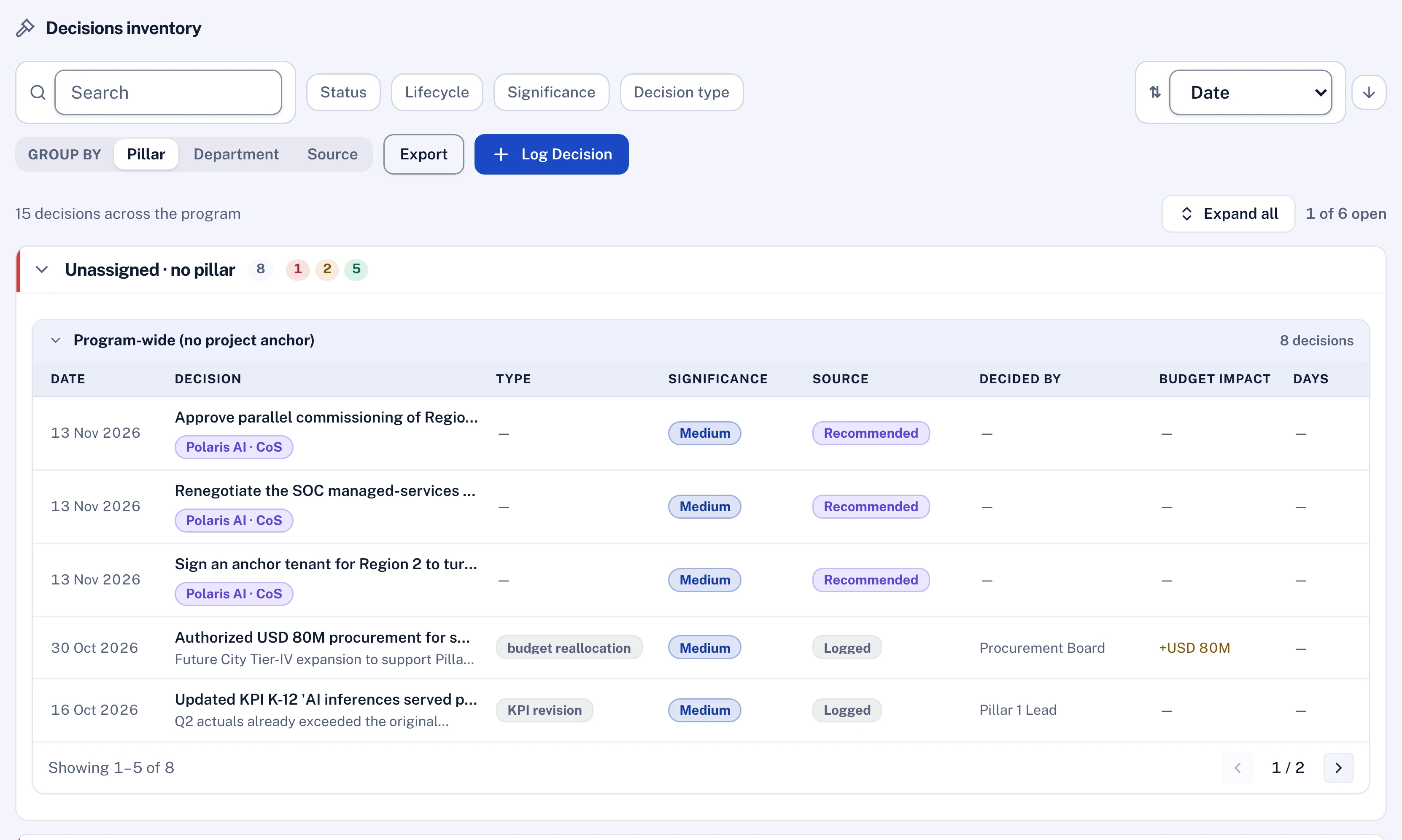
In Lodestar, closing a project is one of the changes that can travel its own approval route. The closure records an outcome, including cancelled or superseded, lists the open risks, issues, actions and unpaid invoices to be acknowledged first, and adds its lessons to the programme's lessons registry. The decision goes into the decisions log with its type and budget impact, so the next review can see what moved.
Questions for your next review
- Which project in this portfolio would we not approve today, and what stops us saying so?
- For our five largest projects, what did the approval say would make each one not worth finishing?
- How much money, and how many people, moved between projects at our last three reviews?
- Who can propose that a project stops, who decides it, and where is that route written down?
- Which approved proposals are waiting for people who are still working on older projects?
A portfolio that cannot stop anything cannot start anything properly either. The route out has to be built at the same time as the route in.

Hany is a strategy and transformation executive with a technical background in software and AI. He has advised C-suites at a top-three strategy consulting firm (MBB) and independently, and has run transformation programmes of more than USD 1 billion.
Connect on LinkedIn