In short
- Equal airtime spends the committee's attention on projects that do not need it.
- Every agenda item should arrive with the decision it asks for.
- A review with no stop or pause list only ever adds work.
The portfolio review is booked for two hours on the last Thursday of the month. There are forty projects on the list, in the order they appear in the tracker. That is three minutes each, and the first six take ten.
Each project manager walks through a slide: progress, spend, next steps, a colour. The questions are polite. By the time the meeting reaches the project that is spending fast and delivering slowly, there are twenty minutes left and eleven projects to go. It gets its three minutes like the rest.
The minute records that the portfolio was reviewed. It records no decision, because nobody was asked for one. The same forty slides come back next month.
What goes wrong
A review like this is built to inform, and a committee can be informed by a pack it reads beforehand. The one thing only the meeting can do is decide. Four features of the usual format stop that from happening.
Equal time for unequal projects. An agenda in tracker order gives the project that is on plan the same airtime as the one that is failing. The committee's attention is the scarcest thing in the building, and it is spent evenly.
No shared scale. Each project reports in its own way: one by milestones, one by spend, one by the manager's judgement. The committee cannot compare, so it cannot rank, so it listens.
No decision is asked for. A slide that ends with "next steps" asks nothing of the room. The projects that need money, people or a new date say so in the corridor afterwards.
Nothing is ever stopped. The list only grows. Every project belongs to someone, and stopping one in front of forty peers feels like a verdict on a person. So weak projects keep drawing people and budget that the strong ones need.
What good looks like
A review that decides has a different shape. None of these moves needs software. They need a chair who insists on them.
Put every project on one scale
Measure progress against plan, variance and budget spent the same way for every project, and have someone other than the project manager do the calculation. A scale built on self-reported percentages compares confidence, so count only what someone else has accepted. Once everything is measured alike, the pack can be read before the meeting, and the projects on plan can be taken as read.
Start with the exceptions
Order the agenda by how far each project is from its plan. The projects that are on plan get a line in the pack and no airtime unless a member asks. This feels unfair to the teams who are doing well. Tell them that being absent from the agenda is the compliment.
Ask for the decision before the meeting, and record it after
Every agenda item arrives with one sentence: what the committee is asked to decide, the options, and what the owner recommends. An item with no decision attached belongs in the pack. Afterwards the minute lists decisions: what was decided, by whom, who carries it out and by when. The next review opens with that list.
Put money, capacity and progress on the same page
A decision to add budget to one project is also a decision about the people who will spend it, and about the project they will be taken from. Show spend against progress and team load by month beside the request. Otherwise the committee approves three things in one afternoon that need the same four engineers in March.
Keep a stop and pause list
Every review should ask what will stop or pause, and write the answer down, including "nothing, and here is why". A pause decided in the room, with a reason and a date to revisit it, is kinder than a project left to starve.
An item with no decision attached belongs in the pack.
Expect the format to slide back
A review that decides is uncomfortable, and every part of it will be worn down unless the chair watches for it.
Everything becomes an exception. Once exceptions get airtime, and airtime gets money, project managers learn to arrive with one. Set the threshold in advance: a variance beyond an agreed band, or a decision above an agreed value. Below it, the item stays in the pack.
The decision is taken before the room. The sponsor and the chair settle it in the corridor and the committee nods. Sometimes that is efficient. Record it as a decision all the same, with who took it, so the log shows where decisions are really made.
The pause that never ends. A paused project with no date to revisit it has been stopped without anyone saying so. Give every pause a date. On that date the project restarts, stops, or is paused again by decision.
Decisions nobody follows up. The log fills and is never opened. Start each review with the last one's decisions and mark each as done, late or reversed.
Take the sorting out of the PMO's week
An exceptions-first agenda depends on someone comparing every project before every meeting. If that takes the PMO three days by hand, it will be done well for a quarter and then skipped.
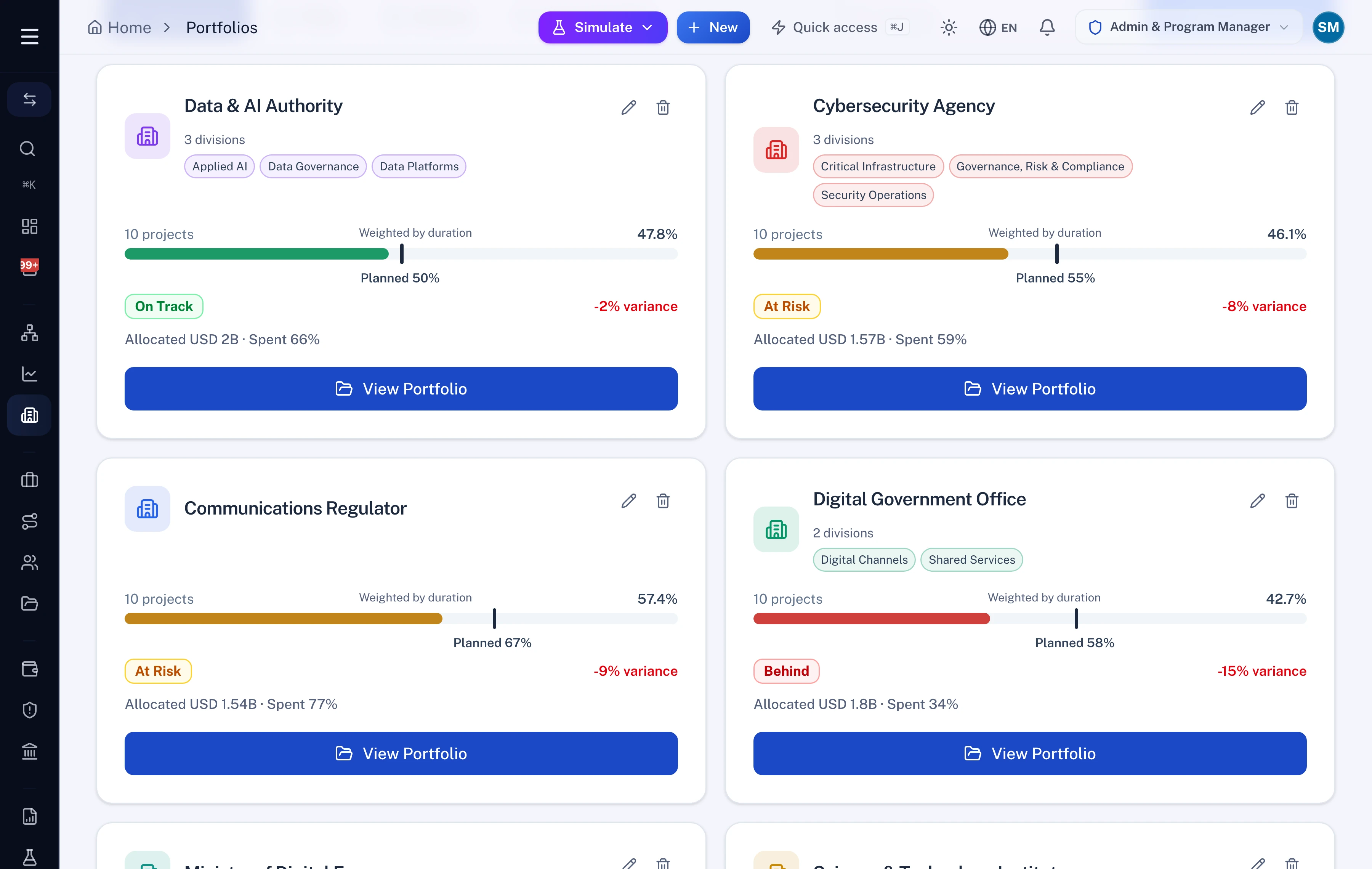
Lodestar does the comparison in the model. Every department and portfolio rolls up on one scale, with progress against plan, variance and budget side by side, and each cycle Polaris writes a Chief of Staff brief that ranks the moves needing a decision. What the committee then decides goes into a decisions log, with who decided and when.
A decision to pause or re-fund a project is the same kind of decision a gate makes, which I come back to in stage gates that hold.
Questions for your next review
- Which projects on today's agenda are here for a decision, and what is the decision?
- Is every project in this pack measured on the same scale, and who calculated it?
- If we approve every request in front of us, which teams are overloaded, and in which month?
- What did we stop or pause in the last three reviews?
- Which decisions from the last review are still open, and who owns each one?
A portfolio review earns its two hours by what changes afterwards. If the minute lists no decision, the pack could have been sent by email.

Hany is a strategy and transformation executive with a technical background in software and AI. He has advised C-suites at a top-three strategy consulting firm (MBB) and independently, and has run transformation programmes of more than USD 1 billion.
Connect on LinkedIn