In short
- Agree the owner, formula, source and evidence for each KPI before the first reading arrives.
- Keep plan, actual and forecast as three numbers. Never overwrite the plan.
- A target may change, by decision: a requester, a reason, another person approving, and the old value kept.
The cascade is drawn in a workshop in January. One strategic target goes at the top of the wall, and by the end of the second day it has been broken down through four levels to the teams. Every box has a number. Someone photographs the wall and everyone agrees to it.
In April the first quarterly readings come in, and one unit is well short. Nothing dramatic follows. The unit head has a quiet word about what is realistic this year. The reading itself is questioned: the source system was migrated in March, and the definition was never quite settled. By June the unit's target in the tracker is lower, and nobody can say which meeting lowered it.
The target at the top of the wall has not moved. The numbers beneath it no longer add up to it. In the programmes I have worked in, that is the point at which people stop believing the cascade, and they are right to.
What goes wrong
A cascade is a set of promises that are meant to add up. It holds while three things stay fixed, and a bad quarter loosens each of them.
The target moves without a decision. A target that can be edited in a spreadsheet will be edited when it hurts. Each change looks reasonable on its own. Nobody tells the level above, so the parent target now rests on children that no longer reach it.
The reading is disputed after the fact. If the formula and the source were not written down before the first reading, any bad number can be argued with. The argument is often fair, which is the problem. The quarter is spent debating how to count, and the question of performance is never reached.
The forecast is a line through the past. Many trackers project the year end from the trend. A trend commits nobody. The owner knows about the contract that slipped and the hiring freeze. The line knows neither.
Put those together and the board sees a strategic target that looks intact, held up by numbers that were changed, contested or extrapolated on the way up.
What good looks like
None of this needs software to begin. It needs five habits, agreed before the first reading arrives.
Write the definition down before the first reading
Each KPI needs four things on one page: an owner by name, the formula, the source the number comes from, and the evidence expected with each reading. Agree them when the target is set, while nobody has a result to defend. A dispute over the definition in April is a negotiation about the result.
Keep plan, actual and forecast as three numbers
The plan is what was promised for the period. The actual is what happened. The forecast is where the owner now expects to land. A tracker that holds only one or two of them invites blending: the plan is replaced by the latest forecast, and the variance disappears. Hold all three, period by period, and never overwrite the plan.
Treat a target change as a decision
Targets should change when the world changes. A change needs a requester, a reason, an approver who is someone else, and a date. The old value stays on the record beside the new one. The level above is told what happened to its sum: another unit takes up the difference, or the parent target moves through a decision of its own.
Make the forecast the owner's commitment
Ask each owner for their own year-end number every period, and put it beside the trend. Where the two differ, that is the conversation worth having. An owner who forecasts a miss in May has done the programme a service, and should be treated that way in the room.
Accept a reading the way you accept a milestone
A reading is a claim until someone other than the owner has seen what supports it: the system extract, the signed return, the survey file. The rule that applies to progress applies to KPIs. If readings are checked only when they are bad, people learn what a check means.
A dispute over the definition in April is a negotiation about the result.
Expect the cascade to drift
Once targets are hard to change and readings are checked, the pressure goes somewhere else. Four habits are worth looking for from the second quarter.
Targets set low at the start. When a miss is costly and a change needs an approver, the bargaining moves to January. Ask for the reason behind every target when it is set, and read it against the baseline and last year's actual.
A forecast that follows the actual. An owner whose year-end forecast drops each period by exactly the latest shortfall has stopped forecasting and started reporting. Keep every forecast that was given, and look once a year at how far each owner's forecasts were from the result.
Corrections after the cut-off. A reading is revised once the period has closed and the pack has gone. Some corrections are right. List every one at the next review, with who made it, so that the right ones are seen to be right.
KPIs outside the cascade. New measures are added for a board request or a new initiative, and linking them is nobody's job. After a year, half the numbers in the pack roll up to nothing. List the unlinked ones each quarter and either link them or retire them.
Keep the history where the numbers live
These habits last only if the record of each change sits beside the number it changed. A target history kept in meeting minutes will not be found in the quarter it is needed.
In Lodestar each KPI in the cascade holds its plan, actual and forecast as separate figures. A change to a target can be sent for approval to someone other than the person who asked, and the old value stays in the KPI's history. The review meeting then lists which targets moved since the last one, and who moved them.
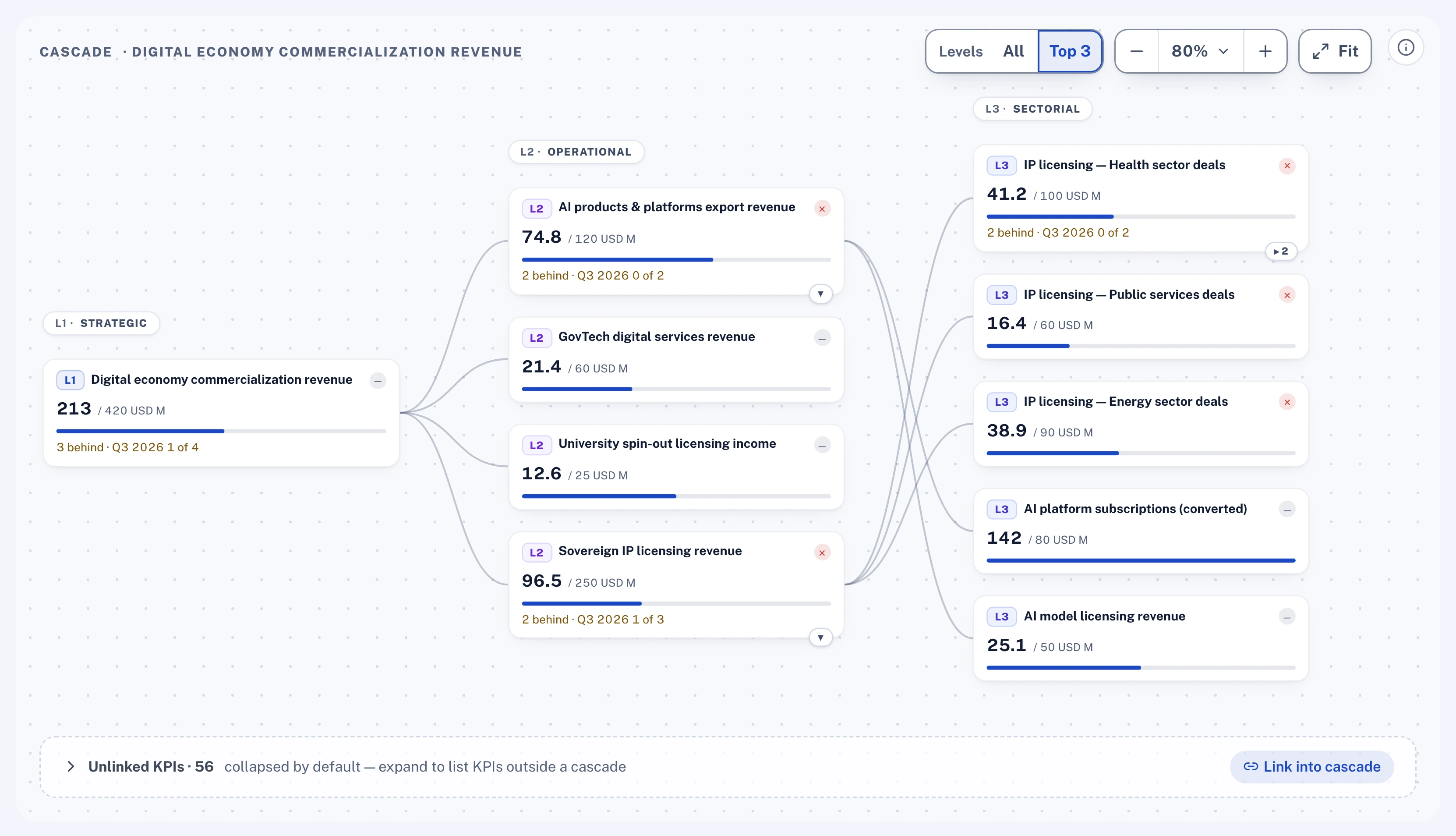
Who may approve such a change, and what happens when they are away, is the subject of governance is a workflow.
Questions for your next review
- For our ten most important KPIs, where is the formula written down, and what is the source of each reading?
- Which targets have changed since they were approved, who approved each change, and does the level above still add up?
- For each KPI in this pack, whose forecast are we reading: the owner's, or a trend line?
- Which readings in this pack has someone other than the owner checked against evidence?
A cascade is tested in the quarter that goes badly. If the targets, the readings and the forecasts come through it with their history intact, people will go on believing the picture.

Hany is a strategy and transformation executive with a technical background in software and AI. He has advised C-suites at a top-three strategy consulting firm (MBB) and independently, and has run transformation programmes of more than USD 1 billion.
Connect on LinkedIn