In short
- Give every measure one job: keeping something healthy, or changing it.
- Pair each key result with the KPIs a push on it could damage, and read them together.
- Choose level names that fit the organisation. The chain matters more than the framework.
Every year or so, someone in the strategy office proposes moving from KPIs to OKRs, or back again. The case for OKRs is that the KPI scorecard has become a wall of numbers nobody acts on. The case for KPIs is that the OKRs felt like a quarterly writing exercise with no link to how the business runs.
Both cases are usually right about the problem. Both pick the wrong cure. The debate runs as though the organisation must choose one framework and pour everything into it.
In the programmes I have worked in, the organisations that settle this well stop choosing. They give each kind of measure a job, and they put both into one chain from the vision down to the task.
What goes wrong
The two kinds of measure do different work. A KPI says whether the business is healthy: the service level, the cost per transaction, the number of safety incidents. It should hold steady or improve slowly, and a move outside its band is an alarm. A key result says whether the business is changing in the direction the strategy chose. It is meant to move a long way in a set time, and once it gets there the change is done.
Trouble starts when one framework is asked to do both jobs, or when the two run in separate worlds.
Everything becomes a key result. The health measures are rewritten as key results so that they fit the new method. The quarter now has thirty key results, most of which say "keep X above Y". The few that ask for real change are lost among them, and the stretch that OKRs were brought in for disappears.
Everything becomes a KPI. The transformation is expressed as a few more targets on the existing scorecard. Nothing marks the number that must move from the numbers that must hold. Change competes with monthly operations for attention, and monthly operations always have a meeting this week.
The two live in different places. OKRs sit in one tool, KPIs in the scorecard, projects in a third. This is the most damaging of the three, because a key result can be bought at the cost of a KPI and nobody sees both on one page. Processing time falls because checks were skipped. The key result goes green and the error rate climbs, in a report that a different committee reads a month later.
The framework brings its own words. An organisation that has always spoken of pillars and programmes is handed themes, objectives and key results. People translate in their heads, and links are lost in translation. Within a year the official structure and the way people actually describe the work have drifted apart.
What good looks like
The fix is a design for the measures, and it works under any method. Five moves cover most of it.
Give every measure one job
Label each measure as health or change. One test sorts most of them: if it reached its target and stayed there, would the work be finished? A change measure would be, so it is a key result. A health measure never is, so it is a KPI. Some measures will argue for both labels. Pick one, and write down why.
Pair every key result with the KPIs it could damage
For each key result, name the two or three KPIs that a hard push on it could hurt. Faster permit decisions, with the appeal rate beside them. Lower cost per case, with customer complaints beside it. Read each pair together at every review. A key result reached by breaking a KPI should count as a miss.
Put both in one chain, from the vision to the sub-task
Vision and mission at the top, then the themes or pillars, the objectives, the initiatives, the projects, and the activities, tasks and sub-tasks beneath them. Key results attach where the change is promised. KPIs attach wherever something must stay healthy, which is at every level. The test of the chain is that anyone can pick a task and trace it up to the objective it serves, and pick a key result and trace it down to the work that should move it.
Use the level names the organisation already speaks
A ministry may plan in pillars and initiatives, a company in themes and objectives, a capital programme in portfolios and programmes. The discipline is the same: few objectives, measured outcomes, work linked to what it should move. Rename the levels to fit the organisation. Asking the organisation to rename itself to fit a framework costs a year of translation and gains nothing.
Retire a key result into a KPI when the change is done
When a key result reaches its target and the new level has held for a period or two, move it to the scorecard as a KPI with a band to stay within. The change has become how the business runs. Keeping it as a key result would leave the next change competing with one that is already won.
Rename the levels to fit the organisation. Asking the organisation to rename itself to fit a framework costs a year of translation.
Keep both in one model
The chain works only if the key results, the KPIs and the plan sit in one model, so that a key result and the KPIs it could damage appear on the same page without anyone assembling them.
Lodestar holds them together. An administrator can start from an OKR structure of themes, objectives and key initiatives, from pillars and initiatives, from portfolios and programmes, or from value streams and workstreams, or name every level from scratch. Beneath any of them sit the same projects, activities, tasks and sub-tasks, and KPIs can sit at the company level, on an objective, on an initiative or on a project.
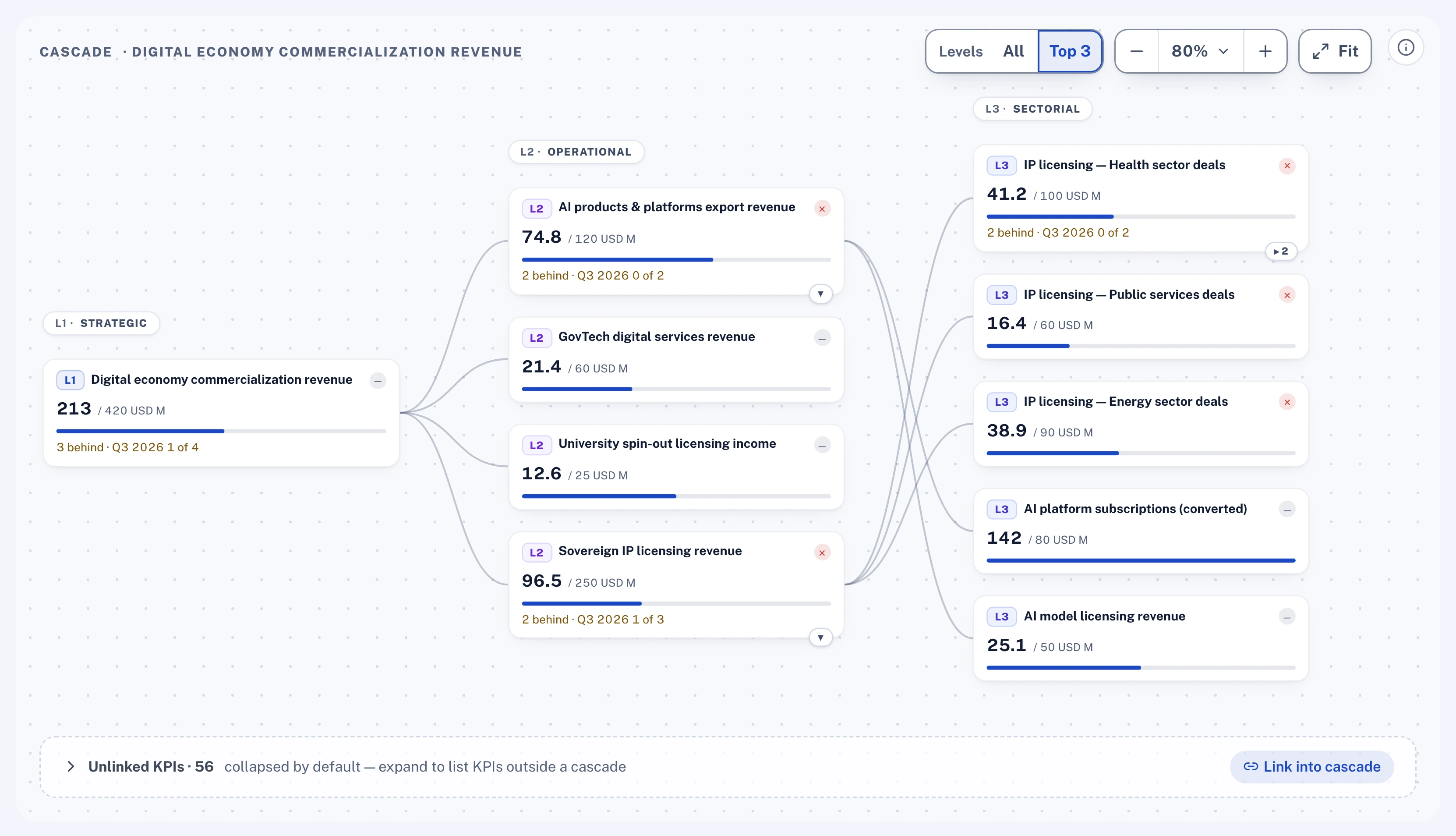
How to keep the targets in that chain honest when a quarter goes badly is the subject of KPI cascades that survive the first bad quarter, and the strategy and KPI model is on its own page.
Questions for your next review
- For each measure in this pack, is it there to keep something healthy or to change something, and does the pack say which?
- Which KPIs could a push on each key result damage, and are they on the same page?
- Pick three tasks from the plan: can we trace each one up to the objective it serves?
- Which key results have reached their target and should now be held as KPIs?
- Do the names of our levels match the words our executives use when they describe the strategy?
The argument over frameworks is mostly an argument about vocabulary. What a board needs is one chain it can follow from the vision to the next task, with each number doing the job it was chosen for.

Hany is a strategy and transformation executive with a technical background in software and AI. He has advised C-suites at a top-three strategy consulting firm (MBB) and independently, and has run transformation programmes of more than USD 1 billion.
Connect on LinkedIn