In short
- Delivery progress and key-result attainment answer different questions. Show both, and never average them into one score.
- Each key initiative names the key result it should move, by how much, and when the effect should show.
- When work and result diverge for two reviews running, the objective owner brings a decision.
The quarterly OKR review gives each objective two slides. The first shows the key initiatives: nine of ten on track, most of them close to ninety per cent complete. The second shows the key result, which was meant to cut the time it takes to resolve a customer complaint. It is where it was in January.
Both slides are true. The room spends twenty minutes on the first, because it is good news and full of detail, and five on the second, because nobody has much to add. The minute records a note to keep monitoring.
The reverse happens too: a key result well ahead of plan while the work meant to move it is late. That one gets even less attention, because nothing on either slide looks wrong.
What goes wrong
An objective carries two numbers that answer two different questions. Delivery progress asks whether the organisation did what it planned. Key-result attainment asks whether the world changed in the way the plan promised. Most reviews read them separately, and three habits make the gap between them invisible.
The numbers are blended. Some trackers average delivery and attainment into one score per objective, or let the progress of a key initiative stand in for the key result it serves. Work that is ninety per cent done and a result that has not moved average to forty-five, a figure that describes neither.
The work is not linked to the result. If nobody wrote down which key initiatives are meant to move which key result, a divergence cannot be read. The committee sees a flat key result and a list of busy projects, and has no way to connect one to the other.
The key result has only a year-end target. A flat key result in the first quarter may be exactly what the plan expected, because the new process goes live in June. Or it may be the first sign that the process will not work. With one target for December, the two look the same until it is too late to choose.
When the two numbers do pull apart, it is for one of four reasons, and each calls for a different decision. The result lags the work, as planned, and the right answer is to wait until a stated date. The work is the wrong work: it was delivered and changed nothing, so the plan behind it needs rethinking. The work is right but too small for the result, so more is needed or the target moves. Or something outside the programme is moving the number, in either direction, and the work is getting credit or blame it has not earned.
A review that cannot tell these four apart ends with "keep monitoring", which is the one decision that fits none of them.
What good looks like
Five moves make the gap visible and make it a decision. None of them needs a particular tool.
Show the two numbers side by side, and never blend them
Put delivery progress and key-result attainment on the same line for every objective, each as its own figure, each against its own plan. Do not let one stand in for the other in any roll-up. The committee should be able to see in one glance which objectives sit in which corner of the grid above.
Link each key initiative to the key result it should move
For every key initiative, write down the key result it serves, how much of the movement it is expected to deliver, and when the effect should start to show. This is the theory of change in three fields. It is what lets a review tell the wrong work from late work.
Score each key result against a phased plan
Set a target for each quarter, or each month, that reflects how the work is planned, including the lag. If the new process goes live in June and the effect shows from September, the plan says flat until September. Then a flat result in April is on plan, and a flat result in October is a finding. A seasonal measure is judged against its own season, and a straight line from January to December is not asked to do a job it cannot do.
Decide when the two diverge
Agree a simple rule: when delivery and attainment disagree for two reviews running, its owner brings a decision to the next one. There are four to choose from. Wait, with a date by which the result should move. Change the work. Add work. Or change the key result, as a decision with a reason and an approver. Record which one was chosen, so that the next review can see whether it worked.
Keep KPIs and key results on the same levels
A key initiative has its own health measures: cost, schedule, quality of what it delivers. A project has its KPIs too. These belong beside the key results, at the same level, so that a push on a key result can be read against what it costs. A project KPI that feeds a key result should be linked to it, so the cascade runs from the company key result down to the project. Why the two kinds of measure need each other is the subject of OKRs or KPIs is the wrong question.
"Keep monitoring" is the one decision that fits none of the four reasons.
Make the comparison part of the record
The comparison holds only if both numbers live in the same place as the plan, linked to each other, and are read at every review without anyone preparing a special slide.
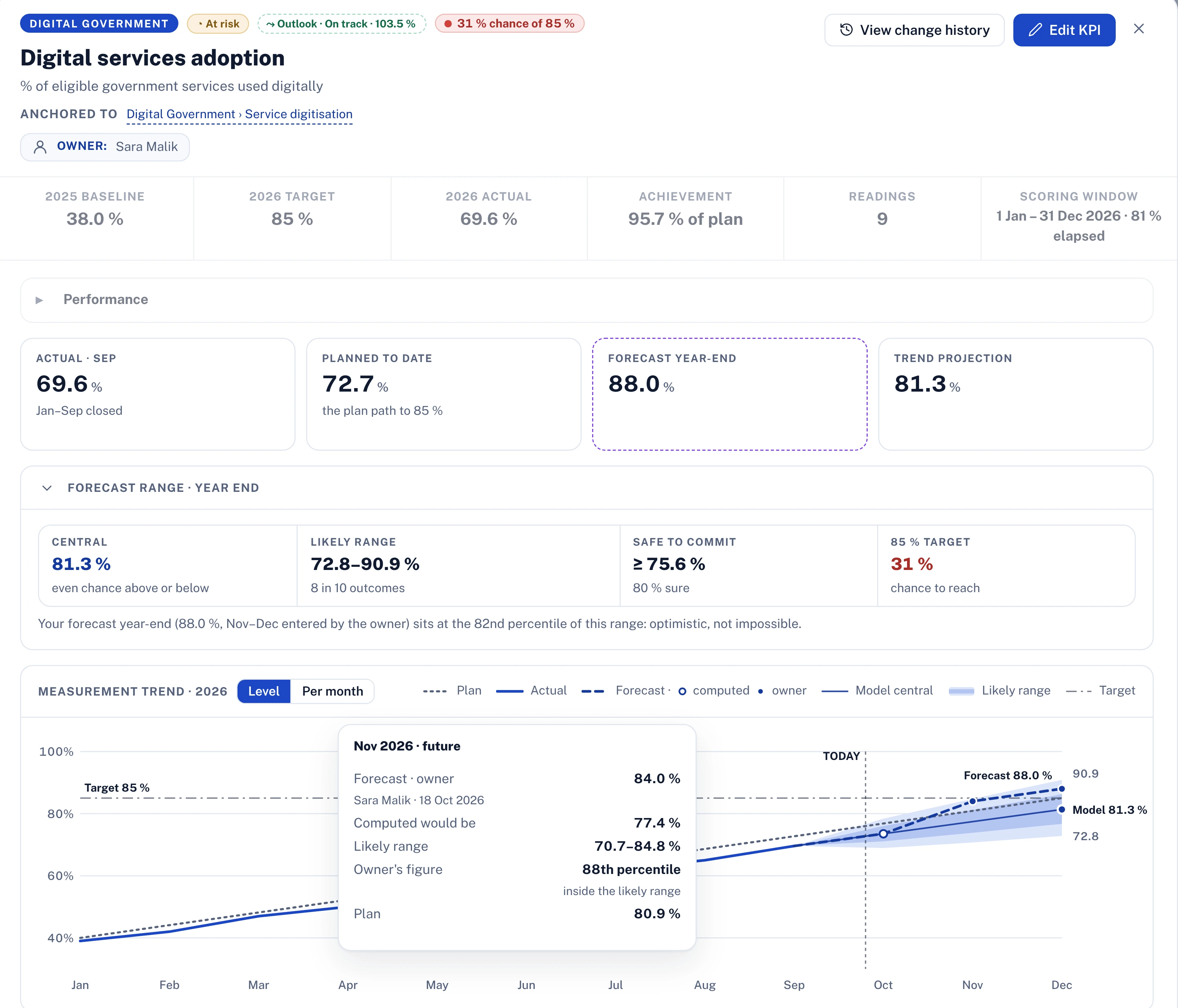
Under the OKR structure in Lodestar, the key results of an objective are KPIs set on it, and its page shows their average attainment as a figure of its own, beside delivery progress and never mixed into it. A KPI can be scored against a phased plan, period by period. KPIs sit at the company level, on an objective, on a key initiative or on a project, and a project KPI can feed the key result above it.
The same gap, between a project delivered and a benefit realised, is where delivered and no benefit picks up, and the strategy and KPI model is on its own page.
Questions for your next review
- For each key result, which key initiatives are meant to move it, and when should the effect show?
- Where is delivery on plan and the key result flat, and which is the explanation: lag, wrong work or too little work?
- Which key results are ahead while the work behind them is late, and what is moving them?
- Is each key result scored against a plan for this quarter, or only against the year-end target?
- The last time a key result and its work diverged, what did we decide, and did it work?
Delivery tells a committee that the organisation is working. Only the key result tells it whether the work is the right work, and the two together tell it what to do next.

Hany is a strategy and transformation executive with a technical background in software and AI. He has advised C-suites at a top-three strategy consulting firm (MBB) and independently, and has run transformation programmes of more than USD 1 billion.
Connect on LinkedIn