In short
- Write down which milestones each KPI target assumes, next to the target.
- When a linked milestone slips, revise the KPI forecast in the same cycle.
- Put the effect on outcomes on every date change request.
The delivery review is on Tuesday. The project to open a new contact centre asks to move its go-live from April to July, because the fit-out contractor is late. The change is explained, the cost is small, and the request is approved. The project shows amber for a month, then green again against its new date.
The performance review is on Thursday, with a different chair and a different pack. The KPI for complaints resolved within five days is on track. Its forecast says it will reach the year's target, because the forecast is drawn from the readings so far, and the readings so far are fine.
The target assumed the new centre would be open from the second quarter. In September the KPI misses, and its owner explains why. Everyone involved had known since March. Nobody had put the two facts side by side.
What goes wrong
Plans and KPIs are usually kept by different people, in different tools, on different calendars. Each side can be run well. The link between them is where the information gets lost, and it gets lost in four ways.
The KPI does not know which work it depends on. When a target is set, someone assumes that certain projects will deliver by certain dates. That assumption is the most important fact about the target, and it is rarely written down next to it. Without it, nobody can say which slips matter to which KPI, so every slip is judged on schedule alone.
The forecast looks backwards. Most KPI forecasts extend the readings so far, or the owner's feel for them. A trend cannot see a step that has not happened yet. If the target assumes a jump when a new service opens, the forecast will read on track right up to the period in which the jump fails to arrive.
The change request prices days and dollars. The approver of a date change sees the new date, the cost and perhaps the effect on other projects. The effect on the target is not on the form. An approved slip quietly lowers the year's outcome, and nobody approved that part.
The lag hides the cause. An outcome moves weeks or months after the output that drives it. By the time the KPI misses, the slip is old news. The conversation turns to the KPI owner's performance, when the decision behind the miss was taken in a different meeting, by different people, months earlier.
Put together, the programme carries two pictures of the same year that disagree. The disagreement surfaces at the worst moment, when the year is too far gone to recover.
What good looks like
None of this needs a new system to begin. It needs the plan and the targets to name each other, and one meeting where both are on the table.
Link each KPI to the work that delivers it
For every KPI that depends on delivery, name the projects that move it and, where one date carries the step, the milestone. Write the assumption down in plain words next to the target: "the target assumes the new centre opens by 1 April." A KPI linked to no work is either measuring business as usual, which is fine, or relying on work nobody named, which is a gap to close.
Phase the target on the delivery date
If the result is expected to step up when something opens, make the target step in that period. The phased plan then shows the dependency on its face. A straight line through the year hides it, and lets a late opening look like a small, steady shortfall that someone will promise to catch up.
Read a slip as a forecast change
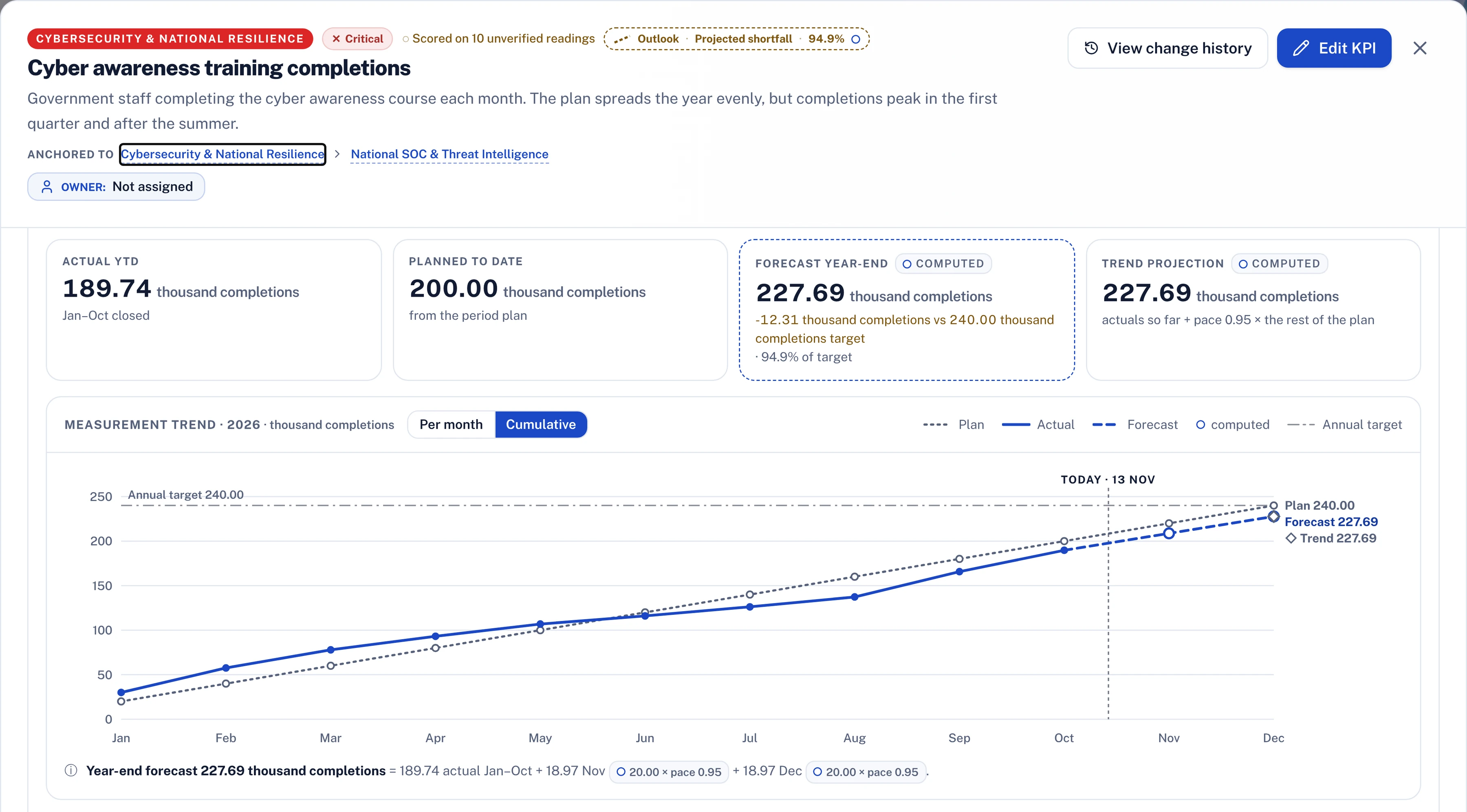
When a milestone that a KPI depends on moves, the KPI owner revises the forecast in the same cycle and records why. Treat that revision like any other change to a number the board relies on: someone other than the owner agrees it. The KPI then shows the gap in March, while there is still time to act on it. A forecast that only extends the trend commits nobody, a point I come back to in KPI cascades that hold.
Put the outcome on the change request
A request to move a milestone that a KPI depends on should say which KPI, by how much and in which period. The approver then decides on the full cost. Sometimes the slip is still the right call. It is a different decision when the room can see the target it costs, and the same is true of a slip that travels between projects first, which I cover in dependencies are the programme.
Review delivery and outcomes in the same meeting
Hold one review, or at least one agenda, where a slip is followed directly by the KPI it moves. The decision then has three honest options: recover the date, change the target through its own approval, or accept the gap and say so in the minute. With separate meetings, the third option becomes the default without anyone choosing it.
In Lodestar, any KPI can be linked to the one activity, milestone, task or sub-task it depends on. A milestone KPI is then done when that item is done, and turns At risk the moment the item's planned finish moves past the KPI's due date or its activity is rated Delayed. A numeric KPI keeps its readings, and its forecast takes its pace from the item. The strategy and KPIs page has the detail.
Questions for your next review
- For our ten largest KPIs, which projects and milestones does each target assume, and where is that written down?
- Which approved date changes this year moved a milestone that a KPI depends on, and was that KPI's forecast revised?
- Does our date change request show what the change costs in outcomes, or only in days and dollars?
- In which meeting are a slip and the KPI it moves discussed together, and who decides there?
A milestone matters because of the result it was meant to bring. Read its slip on that result the day it happens, and the board still has time to choose what to do about it.

Hany is a strategy and transformation executive with a technical background in software and AI. He has advised C-suites at a top-three strategy consulting firm (MBB) and independently, and has run transformation programmes of more than USD 1 billion.
Connect on LinkedIn