In short
- A strategy refreshed every two years fits best on the day it is delivered and drifts after.
- Own the model in-house and bring partners into it, so knowledge stays when they leave.
- Give agents the assembly work, so the office spends its time on judgement and decisions.
The strategy is handed over in a final workshop. Six months of work by a large external team, a polished deck, a programme of initiatives with owners and dates. On the day it is delivered, it fits the organisation better than it ever will again.
Then the external team leaves, and the internal teams implement it alone. A competitor moves, a regulation changes, a technology matures faster than expected. The plan stays the plan. Eighteen months later the gap between what the strategy says and what the organisation needs is wide enough that someone proposes a refresh, and the cycle is bought again.
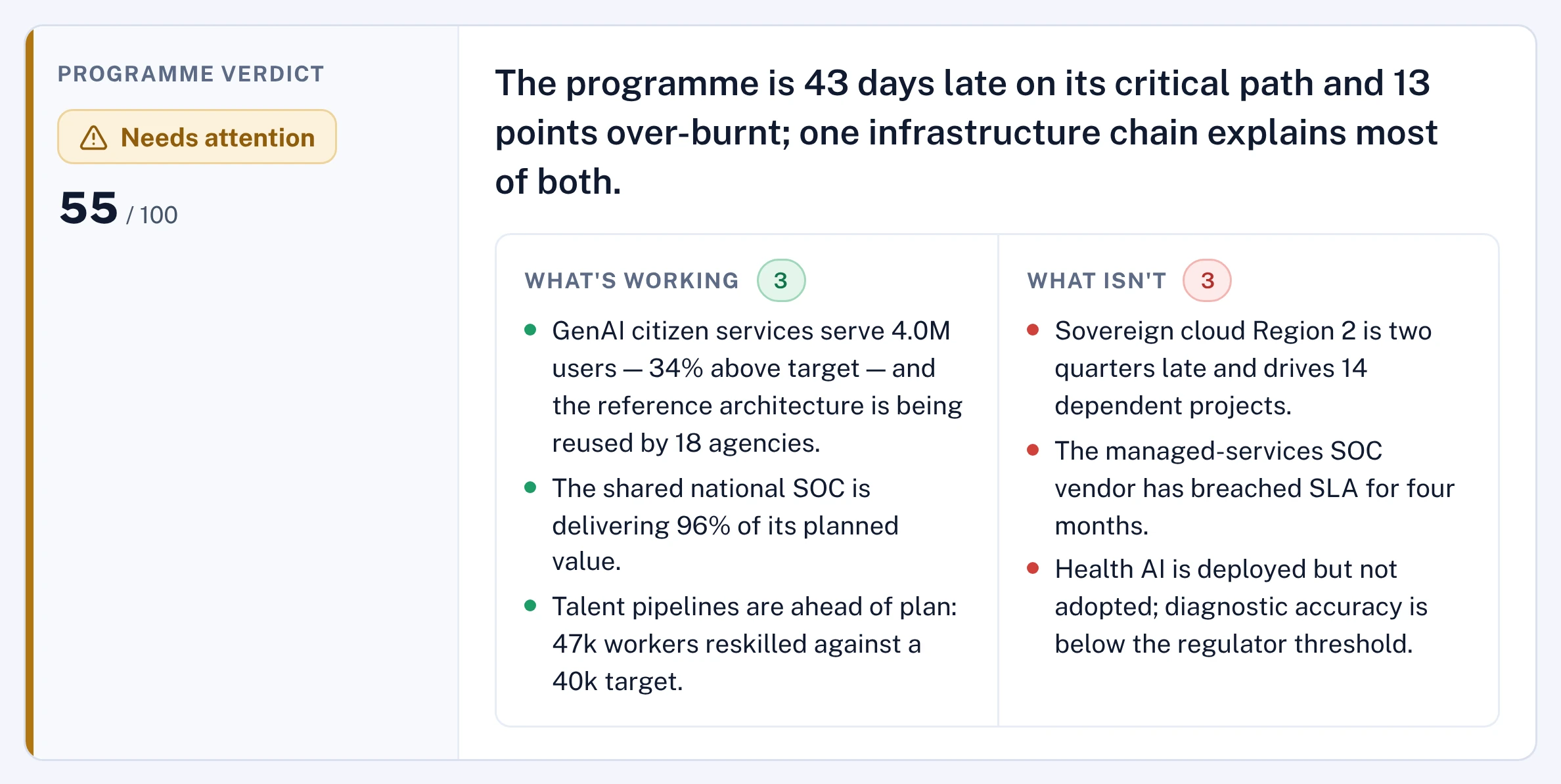
When the board asks its three questions in the meantime, the answers are the same in most organisations I meet.
What goes wrong
The model has served large organisations for decades, and it has strengths: deep analysis, outside perspective, a forcing moment for decisions. Four of its features no longer fit the pace at which the ground moves.
The plan is a point in time. A strategy refreshed every two years is out of date for most of its life. Nothing in the model updates it between refreshes, because the people who built it have gone and the people running it were never given the means to change it.
Delivery is spread across many hands. Strategy firms, integrators, technology vendors and specialists each run a piece, each with its own plan, its own reports and its own contract. Nobody holds the whole. When something slips, every contract points somewhere else, and leaders wait for the reports to be reconciled before they can decide.
Knowledge walks out with each firm. The reasoning behind the plan, the benchmarks, the hard-won understanding of how the organisation works: all of it leaves at the end of each engagement. The next team starts again.
The office does assembly, not judgement. One level down, the truth is scattered: the schedule in a planning tool only the planner opens, the budget in an export reconciled by hand, the risks in a spreadsheet last reviewed before the audit, the KPIs in last month's deck. The lines I hear from the people in these offices are always similar. "I rebuild the plan by hand." "I chase updates across five tools." "I lose nights rebuilding board packs." And from the chief transformation officer: "I see problems after they land."
Meanwhile two things have changed. AI now does much of the research, benchmarking and reporting that once justified a large team. And leaders increasingly want the capability built in-house: their data, their teams, their know-how.
Eight shifts that define the next generation
| Dimension | The rented model | The next-generation office |
|---|---|---|
| Ownership | Held by external firms | Owned and run by the organisation's own teams |
| Cadence | A major refresh every two years or so | Continuous: sense, decide, adjust |
| Advice | Benchmarks built for the average | Drawn from the organisation's own live data |
| Capacity | A large external team | A lean in-house team, with agents doing the assembly |
| Expertise | Fragmented across separate firms | Partners brought in when needed, working in one model |
| Accountability | Blurred across contracts | Clear: the organisation decides, on one source of truth |
| Decisions | Wait for reconciled reports | Taken on live data |
| Knowledge | Leaves with each firm | Builds up inside the organisation |
What good looks like
None of this means doing without outside expertise. It means changing who holds the model and how often it moves. Five moves.
Own the model, and keep it live
The strategy, the KPIs, the initiatives, the plans, the money and the risks should live in one connected model that the organisation owns and its people update. Partners contribute to it; they do not take it with them. A strategy held this way can be adjusted in a month when the ground moves, instead of waiting for the next cycle.
Run a cycle, not a project
Define, plan, execute, monitor, measure, adapt, and then define again with what was learned. Each turn of the cycle feeds live evidence into the next strategy decision. The two-year reset gives way to a steady rhythm of smaller corrections, each one recorded.
Give agents the assembly, and keep the judgement
Chasing updates, rebuilding the plan, reconciling versions and drafting the pack are assembly. They are exactly the work AI agents now do well, under rules and with a person approving what changes. What remains for the office is judgement: which trade-off to put to the executives, what to stop, which risk to act on first. The office gets smaller in headcount and larger in influence.
Bring partners into your model
Keep using the best outside expertise, but for a defined need and inside your model: partners plan and report in your system, under your approvals, and leave their work behind when they go. My colleague sets out how in transformation partners on one model.
Answer the board's three questions on any day
The test of the office is simple. On any day, can it say whether the programme is on track, what is coming, and what the organisation should do about it, with evidence? If those answers need a few days, the office is still assembling.
In Lodestar, seven AI chiefs read the whole programme every cycle and a Chief of Staff reconciles them into one brief. A recommendation is simulated in a sandbox, applied only when a person approves it, recorded in a write-once decision log, and its outcome is measured weeks later. Underneath, every level runs on one model: an owner updates a task once, and the same information rolls up to the project, the initiative, the pillar and the board, with no second copy to keep in step and no double data entry.
Questions for your next review
- When was our strategy last adjusted, and what would it take to adjust it next month?
- How many separate plans and reports do our partners keep, and who reconciles them?
- What did we learn from our last external engagement that still sits inside the organisation?
- Could we answer the board's three questions today, with evidence, without asking for a few days?
The transformation office is becoming a permanent, owned capability rather than a periodic purchase. The organisations that make the shift early will steer by live evidence while others wait for the next refresh.
Hany is a strategy and transformation executive with a technical background in software and AI. He has advised C-suites at a top-three strategy consulting firm (MBB) and independently, and has run transformation programmes of more than USD 1 billion.
Connect on LinkedIn