In short
- An objective sets direction; a key result measures a change someone outside the team would notice.
- Name the key initiatives separately, as bets on how to move each key result.
- Keep KPIs for the health of the business and OKRs for the change you want in it.
The leadership team comes back from its offsite with a decision: from next quarter, the organisation will run on OKRs. Each department is asked for three objectives with three key results each. The drafts arrive two weeks later.
One reads: objective, "Implement the new customer system". Key results: "Go live by June", "Migrate all customer records", "Train every service agent". Another: objective, "Grow digital sales". Key results: "Launch the new app", "Run four campaigns", "Hire a growth lead". Every line is sensible. Not one of them says what will be different for a customer when the quarter ends.
The organisation has not adopted OKRs. It has relabelled its project plan.
What goes wrong
OKRs, short for objectives and key results, look simple, which is why they are so often adopted in a week and abandoned in a year. The framework has more parts than its name suggests, and most first attempts go wrong in the same few ways.
Key results are written as tasks. "Launch the app" is something the team does. Whether customers buy more through it is the result. When key results are activities, every one can be achieved while nothing changes, and the scores look good until someone asks about the outcome.
The objectives are too many. Three objectives per department, five departments, three key results each: forty-five key results for one quarter. Nobody can remember them, so nobody steers by them.
The bets are hidden inside the key results. The organisation decides to build a self-service portal to shorten onboarding. That decision, the key initiative, is a bet that the portal will move the number. Written as a key result, the bet can no longer be questioned: if the portal ships and onboarding does not get faster, the key result still reads as done.
OKRs are confused with what the organisation already measures. Revenue, cost per transaction and customer satisfaction are reported every month as KPIs. Copying them into OKRs adds a second report of the same numbers and no new direction.
The scoring comes too late. Key results are graded once, at the end of the quarter, when nothing can be changed. My colleague covers that problem in forecasting key results instead of grading them.
The four parts of the OKR framework
| Part | What it is | Example | Common mistake |
|---|---|---|---|
| Objective | A short statement of direction: what should be better, and why it matters | Make onboarding effortless for new customers | Naming a project: "Implement the portal" |
| Key result | A measurable change in an outcome, with a starting value, a target and a date | Days from contract to first use fall from 30 to 10 by the end of June | Writing an activity: "Launch the portal" |
| Key initiative | The bet the organisation funds to move the key result | Self-service onboarding portal | Hiding it inside a key result, so it cannot be questioned |
| The work | The projects, activities and tasks that deliver the initiative | Build, test, migrate, train | Scoring the OKR on how much of the work is done |
What good looks like
Five habits separate OKRs that steer an organisation from OKRs that decorate a slide.
Keep the objectives few, and write them as direction
Three to five objectives at the top of the organisation is plenty. Each should say what will be better and why it matters, in words a new employee would understand without a glossary.
Write each key result as a change someone outside the team would notice
A good key result has a starting value, a target and a date, and it describes an outcome rather than an activity. A simple test: could the team do all its work and still miss it? If the answer is no, it is a task.
Name the key initiatives, and link each to its key result
Write the bets down as initiatives in their own right, each linked to the key result it should move. Then the organisation can see when an initiative is delivered and its key result has not moved, which is the most useful signal OKRs produce.
Keep KPIs beside the OKRs, not inside them
The health measures stay as KPIs, reported as before. Pair each key result with the KPIs it could damage: a push to speed up onboarding should sit beside a measure of early cancellations. The fuller argument is in OKRs or KPIs is the wrong question.
Use the names your organisation already speaks
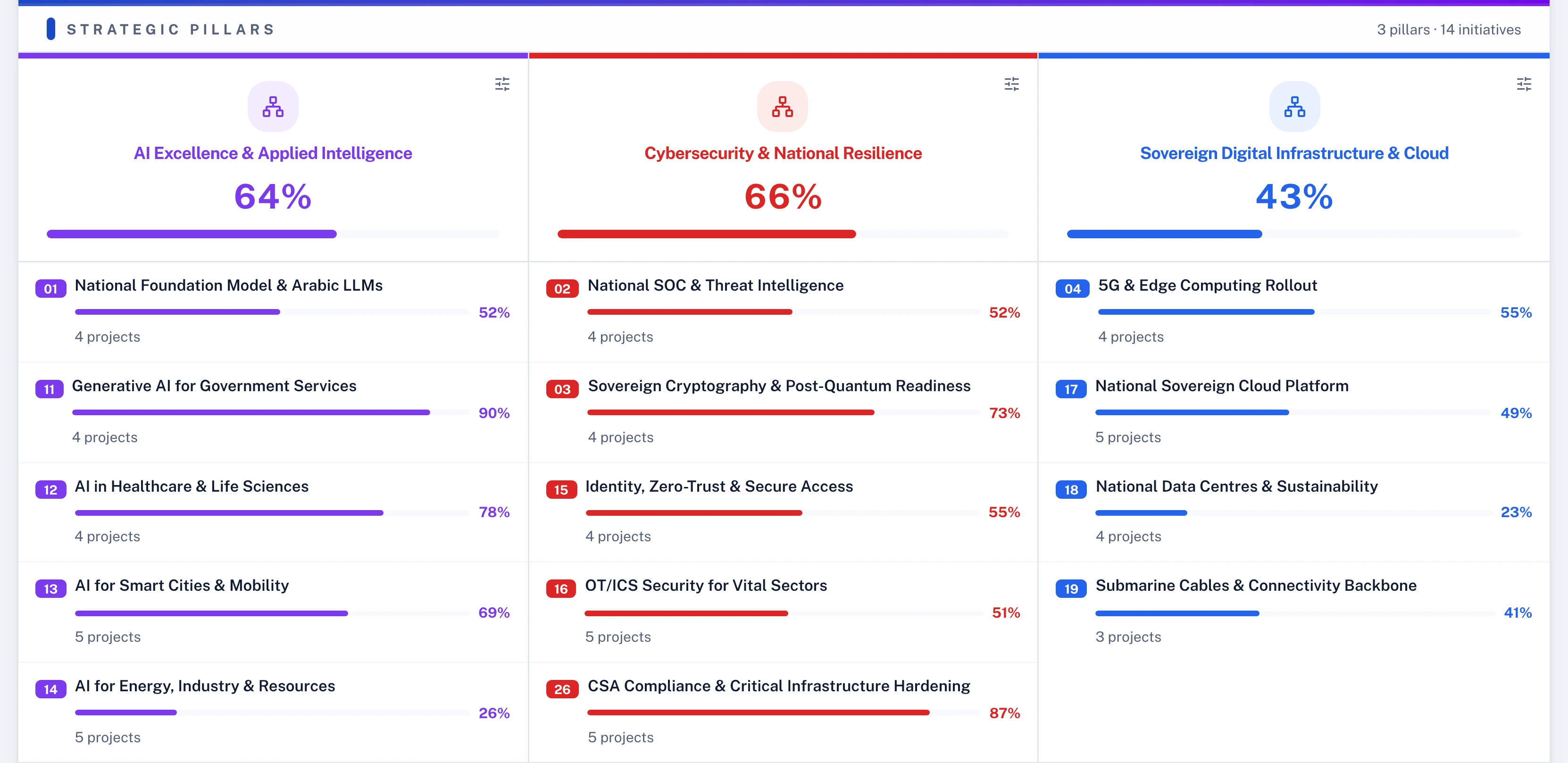
If the organisation calls its top level pillars or themes, keep the word. OKRs are a discipline, not a vocabulary, and new words for old things make adoption slower. In Lodestar, a ready-made OKR structure sets the levels as themes, objectives, key initiatives and projects, and every concept word can be renamed, in English and in Arabic, so KPIs can read as key results across the whole interface.
Questions for your next review
- Which of our key results could be fully achieved without any customer, citizen or colleague noticing a difference?
- Are our key initiatives written down as bets, each linked to the key result it should move?
- How many key results do we have in total this quarter, and could our leaders name them?
- Which KPIs could each key result damage, and are we watching them?
OKRs work when each part does its own job: direction, evidence, bets and work. Mix them up, and the organisation measures its activity and calls it change.
Short answers
What is the OKR framework?
The OKR framework sets a few objectives, each a short statement of direction, and measures each one with two to five key results: measurable changes in an outcome, with a starting value, a target and a date. Key initiatives are the bets meant to move the key results, and projects and tasks deliver those initiatives.
What is the difference between a key result and a task?
A key result describes a change someone outside the team would notice, such as fewer days from contract to first use. A task is something the team does, such as launching a portal. A simple test: if the team could finish all its work and still miss it, it is a key result; if not, it is a task.
Can OKRs be managed in Lodestar?
Yes. Lodestar has a ready-made OKR structure of themes, objectives, key initiatives and projects, and concept words can be renamed in English and Arabic, so KPIs can read as key results. Each key result carries a plan, actual and forecast for every period and can be linked to the work it depends on.

Mariia leads commercial and partnerships at Lodestar. Her background is Big Tech and Big Four consulting, where she led large-scale transformations. She holds an MBA from INSEAD.
More from Mariia