In short
- A grade at quarter end describes a result nobody can change any more.
- Set the owner's forecast beside the computed trend, and treat a wide gap as the warning.
- Keep today's status and the forecast apart, and freeze both when the review closes.
It is the last week of the quarter and the leadership team is grading its key results. Each owner reads out a score between zero and one. Most land around the middle. Three come in low, and the conversation turns to what went wrong.
The owner of one of them says what everyone in the room half knew: the team saw it coming in week four. The supplier slipped, the pilot started late, and from then on the target was out of reach. The weekly check-ins had a confidence score, and it had read seven out of ten every week, because nobody wanted to be the one to drop it.
The grade was accurate. It arrived nine weeks after it could have changed anything.
What goes wrong
OKR scoring was designed as a learning tool: grade the quarter, discuss it, set better key results next time. Used as the main way to track key results, it has four weaknesses.
A grade looks backwards. It describes where a key result ended, on a scale everyone half remembers. It cannot tell the leadership team, in week five, which key results need a decision.
Confidence is a feeling with a number on it. A weekly confidence score is better than nothing, but it rests on the owner's mood and on how safe it feels to lower it. In most teams it drifts slowly and drops suddenly, usually when the result is already lost.
The work and the outcome get blended. When a key result's progress is calculated from the share of its initiatives that are complete, the score moves with activity. A team can be 80% through its work with the outcome not moving at all, and the blended number hides exactly that.
The score can be revised after the fact. When grades are kept in a slide or a spreadsheet, the quarter's story can be rewritten at the next review. Nobody can show what the organisation believed in week six, so nobody can learn whether its forecasts were any good.
What good looks like
Treat each key result the way a finance team treats a budget line: a plan for each period, an actual, and a forecast of where it will land, updated at every check-in. Five moves.
Forecast where each key result will land
At every check-in, ask the owner for one number: where will this key result be on its due date? Give the key result a plan for each period too, so the actual can be compared with where it should be by now, not only with the final target. A forecast is a commitment the owner can be asked about; a confidence score is not.
Ask one follow-up whenever a forecast moves: what changed? A forecast that drops because a supplier slipped is information the leadership team can act on. A forecast that drops for no stated reason is a sign the owner was guessing before, and that is worth knowing too.
Set the owner's forecast beside the trend
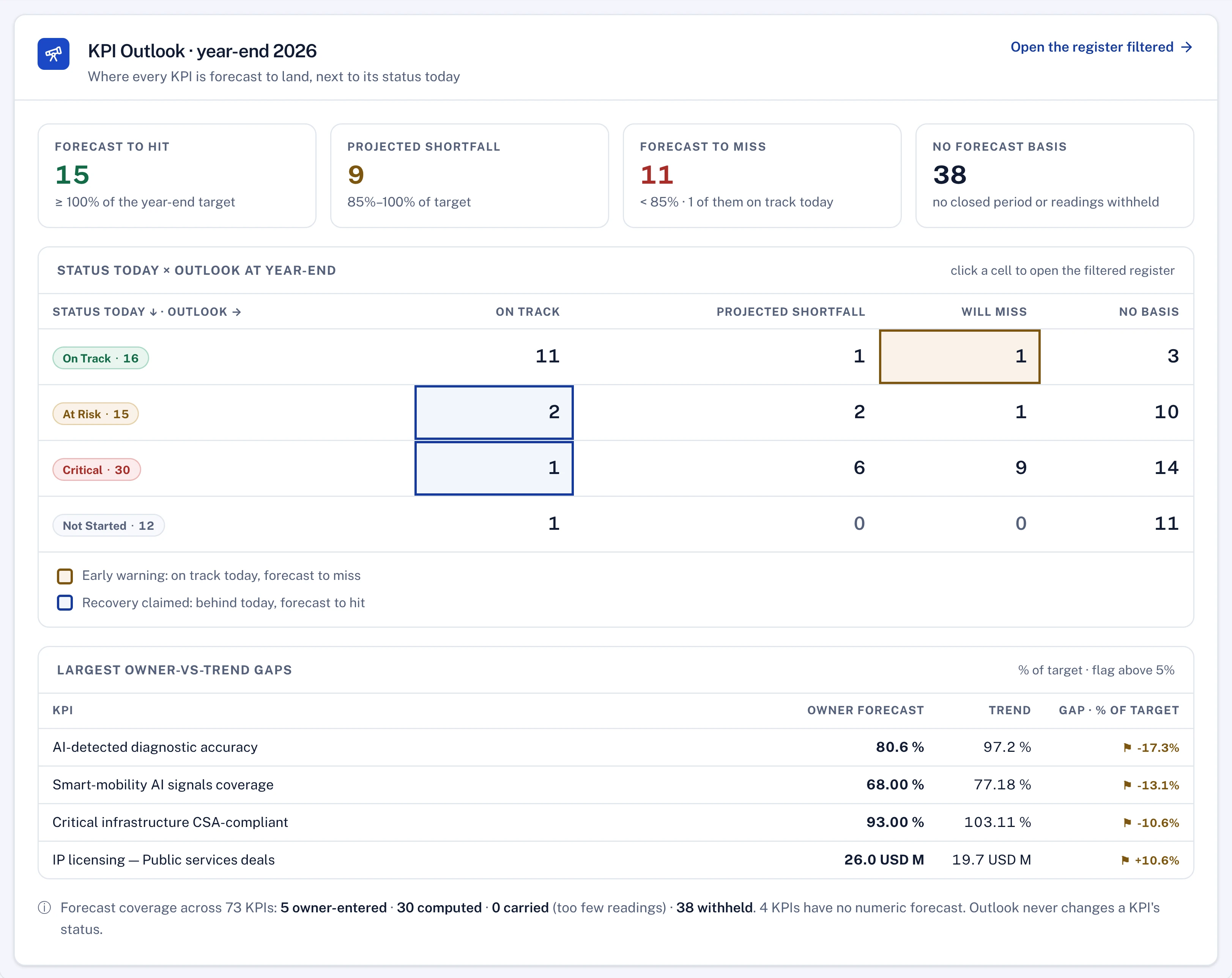
Calculate a trend from the readings so far, and show it next to the owner's forecast. When the two agree, there is little to discuss. When the owner forecasts the target and the trend says two thirds, that gap is the most useful signal in the review: either the owner knows something the trend does not, or the forecast is hope.
Link the key result to the work it depends on
Many key results cannot move until a piece of work lands: the new portal, the changed process, the signed contract. Link the key result to that item. Then, when the item's planned finish moves past the key result's due date, the key result reads at risk on the same day, months before any reading would show it. The mechanics are in a slipped milestone is a KPI forecast change.
Keep status and forecast apart
Today's status says where the key result stands against where it should be by now. The forecast says where it will end. Show both, and never let one overwrite the other. A key result can be on track today and forecast to miss, and that combination is the one worth discussing first.
Freeze the review when it closes
At the close of each review, freeze the status, the attainment, the outlook and the forecast as they stood. The next review then compares against a record nobody could edit, and after a few quarters the organisation learns whose forecasts to trust. That is where real OKR scoring belongs: as a check on the forecasts, not as the forecast.
In Lodestar, each KPI or key result carries a plan, actual and forecast for every period. The year-end outlook uses the owner's forecast where one is entered and the computed trend otherwise, and flags a key result when the two differ by more than a set share of its target. A forecast never changes a status. A roll-up key result takes its forecast from its drivers, and a closed review is frozen.
Questions for your next review
- For each key result, where does its owner forecast it will land, and where does the trend say it will?
- Which key results are on track today but forecast to miss?
- Which key results depend on a piece of work, and is that link recorded?
- Can we show what we forecast in week six of last quarter, and how close it came?
A key result graded at the end of the quarter is history. Forecast it every check-in, and it becomes something the organisation can still act on.
Short answers
How should OKRs be scored?
Use scoring as a check on forecasts, not as the main way to track key results. At every check-in, ask the owner where each key result will land on its due date, set that beside the trend from the readings, and act on wide gaps. At quarter end, grade the result and compare it with what was forecast mid-quarter.
What is an OKR confidence level?
An OKR confidence level is the owner's estimate, often out of ten, of how likely a key result is to be met. It is better than nothing, but it rests on mood and tends to drop suddenly when the result is already lost. A forecast value, set beside a computed trend, gives an earlier signal that can be tested.
How does Lodestar forecast key results?
In Lodestar, each KPI or key result carries a plan, actual and forecast for every period. The year-end outlook uses the owner's forecast where one is entered and the computed trend otherwise, flags a wide gap between the two, and never changes the status. A milestone key result linked to work reads at risk once that work is planned to finish after its due date.

Hany is a strategy and transformation executive with a technical background in software and AI. He has advised C-suites at a top-three strategy consulting firm (MBB) and independently, and has run transformation programmes of more than USD 1 billion.
Connect on LinkedIn