In short
- An AI roadmap on a slide cannot show which use case is waiting on which foundation.
- Keep proposals in a pipeline, outside delivery numbers, until they pass a gate.
- Tie each use case to a KPI the business already reports, linked to the work that moves it.
The AI strategy was approved in the spring. The final pack had a long list of use cases, each scored for value and feasibility, a two-by-two with the quick wins circled, and three waves across two years. The sponsor liked it. The board liked it.
By the autumn there are eleven pilots. Each has a business owner and most have a vendor. The steering committee hears three of them a month, in turn. Nobody can say whether wave one is on track, because wave one was never a plan. Four of the wave-two use cases are waiting for the same data platform, and the data platform project has its own steering committee, which does not know they are waiting.
The strategy was sound. Nothing was set up to execute it.
What goes wrong
An AI strategy is usually written as a document, and the document is treated as the plan. The work of execution then happens in many small places that do not connect.
The long list never becomes a pipeline. A ranked list of use cases is a set of proposals. Each one needs a decision: fund it now, hold it, or drop it. When there is no gate, use cases slide into delivery because a sponsor was keen or a vendor offered a free pilot. They then sit in the portfolio numbers alongside committed work, and the progress figure for "the AI programme" averages funded projects with ideas.
The foundations are not on the plan. Most use cases depend on a small number of shared pieces: a data platform, access to a source system, a security review, a model approval, trained people in the business. On the slide these appear as a box labelled "enablers". In delivery they are projects with dates, and each use case waits on one or more of them. When the dependencies are not recorded, a slip in the data platform shows up months later as several use cases that cannot start, each explained separately.
The value is a slide estimate. Each use case was scored for value during strategy work, and that score is often the last time anyone wrote the value down. The pilots report activity: models trained, users onboarded. None of it connects to a number the business already tracks, so nobody can say what the programme has changed.
The steering committee sees one pilot at a time. Reviewing use cases in turn feels thorough. It leaves no meeting where the portfolio is looked at as a whole: which wave is slipping, which foundation is on the critical path, which pilot has stopped earning its place.
Nothing stops. Pilots are cheap to start and awkward to end. Without a stop rule agreed at entry, a weak pilot continues because ending it reads as a failure. I wrote about that pattern in the project nobody will stop.
What good looks like
Executing an AI strategy means running it as a programme like any other: the same model, the same gates, the same rhythm. Five moves.
Keep the long list as a pipeline, outside delivery
Every use case from the strategy enters as a proposal in a pipeline. It carries an owner, a short case and the foundations it needs. It does not count in the programme's progress or weighting. It moves into delivery only through one deciding gate, where someone with the authority funds it, holds it or drops it. The portfolio numbers then describe committed work, and the pipeline shows what is queued and why.
Plan the foundations as projects, and link the use cases to them
Give each shared foundation its own project, owner and dates. Then record each use case's dependency on the foundations it needs, as a link between projects that both owners agree to. Now a slip in the data platform moves the dates of every use case waiting on it, on the day it happens, and the programme's critical path runs through the foundation where it belongs.
Tie each use case to a KPI the business already reports
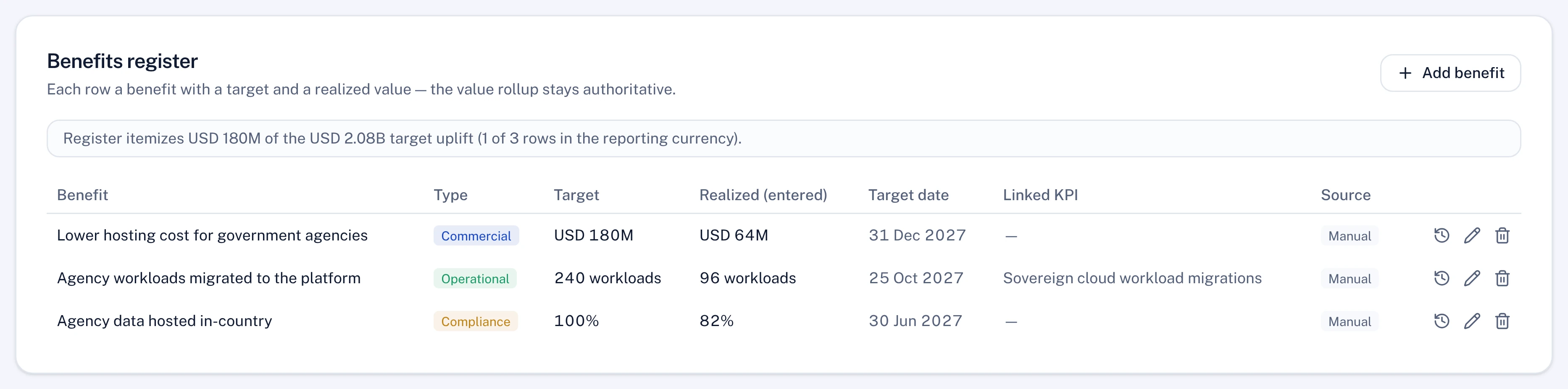
Write the benefit of each funded use case against a number someone outside the AI team already tracks: claims handled per week, days to close a case, unplanned outages. Take the baseline before go-live, name the owner of the benefit, and link the KPI to the delivery item that has to land for it to move. The detail of baselines and benefit owners is in the AI portfolio needs a baseline.
Review the portfolio, not the pilots, on a fixed cadence
Hold one steering meeting a month that looks at the programme as a whole: the pipeline and what is waiting at the gate, the foundations and their dates, the use cases in delivery against plan, and the KPIs they are meant to move. Individual pilots come to the meeting by exception, when they need a decision. A fixed cadence with phase gates gives the sponsor something to steer by.
Agree the stop rule at the gate
At the deciding gate, write down what would end the use case: a benefit not visible by a date, a cost above a ceiling, a foundation that will not arrive in time. Then the decision to stop is a review against a rule everyone agreed, and stopping a weak pilot frees people and budget for the next one in the pipeline.
In Lodestar, ideation and project request can sit in front of delivery as pipeline stages. A proposal there carries no weight and stays out of delivery roll-ups, and it enters delivery only through its deciding stage. Each project's benefits register records the target, the value realised so far and the linked KPI that measures it.
Questions for your next review
- Which of our AI use cases are funded and which are still proposals, and does our progress figure tell them apart?
- Which foundations do the use cases depend on, and who owns each foundation's dates?
- For each funded use case, which business KPI should move, and what was its value before go-live?
- Which pilot would we stop today if we applied the rule we agreed when we started it?
An AI strategy describes where the organisation wants to go. It is executed the way every other strategy is: through a programme with gates, dependencies and a number someone is accountable for.

Hany is a strategy and transformation executive with a technical background in software and AI. He has advised C-suites at a top-three strategy consulting firm (MBB) and independently, and has run transformation programmes of more than USD 1 billion.
Connect on LinkedIn