In short
- Order the review by what changed since the last one. Scorecard order buries the KPIs that matter.
- A target or a reading that changes between reviews must be shown as a change, with who made it.
- Start with the actions agreed last time. An action that nobody will check is a comment.
The quarterly business review is booked for two hours. The pack has a page for every KPI, in the order of the scorecard. The first pillar has nine KPIs and seven of them are green. Each owner presents a page, the green ones included, because the page is there and it would be odd to skip it.
At an hour and forty minutes the review reaches the fourth pillar, where two KPIs have been off plan for three quarters. The chair asks for them to be taken offline. The review ends on time.
Three months later the same two KPIs are on the same pages. One of them is now amber, and nobody can say whether the performance improved or the target did. I have sat in reviews like this one. The pattern is the same whether an organisation reviews KPIs or checks in on objectives and key results. The framework makes little difference. The running order makes a great deal.
What goes wrong
A review that changes nothing usually fails for five reasons, and they compound.
The order of the pack is the order of the scorecard. A pack laid out pillar by pillar gives every KPI a page and every page a turn. Time is spent in proportion to the number of KPIs, with no regard to how far each is from plan. Each green KPI is quick, but there are many of them. The off-plan ones are met late, by a room that is tired and watching the clock.
The numbers are still moving. Without a firm deadline, readings arrive until the morning of the review, and some are corrected after the pack has gone out. The opening of the review goes on which number is right. Owners learn that a late number is examined less than an early one, because nobody has had time to read it.
Targets are restated between reviews. A target is moved, for a good reason or a poor one, and the scorecard shows only the new status. A KPI that was red against the old target is amber against the new one. Unless the pack shows the change, with who made it and under which decision, the room reads a restatement as a recovery.
Plan, actual and forecast are blended. An owner who is behind plan presents a forecast that lands on target, and the page shows one colour. The room cannot tell a KPI that is on plan from one that is behind today and promised for later. The reverse case does more damage: a KPI that is on plan today and forecast to miss gets no attention, in the one review where it could still be helped.
Last review's actions are not on the agenda. Actions are agreed at the end, in a hurry, and filed with the minutes. The next review opens on page one of the scorecard. An action that nobody will check is a comment, and owners know the difference.
What good looks like
These rules apply to a monthly KPI review and to a quarterly check-in on objectives and key results alike. None of them depends on a tool.
Close the numbers before the review
Set a submission deadline, and a cut-off a few days after it. A reading changed after the cut-off still counts, and it is shown as a late correction: the old value, the new value, who changed it and when. Before the review, the chair should know which readings are in and which owners have not reported, with time left to chase them.
Lead the pack with what changed
The first page answers three things. What moved since the last review, up or down. What was restated: every target that changed, and the decision that allowed it. What is missing: every KPI with no reading for the period. A reader who stops after that page knows where the review should spend its time. How the targets are tied together in the first place is the subject of KPI cascades that hold.
Keep plan, actual and forecast apart
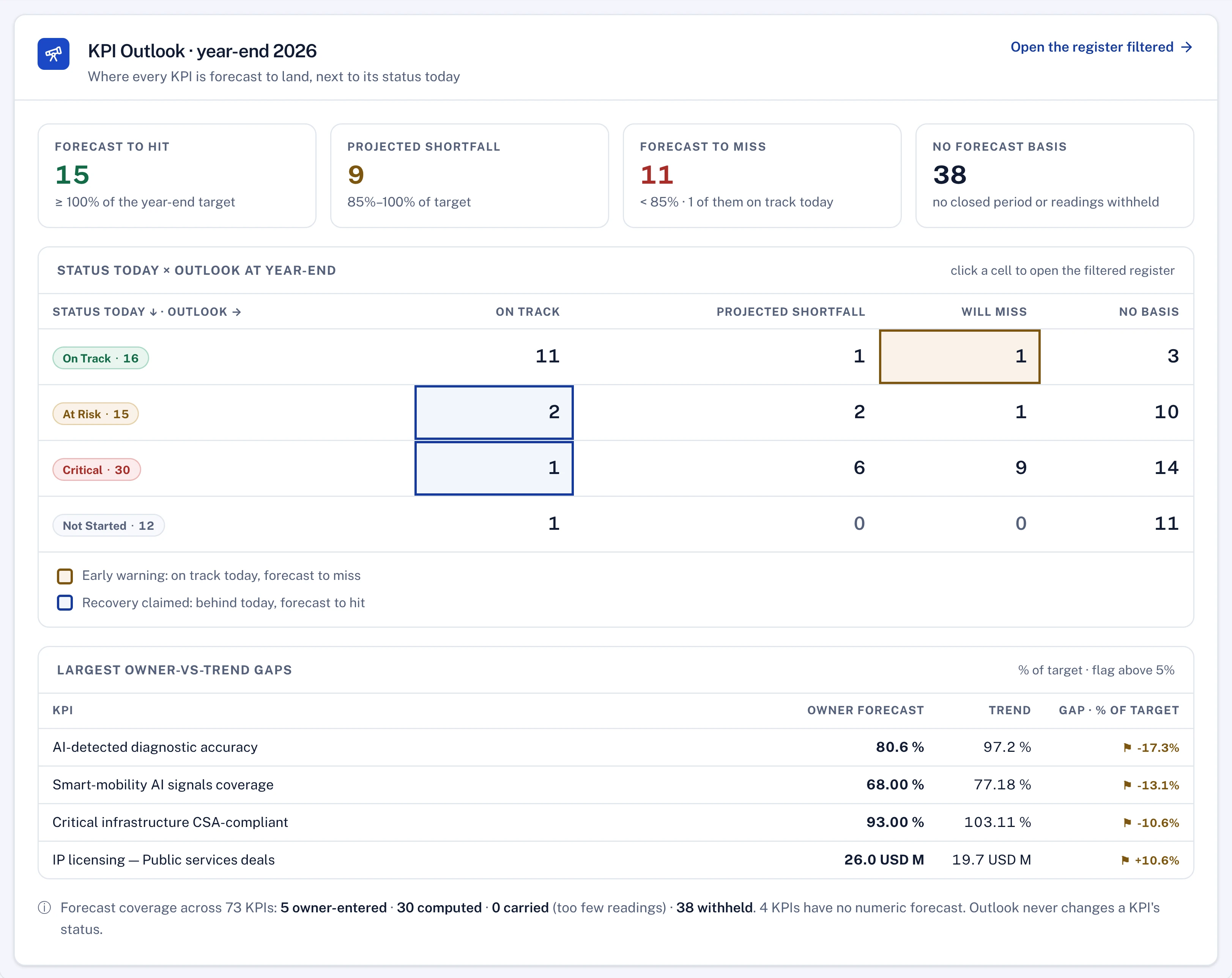
Score status on the actual against the plan to date, and on nothing else. Show the forecast beside it as a separate fact. Two groups then stand out. KPIs on plan today and forecast to miss are an early warning. KPIs behind today and forecast to hit are a recovery someone has claimed and should explain. Where the owner's forecast and the trend of the readings are far apart, put that on the agenda too.
Give every off-track KPI a cause, an action, an owner and a date
The owner of an off-track KPI brings a note written before the review: what caused the gap, and what they propose. The room accepts the action or changes it, and records it against the KPI with a name and a date. "Monitor closely" is a decision to do nothing and should be minuted as one. KPIs on plan are taken by exception: read beforehand, raised only if someone asks.
Start with the actions from last time
The first agenda item is the list of actions from the previous review, each marked done or still open. An open action carries forward under its original date until it is closed. This is the cheapest change on the list. It also changes how actions are agreed, because everyone in the room knows the list will be read out next time. The weekly meeting needs the same habit, as I set out in the weekly PMO meeting should not start with a status round.
An action that nobody will check is a comment.
Freeze what each review saw
"What moved since last time" can only be answered if last time was kept: the status, the target and the forecast of each KPI as the review saw them. A scorecard that is overwritten every month has no last time to compare with. The review needs a record that is fixed when the meeting closes, and the next review should read from it.
In Lodestar, a forum can be set to review KPIs, an option an administrator switches on. The review then shows which readings are in, which targets changed since the last review and which readings were corrected after the cut-off. Review rules suggest the exception KPIs for the agenda, and closing the meeting freezes the KPI record the next review is compared with. The KPI outlook sets each KPI's status today beside its forecast.
Questions for your next review
- Which KPIs changed status since the last review, and which targets changed?
- Which readings in this pack were entered or corrected after the deadline?
- Of the actions agreed at the last review, which are done, and who checked?
- Which KPIs are on plan today and forecast to miss the year?
- For each off-track KPI, who owns the action and what is its date?
A business review earns its two hours by what is different afterwards. Order it by what changed, and check next time that the change happened.

Hany is a strategy and transformation executive with a technical background in software and AI. He has advised C-suites at a top-three strategy consulting firm (MBB) and independently, and has run transformation programmes of more than USD 1 billion.
Connect on LinkedIn