In short
- Updates belong before the meeting. The hour is for exceptions and decisions.
- Every agenda item ends with a decision, an action with an owner and a date, or an explicit carry.
- Write the minutes in the room and fix them at the close. Minutes from memory are one person's account.
It is nine on Monday and the weekly PMO meeting has started. The deck on the screen was assembled on Sunday night from updates sent on Thursday. The first project lead reads her slide aloud. Then the second reads his. There are twelve leads in the room and each has a slide.
By ten to ten the room has heard twelve summaries, most of them green. Two projects need a decision, and they share the last ten minutes with the chair's next appointment. Someone promises to circulate the actions.
The actions arrive on Wednesday, typed from memory, in a document attached to nothing. I have chaired that meeting and I have sat through it. The people in it were capable. The format failed them.
What goes wrong
A status round feels like diligence. Everyone speaks, every project is covered, nothing is hidden. Look at what the hour is made of and four faults appear, each feeding the next.
The meeting is used to collect the updates. If the updates are not in before the meeting, the meeting becomes the place where they are given. Reading aloud is the slowest way to move information that already exists. Ten people listen to a summary that concerns two of them, and the ones who need a decision wait their turn behind the ones who need nothing.
The room works from a copy. The deck was true when it was assembled, at best. By Monday a milestone has moved, an invoice has been paid, a risk has been closed. Part of the hour goes on correcting the slide: "that is done now", "ignore that date". When the copy and the plan disagree, nobody is sure which of them the meeting decided on.
The agenda is a list of projects. An agenda with one slot per project gives a project that is on plan the same time as one that is stuck. The order is the order of the slides, so the hardest item is as likely to come last as first. An agenda built this way also has no slot for the problem that sits between two projects, and those are the problems only this meeting can settle.
The record is written afterwards. Decisions and actions are rebuilt from someone's notes, days later. An action that had no owner in the room acquires one in the write-up, and the owner finds out by email. A decision is recorded in the words of whoever typed it. Nothing links the minute to the milestone it moved, so next week nobody checks it, and the same item comes back as a fresh update.
The result is a meeting that takes an hour from every senior person in the programme and produces a document. In the programmes I have worked in, the weekly meeting was among the most expensive routines on the calendar and among the least often redesigned.
What good looks like
None of this needs a new tool to begin. It needs five rules about what happens before, during and after the hour.
Get the updates in before the meeting
Set a cut-off, a day or so ahead, by which every owner has updated progress, next steps and the support they need. On the morning of the meeting the chair should be able to see who has updated and who has not, and chase the gaps before anyone sits down. An update that arrives in the meeting has arrived late.
Put the exceptions on the agenda
With the updates in, the agenda can be built from what needs the room: requests for a decision or for support, items that slipped since last week, and actions still open from earlier meetings. Projects on plan are read beforehand and left alone. Take last week's open actions first, so that everyone knows an action agreed today will be checked next week.
Run the meeting from the records
Put the plan itself on the screen: the project's progress against plan, its milestones, its open risks and actions. If a date is wrong, correct it there, in front of the people who own it. Nobody then has to reconcile the meeting with the plan afterwards. It also ends the Sunday night spent building slides, which I come back to in what a PMO should stop doing by hand.
End each item with a decision or an owned action
Every agenda item closes in one of three ways: a decision, with who took it; an action, with an owner and a date; or an explicit carry to the next meeting. "Noted" is none of the three. Record the outcome while the item is on the screen and read it back before moving on. The owner hears the action in the room and can object there.
Write the minutes in the room and fix them at the close
Minutes written as the meeting goes are short, because the decisions and actions are already recorded and the minutes only need the discussion around them. Someone other than the note-taker confirms them before they are issued, usually the chair. Once the meeting is closed, the record does not change: what was decided, what was left open, and what the numbers were on the day. Anything added later is marked as added later.
An update that arrives in the meeting has arrived late.
Keep the meeting where the plan is
These rules decay when the meeting lives in one place and the plan in another. The deck, the action log and the minutes each become a copy to maintain, and people stop trusting whichever copy is maintained least.
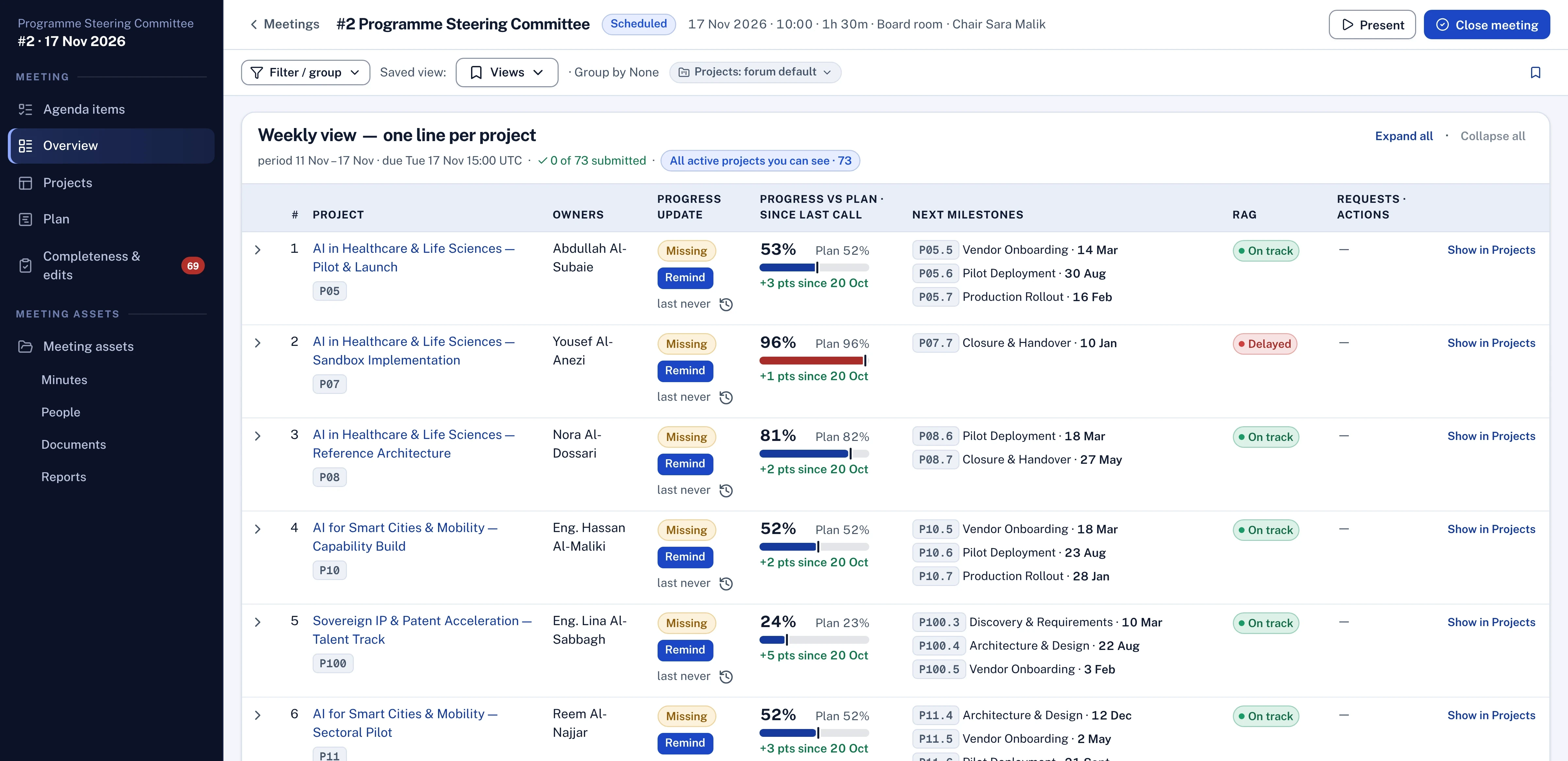
We built meetings in Lodestar on that point. The chair opens the meeting on the live plan: one line per project, progress against plan since the last call, and who has not yet updated. A decision or an action recorded in the room goes straight to its register, the action with its owner and due date. Closing the meeting freezes the minutes and the record as the room saw it, and can carry unfinished items to the next agenda.
The monthly or quarterly review of KPIs has the same fault in a different form, and I take it up in business reviews that change something.
Questions for your next review
- In last week's meeting, how many minutes passed before the first decision was asked for?
- Which of the updates on the screen were entered before the meeting, and which were given aloud?
- Of the actions agreed four weeks ago, how many have an owner, a date and a recorded outcome?
- Who confirmed the last set of minutes, and could they have been changed since?
- If we opened the meeting of three months ago, could we see what the room saw on the day?
A weekly meeting is the one hour in which the people who can unblock a programme are in the same room. Spend it on the items that need them, and leave a record that will read the same in a year.

Hany is a strategy and transformation executive with a technical background in software and AI. He has advised C-suites at a top-three strategy consulting firm (MBB) and independently, and has run transformation programmes of more than USD 1 billion.
Connect on LinkedIn