In short
- A PMO described by its reports is a reporting team, and the first cut when budgets tighten.
- Start from the decisions leadership must take, then design the office that serves them.
- Own the rules work moves by: gates, the change route and what counts as done.
The new head of the PMO is three weeks into the job when the chief operating officer asks a simple question in the corridor: what does the PMO do? The answer comes out as a list. A project template. A weekly status report. A monthly dashboard. A risk log. A methodology document.
The chief operating officer nods and walks on. Every item on the list is real work, and none of it answered the question. The list described what the office produces. It said nothing about what the organisation would decide differently, or worse, without it.
That gap shapes the office's future. When costs are next reviewed, an office described by its outputs is judged on the price of those outputs, and reports always look expensive for what they are.
What goes wrong
A PMO, short for project management office, is the function that sets how projects are run, governed and reported across an organisation. The term covers very different offices. Some support project managers with methods and tools. Some control delivery through standards and reviews. Some run the portfolio for the executive. Many are a mix that nobody wrote down.
The trouble starts when the office is set up from its outputs rather than its purpose. Four things follow.
It becomes the reporting team. The easiest thing to stand up in a new office is a report. So the first quarter goes on templates and a dashboard, and the office is known from then on as the people who chase status. Project managers see it as overhead. Executives see it as a pack that arrives a week late.
It reports on rules it does not own. Gates, the change route and the definition of done are set by each project, or by habit. The PMO then reports on work it has no standard to judge. A project at 90% means whatever its manager meant by it.
It keeps a copy of the truth. The plans live in one tool, the money in another, the risks in spreadsheets, and the PMO rebuilds them into its pack every month. The pack is out of date on the day it is sent, and any disagreement turns into a debate about whose numbers are right.
It cannot show what it changed. Asked for its value, the office counts its outputs: reports sent, reviews held, templates adopted. None of them is a decision, a slip caught early or money moved, so none of them survives a budget conversation. I wrote about building that record in proving the PMO is worth keeping.
Name the kind of PMO you are setting up
The same three letters cover offices with very different jobs. Naming which one you are building is the first decision, because it sets who the office serves.
| Office | Serves | Decides or prepares |
|---|---|---|
| Project PMO | One large project or programme | Plan, scope changes, the schedule and its risks |
| Enterprise PMO (EPMO) | The executive team | Which projects run, in what order, with which people and money |
| Strategy PMO or strategy management office | The board and the chief executive | Targets, the KPI cascade, alignment of the portfolio to the strategy |
| Transformation office | The sponsor of a multi-year change | The value case, the sequence of change, what to start and stop |
An organisation can need more than one, and they should share one record. How the enterprise and strategy offices relate is covered in from PMO to enterprise PMO.
What good looks like
A PMO that lasts is designed backwards: from the decisions it serves, to the rules it owns, to the record it keeps. Five moves.
Start from the decisions leadership has to take
List the decisions the office exists to support, with the person who takes each and how often. Which projects start this quarter. Which one gives way when two need the same people. Whether a slipped milestone moves the target or the plan. Every report the office produces should feed one of those decisions. A report that feeds none can stop.
Own the rules work moves by
The office should set, and keep, the rules that every project follows: the stage gates and what each one asks for, the route a change takes and who approves it at which value, what counts as done and what evidence proves it. Projects keep their own methods. The rules at the joins are the PMO's. One rule matters more than the rest: nobody approves their own request.
Keep one record, and stop rebuilding the pack
Plans, milestones, money, risks and KPIs should live in one model that owners update and the PMO reads. The board pack is then a view of that record, produced on the day it is needed, and a disagreement is settled by opening the record. Reconciling copies is the work most likely to eat the office's week. Done well, every level sees the same information: an owner updates once at the level where the work happens, and the project, portfolio and board views all read that one entry.
Put the routes in the system, not in a policy document
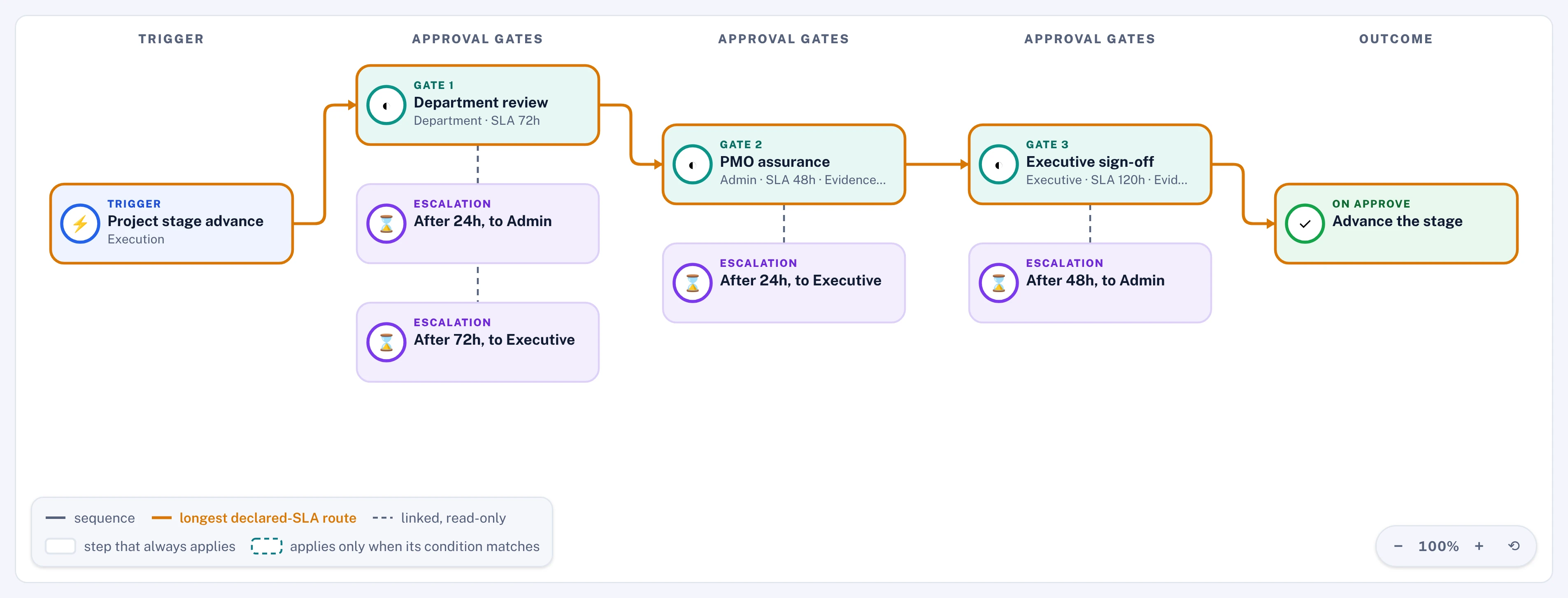
A gate written in a methodology document is applied when someone remembers it. A gate built into the system is applied every time: the stage cannot advance until the required forms are complete and the approver has signed. The same holds for change requests and budget increases. The PMO's authority then comes from the route, and its staff stop policing by email. In Lodestar, approval routes for 23 kinds of change are set without code, with conditions, value thresholds, committees and deadlines on every step. The person who raises a request can never approve it, administrators included, and the route is frozen when the request is raised.
Measure the office by what it changed
Keep a short ledger: decisions taken sooner or differently because of the office, slips caught while they were cheap, money moved, hours given back to project managers. Show it to the sponsor every quarter. That page answers the corridor question better than any list of outputs.
Questions for your next review
- Which decisions does our PMO exist to support, and who takes each one?
- Which of our reports feeds none of those decisions?
- Who owns our stage gates and change route, and are they applied by the system or by memory?
- What did the PMO change last quarter that would not have happened without it?
A PMO earns its place through the decisions it makes better, faster or fairer. Everything else it produces is a means to that, and should be judged as one.
Short answers
What does PMO stand for?
PMO stands for project management office, and sometimes for programme or portfolio management office. It is the function that sets how projects are run, governed and reported across an organisation: methods, stage gates, the approval route for changes, and the record leadership decides from.
What are the types of PMO?
Common types are the project PMO for one large project or programme, the enterprise PMO that runs the portfolio for the executive team, the strategy PMO or strategy management office that ties the portfolio to the strategy, and the transformation office that steers a multi-year change.
What software does a PMO need?
A PMO needs one record of plans, money, risks and KPIs that owners update directly, approval routes built into the system, and reports produced from that record. In Lodestar, approval routes for 23 kinds of change are set without code, and the person who raises a request can never approve it.

Hany is a strategy and transformation executive with a technical background in software and AI. He has advised C-suites at a top-three strategy consulting firm (MBB) and independently, and has run transformation programmes of more than USD 1 billion.
Connect on LinkedIn