In short
- Make four things common: the progress scale, the status rules, the evidence rule and the routes for cross-cutting changes.
- Leave departments their methods, templates, tools and meetings. Standardising those costs more than it returns.
- The enterprise PMO reviews the exceptions the common rules produce, not every project in every department.
It is Monday in the enterprise programme office. Six packs have arrived, one from each departmental project management office (PMO). Finance scores its projects on a five-point scale. Operations uses red, amber and green, and calls a project amber when its manager is worried. Capital works sends a schedule export, and the digital team sends burn-up charts.
By Wednesday the analysts have mapped all six into the enterprise template. On Thursday the executive committee spends its first twenty minutes asking what amber means in each department. Near the end, someone mentions that a shared system cutover has moved by a month. Each department's board approved its own part of the change. Nobody approved the whole of it, and two other departments learn of it from the minute.
Every office here is doing its job. The enterprise office has become a translation service.
What goes wrong
An enterprise PMO (EPMO) that sits over departmental or business-unit PMOs is often called a federated PMO. The departments keep their own offices, and the centre is meant to steer the whole. The model is sound. It goes wrong through four differences that nobody agreed to keep.
Each office has its own scale. Five points in one department, three colours in another, a percentage in a third. The EPMO maps each one to its template, and every mapping is a judgement. A four on the finance scale becomes amber in the enterprise pack, and the head of finance no longer recognises her own project.
Each office has its own status rules. Even where the colours match, the rules behind them do not. One department calls a project amber at a week's slip, another at a month's, a third when the manager says so. Rolled up, the enterprise figure averages things that were never measured the same way.
Each office has its own idea of done. One counts a milestone complete when the contractor says so. Another waits for a signed acceptance. The enterprise roll-up adds the two together, and the department with the stricter rule looks slower for being more careful.
Changes that cross departments have no route. Each departmental board approves changes to its own projects. A change that moves another department's dates, or draws on a shared budget, is approved in pieces, and nobody sees the whole of it before it is made.
Because the EPMO cannot trust the numbers, it reads every project, and the time meant for steering goes on translation. The usual cure makes this worse: one method and one template imposed on every department. The departments that already worked well keep their own way of working and fill in the enterprise template on top, so every project manager now reports twice.
What good looks like
My view is that an EPMO should standardise as little as it can, and hold that little without exception. From PMO to enterprise PMO covers what changes when one office grows into the enterprise role. This piece is about the other way in, where the departmental offices came first.
Agree the four things that must be common
Write them down and have the sponsor sign them: one progress scale, one set of status rules, one rule for done, and the routes for changes that cross departments. Everything else stays with the departments: their delivery methods, their templates, their tools and their internal meetings. A department that plans in sprints and one that plans in detailed schedules can report on the same scale, as long as the scale measures progress against each one's own plan.
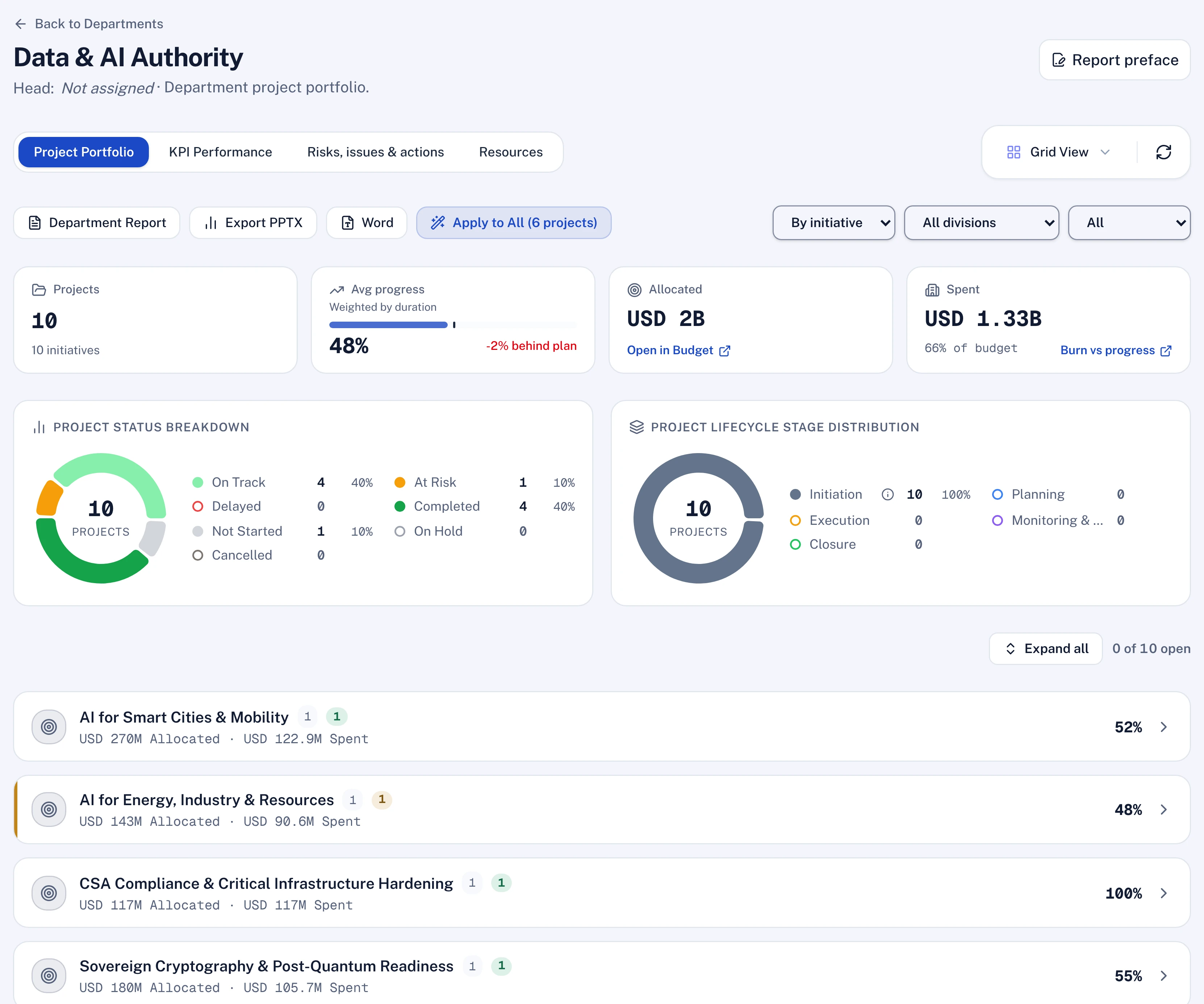
In Lodestar, each department has its own portfolio in one shared model, and department and portfolio roll-ups sit on one scale: progress against plan, variance, status and budget.
Write the status rules once, and compute them
Agree how far behind plan a project must be to read at risk, and how far to read delayed. Then let the colour come from the numbers and not from the manager's mood. A rule applied by judgement drifts department by department, however clearly it is written. A computed rule does not.
In Lodestar, a project's health is computed from its progress against plan, with the At Risk and Delayed thresholds set once in the programme configuration, so the same lag reads the same in every department.
Use one evidence rule for done
A milestone is complete when the evidence it names has been approved by someone other than its owner, in every department. This is the rule that keeps the enterprise roll-up fair, because it stops a generous department from looking faster than a careful one. The reasoning is in Green, and wrong.
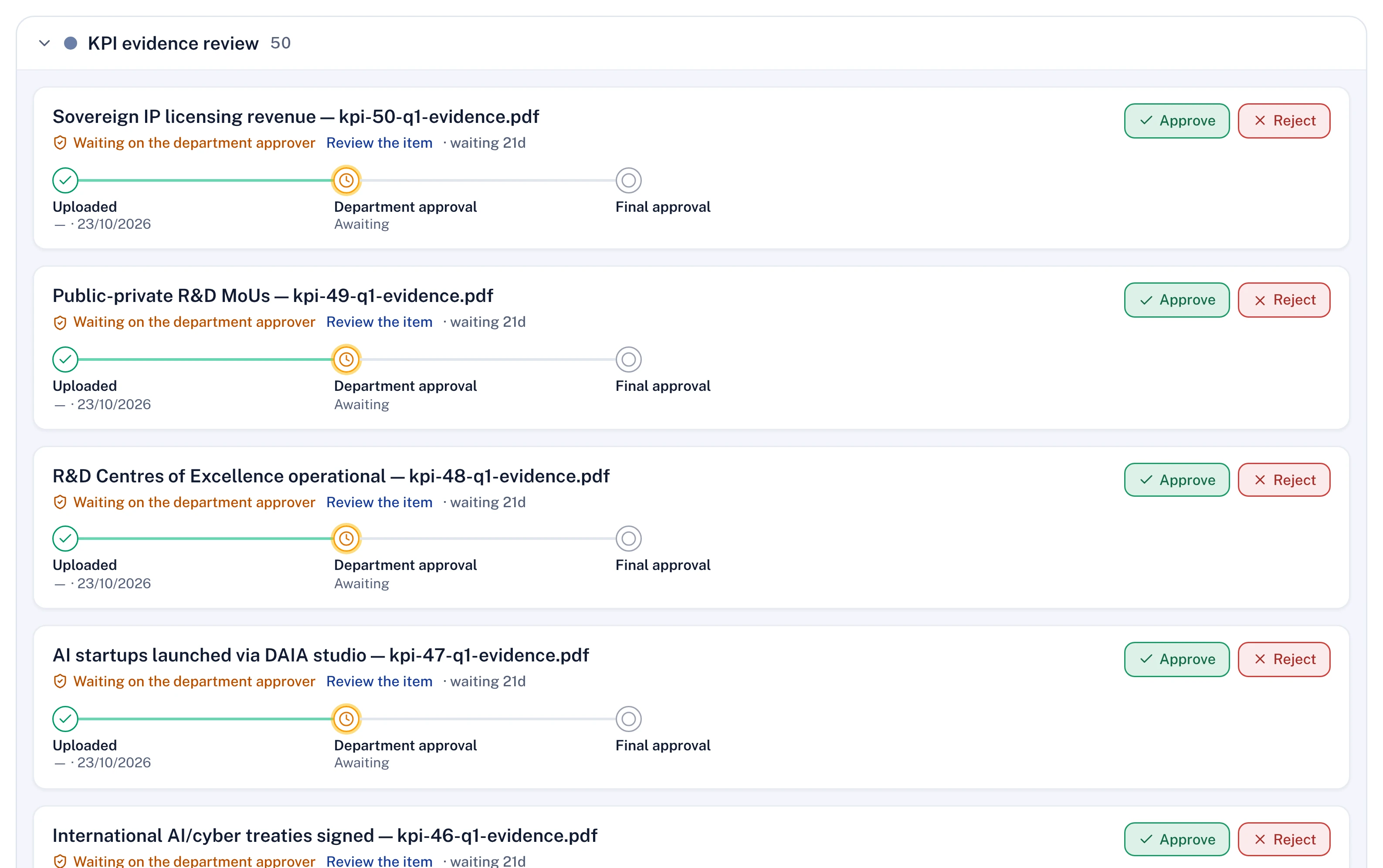
In Lodestar, an activity cannot be submitted as complete without the evidence its gate requires, and until someone else approves it, a claimed 100% counts as 95% in every roll-up, whichever department it belongs to.
Route cross-cutting changes above the departments
A department should approve its own changes, within its own limits. A change above a set value, a slip beyond a set number of days, or a kind of change that touches shared systems or shared money goes on to an enterprise board. Write the thresholds down, and fix the route when the request is raised, so it cannot be steered to a friendlier approver halfway through.
In Lodestar, a change request goes by default to the department's approver first, and later steps set in Workflow Studio can apply only above a budget change, beyond a schedule slip in days, or for a given kind of change. The route is frozen when the request is raised, and the person who raised it can never approve it.
Let departments run their own portfolios, and review exceptions at the centre
Each department head runs the review of her own portfolio, with her own office. The enterprise review then takes only what the common rules throw up: projects past the delayed line, changes waiting for the enterprise board, spend running ahead of progress, and greens with no reports behind them. An EPMO that reviews exceptions has time to ask why they keep arising in the same places, which is the steering it was set up to do.
In Lodestar, department heads hold rights over their own department under role-based access, and Polaris writes a Department Head Brief scoped to that department. Detectors flag patterns such as spend running ahead of progress across the whole model, so the enterprise review starts from a list.
Keep the enterprise PMO's common layer small
The common layer grows when nobody guards it. Watch for three habits.
The template that grows. Each quarter the enterprise pack asks for one more field. Within a year the departments are filling in a second plan. Before adding a field, ask which decision it serves.
A rule for every incident. A late project in one department prompts a new common rule for all of them. Fix that department's practice, and keep the common rules to the four.
The full read-through. After a bad review, the EPMO goes back to reading every project. Look harder at the exceptions instead.
The same discipline applies when choosing enterprise PMO software. It should hold each department's own projects, plans and owners under one common set of rules, without asking any department to change how it plans.
Questions for your next review
- Does amber mean the same lag in every department's pack, and where is that written down?
- When does a milestone count as done in each department, and who accepts it?
- Which changes approved last quarter moved another department's dates or budget, and who saw the whole change?
- How much of the enterprise PMO's week goes on mapping departmental packs into its own template?
- Which items in our last enterprise review were exceptions, and which were a walk through every project?
A federated PMO works when the centre and the departments agree a few rules and keep them. The methods underneath can differ, as long as the numbers mean the same thing when they reach the top.

Mariia leads commercial and partnerships at Lodestar. Her background is Big Tech and Big Four consulting, where she led large-scale transformations. She holds an MBA from INSEAD.
More from Mariia