In short
- Let each department keep its method, and make the definition of done common to all.
- Route approvals by value, so the board decides only what only the board should.
- Run the weekly rhythm on exceptions, because the whole portfolio will not fit in one meeting.
The PMO has had a good year. Its IT projects landed on time, the steering committee trusts its RAG column, and the chief executive has noticed. The next memo widens the remit: from January, the PMO becomes the enterprise PMO (EPMO) and runs the portfolio for every department. Capital works, operations, finance, HR and the transformation office's programmes, all of it.
The PMO lead does the sensible thing and extends what worked. The same template goes to every department, with the same weekly status request and the same spreadsheet roll-up. Within a quarter, the capital works team is sending Primavera exports nobody can merge, HR is reporting milestones that exist in no plan, and project portfolio management has become a monthly copy-and-paste exercise.
Nobody did anything wrong. The office was asked to do a different job with the tools of the old one.
What goes wrong
An enterprise PMO is often described as a PMO with more projects. In the programmes I have worked in, four things change at once when the portfolio becomes the whole organisation, and project-level tools and spreadsheets stop scaling at each of them.
The office now has to help choose the work. A project PMO receives its projects. An EPMO is asked which projects the organisation should run at all: whether a system upgrade or a depot refurbishment gets the money, and what stops to make room. That is strategic portfolio management, and a scheduling tool has nowhere to make the comparison.
The methods multiply. IT runs sprints. Capital works runs detailed Primavera schedules. HR runs a list of milestones. The transformation office needs programme management across all of them, because its outcomes depend on projects in several departments. Forcing one method on all of them breaks the teams that already work. Accepting every method with no common layer breaks the roll-up.
The committee drowns. A project PMO can send every decision to one steering committee. At organisation scale that committee meets monthly and sees more items than it can read. Decisions either queue for weeks or get made in the corridor, and neither leaves a record.
The roll-up stops meaning anything. Eighty percent complete means four of five deliverables accepted in one department, and eighty percent of the budget spent in another. Averaged into one portfolio figure, it tells the board nothing, and the board soon notices.
Spreadsheets hide all four problems for about a quarter. The PMO's analysts become the integration layer, merging files, chasing status and rebuilding the pack, and the office that was hired to give the organisation control spends its week on consolidation.
What good looks like
Hold one portfolio model, and let each department keep its method
Agree the common layer and nothing more: initiative, project, milestone, owner, dates, budget and the link to the strategy. Below that, each department plans the way it plans. Schedules come in from the tools they already use, and are updated in place on the next import, so nobody types a plan twice.
Use one definition of done, backed by evidence
A milestone counts as complete when the evidence it names has been approved by someone other than its owner, in every department. That single rule does more for the roll-up than any weighting formula, because it makes sixty percent mean the same thing in IT as in capital works. I set out the reasoning in green, and wrong.
Route stage gates and approvals by value
Small changes are approved inside the department. Larger ones go to a portfolio board, and the largest to the executive committee. Thresholds are written down per kind of change, the person who raises a request never approves it, and delegation runs for a fixed period. The board then sees only the decisions that are truly its own. Governance is a workflow covers how to set those routes.
Manage capacity and money across the whole portfolio
At organisation scale the constraint is rarely one project's budget. It is the shared teams every project needs, such as procurement, legal, data and architecture, and the spend running ahead of progress in places nobody is looking. Show both across the whole portfolio, by month, so a new project's demands land on a picture of what is already booked.
Build the weekly rhythm on exceptions
The whole portfolio will not fit in one meeting, and it should not try. The weekly session takes the late milestones on the critical path, the approvals that are overdue and the projects whose spend has outrun their progress. Everything else is read beforehand.
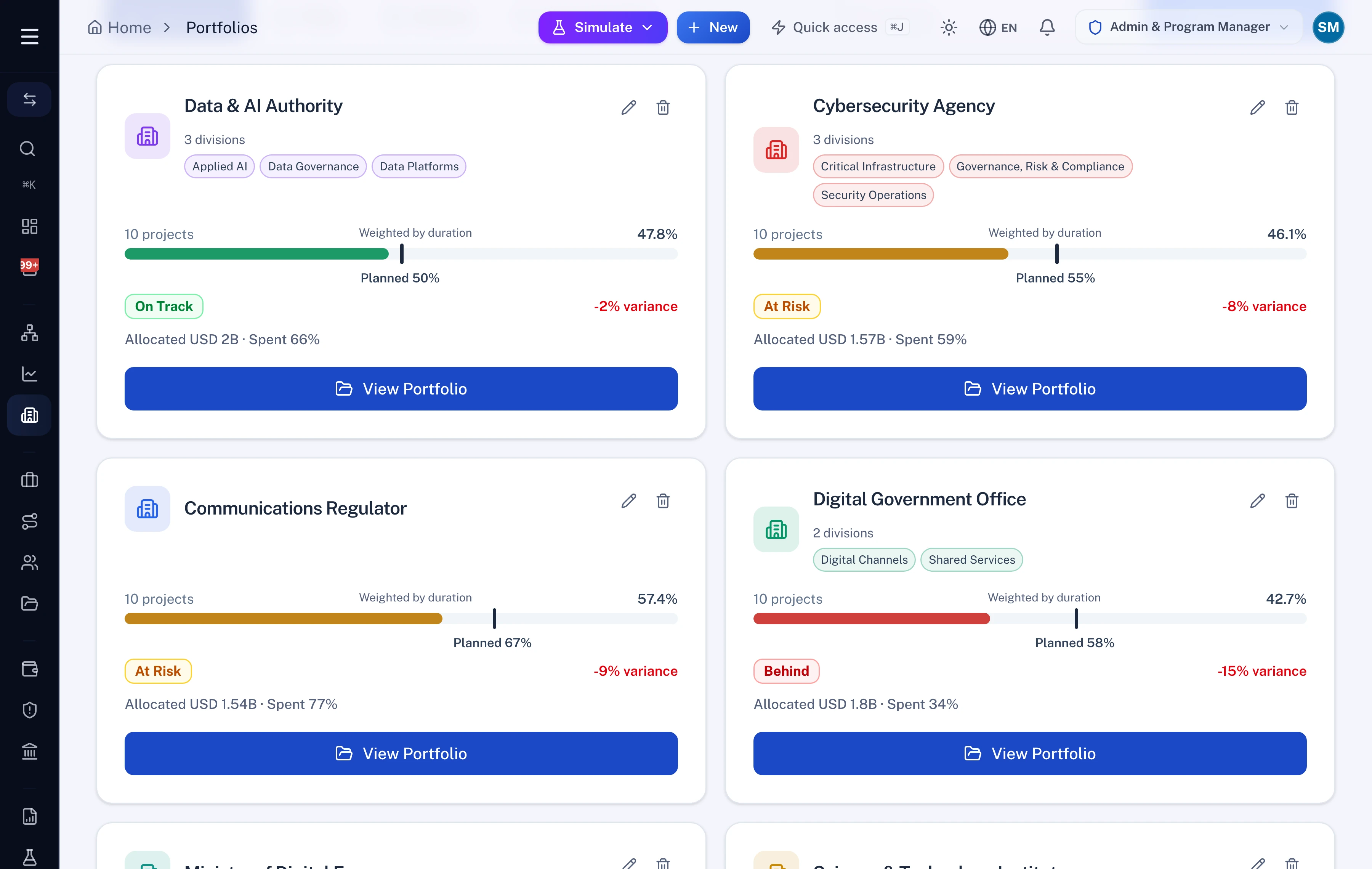
This is the setting Lodestar was built for. Department and portfolio roll-ups sit on one scale, approval routes for 23 kinds of change are set in Workflow Studio without code, and a portfolio Gantt shows the critical path across projects. Schedules come in from Microsoft Project as XML and from Primavera P6 as PMXML, so each department keeps its tool.
Questions for your next review
- If the board asked which projects to stop to fund a new priority, what would we compare them on?
- Does eighty percent complete mean the same thing in every department, and who decided that it does?
- Which approvals still wait for the monthly committee that a named delegate could decide below a set value?
- Which shared teams are booked beyond their capacity next quarter?
A PMO earns the enterprise remit by running its own projects well. It keeps the remit by giving the organisation one set of numbers it can decide on, whatever method each department uses underneath.

Hany is a strategy and transformation executive with a technical background in software and AI. He has advised C-suites at a top-three strategy consulting firm (MBB) and independently, and has run transformation programmes of more than USD 1 billion.
Connect on LinkedIn