In short
- A report that costs nothing to write is worth only what someone decides because of it.
- The PMO's work is the four judgements a draft cannot make.
- Count the decisions the office prepared. The pages it produced are now nearly free.
The status report now arrives before anyone asks for it. Forty projects, a paragraph each, a colour, the next steps. It was drafted overnight from the plan and the owners' updates. The prose is clean and the numbers match the schedule. The analyst who used to spend Thursday building it reads it through in twenty minutes and corrects one date.
At the steering committee the chair reads the summary in two minutes and asks the question it does not answer. Three projects want more money this quarter, and there is enough for one. Which one? The PMO has not prepared that. It prepared the report.
Every head of PMO should now be asking a blunt question. If the report writes itself, what is my team for? The answer decides whether the office grows or is quietly cut at the next budget round.
What goes wrong
For years the report was the part of a PMO's work that everyone could see. When that part becomes free, four things go wrong, and they compound.
The job was defined by its output. A PMO was judged on whether the pack went out on time, complete and consistent. The judgement inside the pack, which projects belong on the first page and what to ask the committee, was folded into the compiling and never named. Automate the compiling and the judgement goes with it, because nobody had written it down as a separate task.
A fluent draft has no seams. A report built by hand shows where it was hard to write: the paragraph that hedges, the update that came in late, the number the analyst had to phone about. Those seams were where a PMO noticed trouble. A generated draft summarises what the owners said, evenly and well. Evenness is the opposite of a priority.
Cheap reports multiply. When a report costs nothing, people ask for more of them. The weekly pack gets a daily version, a version per sponsor and a version per department. The PMO becomes the editor of a report factory. The number of pages rises. The number of decisions does not.
Nobody makes the call. In a manual cycle, the analyst who wrote "slipped by three weeks" had spoken to the owner and asked why. A generated sentence records the slip and asks nothing. The owner is not called, the recovery date is not agreed, and next week's report records the slip again.
The result is an office that produces more than ever and decides less. Its budget is defended by volume, and volume is the one thing the software has made cheap.
A report that costs nothing to write is worth only what someone decides because of it.
What good looks like
A PMO that survives free reporting owns the judgements a draft cannot make. There are four of them, plus one change in how the office counts its own work, and none of it needs particular software.
Put one trade-off in front of the committee every cycle
The report says what happened. The PMO says what it costs. Each cycle, pick the decision the committee is avoiding and frame it as options: fund this project and that one waits until March; keep the date and drop the second release; add the contractor and spend the contingency. Put the money, people and dates for each option on one page, with the PMO's recommendation. A committee that is handed a choice will usually make one.
Bring a stop list to every review
The PMO is the one function in the programme with no project of its own, which makes it the only one that can name what should stop without defending its own work. Bring two or three candidates to every portfolio review, with the reason and what a stop would release. The committee may reject every one. It will still have had the choice. I go further into why stopping is so rare in the project nobody will stop.
Hold the owner to the date they gave
Accountability needs three things: a named person, a commitment they made themselves, and a record of whether they kept it. When a date moves, the PMO goes back to the owner with the original commitment and asks for the recovery plan and a new date, in the owner's own words. That conversation is the part of status chasing that was always worth doing. The chasing can go to the system. The conversation stays with a person.
Decide what counts as proof
A draft is only as true as what it is fed. If the inputs are the owners' own assessments, the draft is a well-written self-assessment. The PMO's job is to set, for each milestone and KPI, the evidence that will show it is done, and to make sure the person who accepts that evidence is not the person who claimed it. This is where a generated report earns trust or loses it.
Measure the office by decisions prepared
Stop counting packs. Count the decisions the committee took on a paper the PMO prepared, the projects stopped or paused, the money and people moved, and the owners spoken to after a missed date. Report that count to the sponsor each quarter. It is the case for the office's budget, and the hours freed from compiling are where it comes from. Which chores to hand over, and which to keep, is the subject of what a PMO should stop doing by hand.
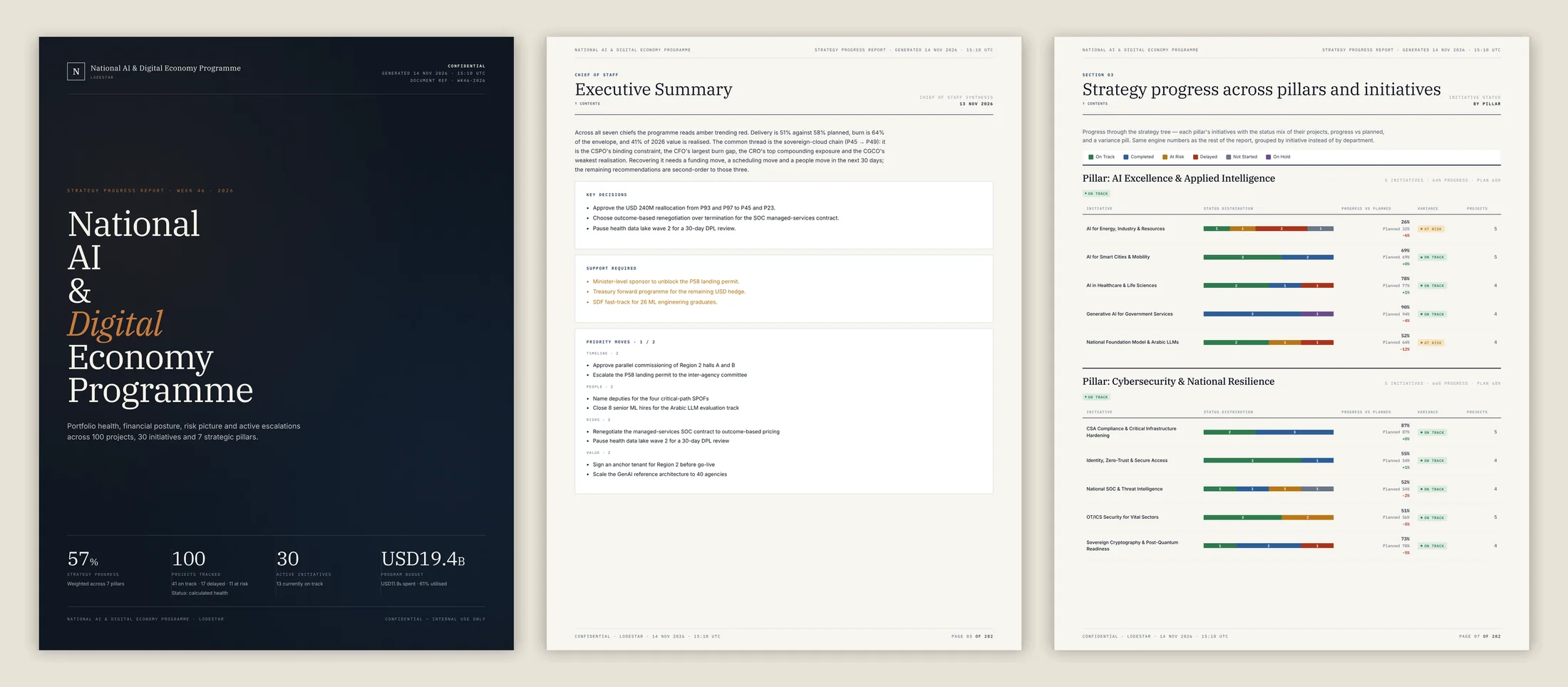
In Lodestar the report is the part we took off the PMO's desk. The strategy progress report, the KPI scorecard and a one-page deep dive for every project are generated from the live model and export to PDF, PowerPoint and Word. What the software does not do is choose the trade-off, name the stop or accept the evidence. Those stay with named people, on the route your governance sets.
Questions for your next review
- Which decision did this committee take last month on a paper the PMO prepared, rather than a report it compiled?
- If we needed money back this quarter, which project would we stop first, and has anyone written that down?
- When an owner missed a date last quarter, who spoke to them, and where is the new date recorded?
- Which numbers in this pack rest on the owner's own assessment, and which on evidence someone else accepted?
- If the report cost nothing to produce from tomorrow, what would the PMO do with Thursday?
A status report was always a means of reaching a decision. Now that the report is nearly free, a PMO will be judged by the decisions it prepares, which is the better job of the two.

Hany is a strategy and transformation executive with a technical background in software and AI. He has advised C-suites at a top-three strategy consulting firm (MBB) and independently, and has run transformation programmes of more than USD 1 billion.
Connect on LinkedIn