In short
- Activity counts grow with the office's cost, so in a cost review they argue for the cut.
- Record each decision the office changed, from the committee's own minute, when it is taken.
- Give the sponsor one page a quarter: what changed, what moved, and what the office cost.
The cost review has reached the programme office. Finance has a spreadsheet of every overhead line, and the PMO is one of them: a head of office, five analysts, a software licence and an external adviser. The head of the PMO has ten minutes.
His slides show what the office does. Monthly reports produced, steering committees supported, templates rolled out, projects tracked, and a maturity assessment that moved up a level last year. All of it is true. The chief financial officer listens, then asks what the organisation would lose if the office closed at the end of the quarter.
He starts to answer with the reports. The sponsor, who values the office, cannot answer either. She knows it helps, and she cannot say how. The office goes on the list. I think a good programme office is more exposed in this meeting than a poor one, and the reason lies in how it describes itself.
What goes wrong
A PMO that is cut first has rarely done nothing. Its results sit in other people's columns, and the four habits below keep them there.
The office reports its activity. Reports produced, meetings supported and projects tracked are counts of work done. They grow with the size of the office, which means they grow with its cost. In a cost review, a longer list of activity makes the case for the cut.
Its best work leaves no trace with its name on it. When the office spots a slipping supplier in time, the project's date holds and the project manager reports on plan. When its analysis shows that a stalled project should release its budget, the minute records that the committee decided. Both outcomes are right. Neither carries the office's name, and the better the office works, the less of its work anyone can see.
Maturity scores answer a question the cost review is not asking. A maturity level compares the office's processes with a model. The person deciding what to cut wants to know what the organisation would lose. A higher level costs more to reach and says nothing about what the office changed last quarter.
The sponsor sees only the pack. She sees what reached the steering committee. She does not see the slip caught early that never became a red, or the hours the office took off project managers by doing the chasing itself. A sponsor cannot argue for value she has never been shown, and in a cost review the sponsor is usually the only advocate the office has.
Put together, the office is judged on its cost, which sits on one line of a spreadsheet, against its value, which is spread across other people's results. The review compares a known number with an impression, and the number wins.
What good looks like
From the buyer's side, a PMO is a service the sponsor pays for and renews each year. It should be able to show her what any supplier would show: what changed because it was there, and what that was worth. Five habits do it, and none of them depends on a tool.
Keep a ledger of the decisions the office changed
Each time the office's analysis leads a committee to decide differently, or sooner, record it: the decision, the date, what the office brought to it, and what would have happened otherwise. Stopping a project counts. So does moving a date before it was missed, and taking a risk to the committee before its owner would have. Use the committee's own minute as the source, so that the record is never the office describing itself.
State the money moved, in figures finance will confirm
Budget released from a stalled project and given to one that was ready. A contract change prompted by the office's cost tracking. A payment held until a deliverable was accepted. Record each amount and have finance confirm it. Keep these figures apart from savings. Money moved is a fact with a minute behind it, and it survives a finance review. A claimed saving often does not, as A business case without invented savings sets out.
Count the slips caught while they were cheap
For each early warning, note when the office raised it, when the owner would otherwise have reported it, and what was done in between. The gap between those two dates is the office's contribution. A list of red flags shows that the office was watching. A list of warnings, each with the action it bought, shows that the watching paid.
Measure the hours given back to project managers
If the office takes the chasing, copying and pack-building off project managers, measure it with a simple log before and after. Report the result as capacity, and say what the project managers did with the time. Do not turn it into cash unless a post or a contract really ends.
Put it in front of the sponsor every quarter
One page: decisions changed, money moved, slips caught early, hours given back, and the office's cost on the same page. Add what the office stopped doing this quarter, and why. A sponsor who reads that page four times a year can answer the question in the cost review herself, and she will be believed, because the page existed before anyone asked for it.
The gap between those two dates is the office's contribution.
Make the record a by-product of the work
A ledger written at the end of the quarter is written from memory, and memory flatters. The record has to be made when the decision is taken, in the place where it is taken, with the money and the time it moved written beside it. Then the quarterly page is a query, and nobody has to assemble it.
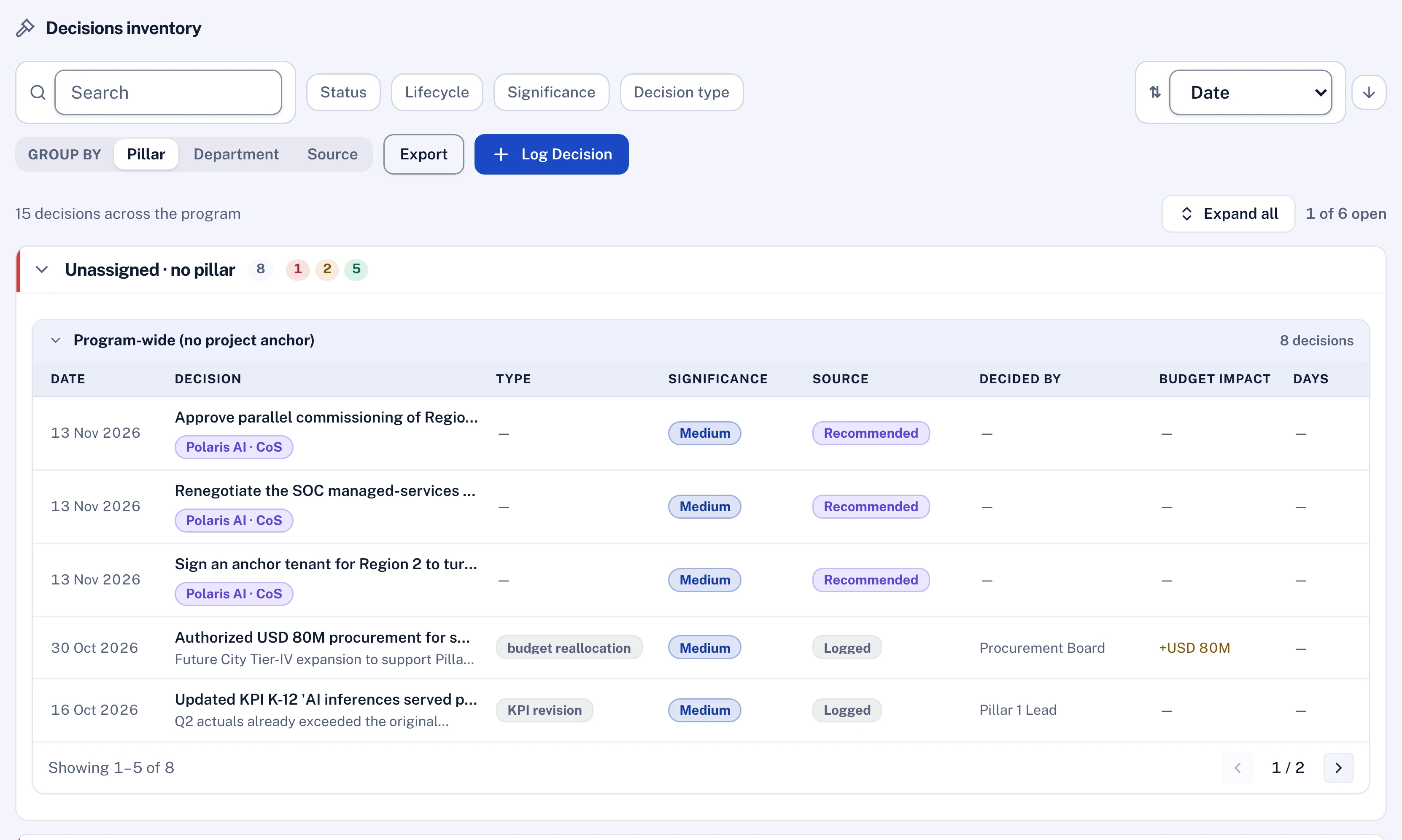
Lodestar keeps a decisions log of this kind. Each decision carries its type, such as a budget reallocation or a timeline extension, its significance, its budget impact and its timeline impact in days, and links to the project, pillar or KPIs it affects. Recommendations from Polaris follow the same path: simulated in a sandbox, approved by a person, recorded in a write-once decision log and measured weeks later.
Questions for your next review
- Which decisions did a committee take last quarter that it would have taken later, or differently, without the programme office?
- How much budget did the office's work move, and has finance confirmed each amount?
- For the last five slips we caught, how much warning did we have, and what did we do with it?
- How many hours a week do project managers spend on status and packs today, and how was that measured?
- What has the office stopped doing this year, and who noticed?
A programme office is cut when its cost is a number and its value is an impression. Write the value down as decisions, money and weeks, and the cost review has something to weigh.

Mariia leads commercial and partnerships at Lodestar. Her background is Big Tech and Big Four consulting, where she led large-scale transformations. She holds an MBA from INSEAD.
More from Mariia