In short
- Agree the decisions the office will serve before writing a single template.
- Set the approval routes before the first report, so the office sees changes before they happen.
- By day ninety, show the sponsor one decision that was taken differently because of the office.
The memo is two paragraphs long. The executive committee has approved a strategy PMO, with a director, three analysts and a sponsor who sits on the committee. Its first report is due at the end of the quarter.
The team does what new offices do. In the first month it writes a charter template, a status template and a definition of red, amber and green. In the second it builds a tracker of every initiative and asks the owners to fill it in. In week twelve the first pack reaches the committee. The sponsor thanks the team and moves to the next item. Nothing in the pack asked her to decide anything.
By the following quarter she is sending a deputy.
Setting up a strategy PMO (SPMO), which some organisations call a strategy management office (SMO), is judged on its first ninety days whether or not anyone says so. So is an enterprise PMO (EPMO) handed a strategic mandate. In my view the quarter is usually lost in the order of the work. The office builds what it controls first, and leaves until later the things that need other people: the decisions, the data and the authority.
What goes wrong
Four habits make the first quarter disappear, and each one feels like progress while it happens.
The outputs come before the decisions. Templates and trackers are quick and within the team's control. Agreeing which decisions the office will serve needs the sponsor's time and the consent of other executives. So the team starts with the part it can finish. By the time anyone asks what the office is for, the templates have answered: reporting.
The tracker is a copy. Owners already keep their plans in a schedule file, a spreadsheet or a slide. The tracker asks them to type the same facts again, for a team with no authority over them yet. It is filled in late and in part, and the office spends its second month collecting status.
Reporting runs ahead of authority. Without approval routes, the office learns about changes after they are made. A target is lowered in June. Money moves between two initiatives after a conversation in a corridor. The office can describe these changes in the pack, and was never asked before they happened. An office that only describes decisions is read as commentary.
The first pack spends the sponsor's attention. A sponsor gives a new office a quarter, perhaps two. If the first pack holds status and no choice, the sponsor files the office under reporting, and the second quarter starts from there.
The four feed one another. With no decisions to serve, the tracker grows to cover everything. With no authority, the pack can only describe. With no decision in the pack, the sponsor's attention moves on, and an office without an attentive sponsor finds its approval routes harder to set than ever.
What good looks like
The same ninety days, in a different order. Each move makes the next one easier.
Agree the decisions the office will serve
Sit with the sponsor in the first fortnight and write down the decisions the office will prepare or take: changes to KPI targets, money moved between initiatives, initiatives started or stopped, the gates a project must pass. Name the forum that takes each one and how often it meets. Ten are plenty. Every template written later should serve a line on the list. In Lodestar, each governance body is set up with its terms of reference, its decision authority, its quorum and its meeting cadence, so the list the sponsor agreed becomes the structure the meetings run on.
Load one portfolio on its real data
Choose one portfolio whose head wants the office to succeed. Load its real projects, owners, dates, budgets and KPIs, taken from the plans the owners already keep, so that nobody types a schedule twice. One portfolio the committee can trust does more for the office than a tracker that covers everything and convinces nobody. In Lodestar, Microsoft Project schedules saved as XML and Primavera P6 schedules are imported, and a later import updates the plan in place. The set-up is done with each client by a delivery lead and a solution architect, on the client's own data.
Set the approval routes before the reporting
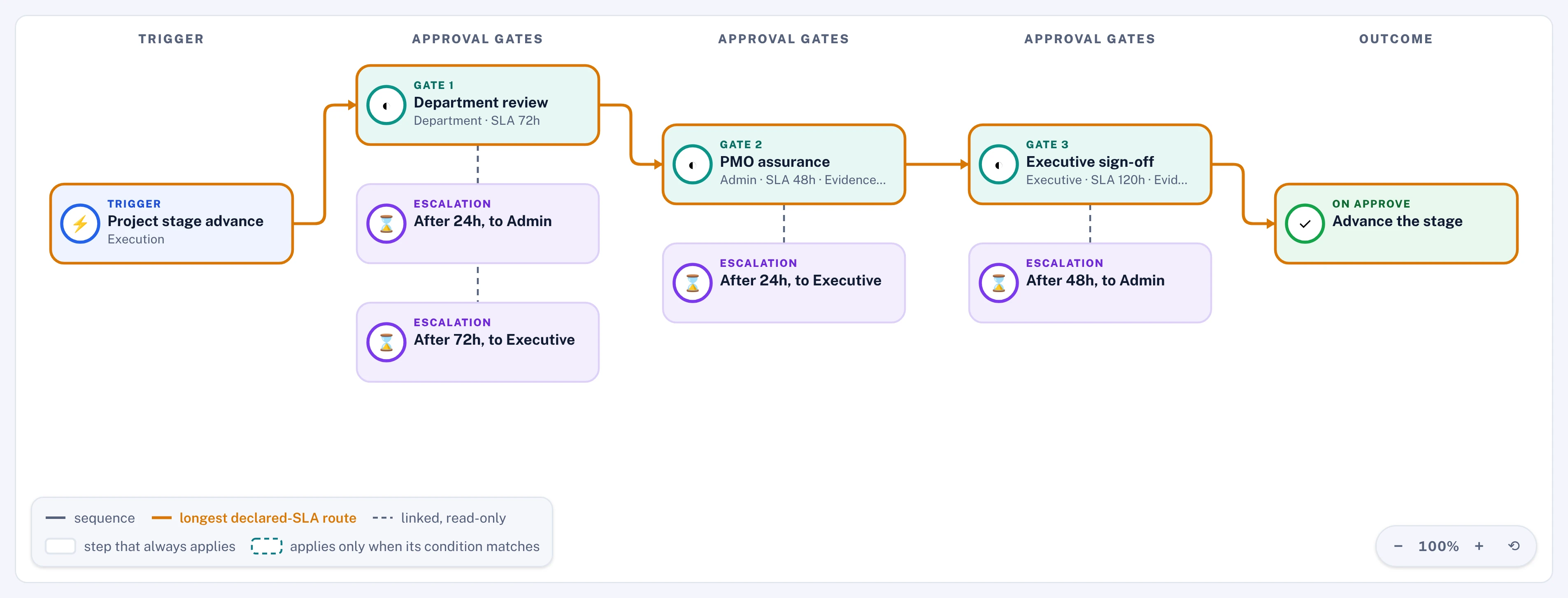
The delegation of authority usually exists already, as a document nobody opens. Turn it into routes: who approves a budget change above a set amount, who approves a change to a KPI target, who stands in when an approver is away, and for how long. Do this before the first pack, so that the changes it reports are ones the office saw approved. There is more on setting those routes in Governance is a workflow. In Lodestar, Workflow Studio sets approval routes for 23 kinds of change, budget changes and KPI targets among them, with value thresholds and time-boxed delegation that cannot be passed on. The person who raises a request can never approve it.
Run one governance rhythm
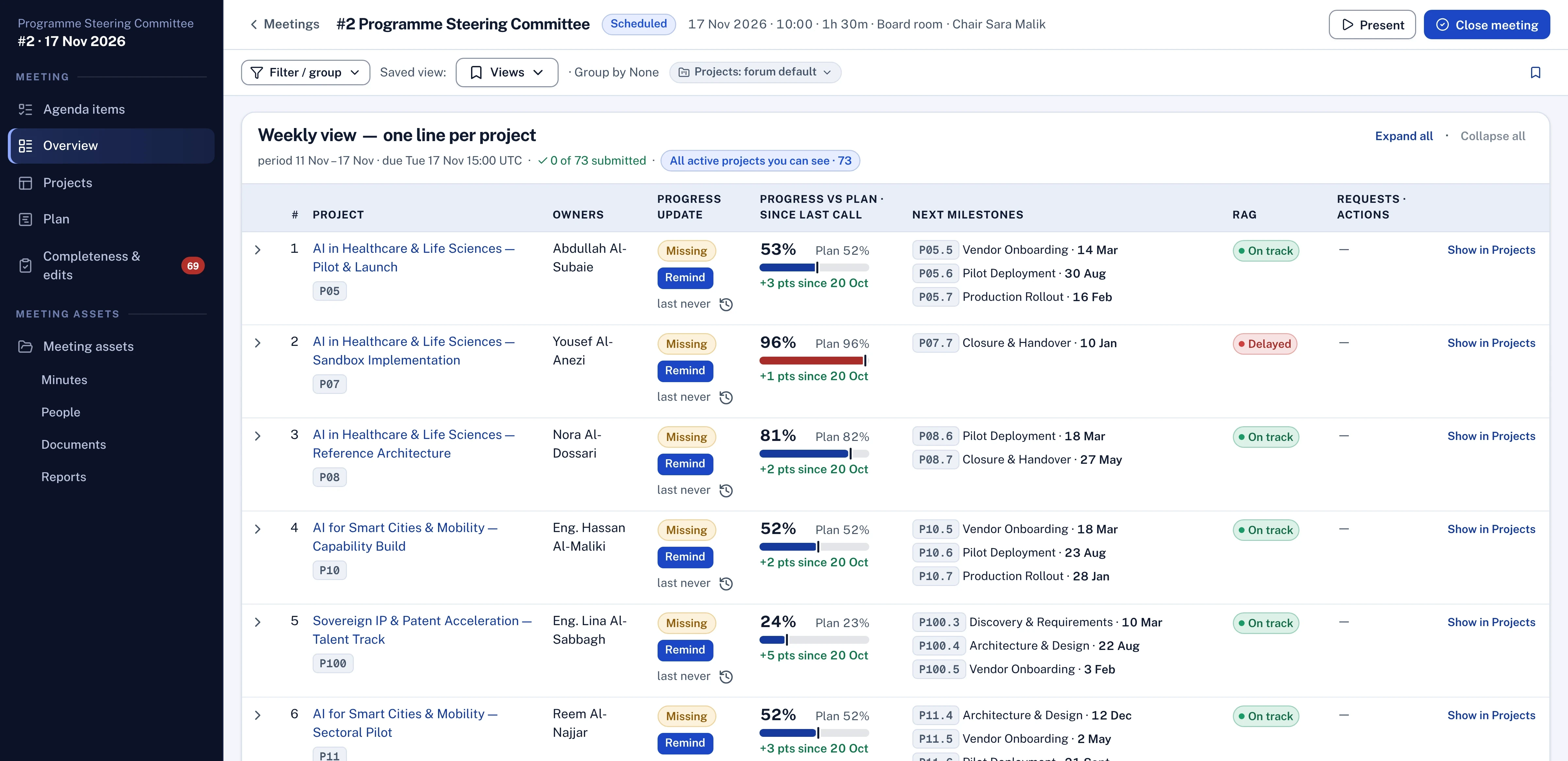
Start one forum on one cadence, usually a monthly strategy review with the sponsor in the chair. Build its agenda from the decisions owed and the exceptions: the KPIs off their forecast, the initiatives whose spend has run ahead of their progress, the requests waiting for the forum. Status for everything else is read beforehand. Record each decision as it is taken. Add a second forum only when the first is deciding things. In Lodestar, the meeting host opens each meeting on one line per project, with progress since the last meeting already worked out, and the minutes can be generated as PDF or Word when the meeting is closed.
Show the sponsor a decision the office changed
By day ninety, the office should be able to point to one decision that was taken differently because of its work: an initiative paused, money moved, a target corrected through its approval route, a gate held until the evidence arrived. Write it up on one page, with the options that were on the table and what the office showed. In Lodestar, a decision is recorded with the options considered, who decided it and the date, and the follow-up actions link back to it.
An office that only describes decisions is read as commentary.
Keep the strategy PMO's first quarter small
Some good work belongs in the second quarter.
The full methodology. A handbook written before the office has run one cycle describes an office that does not exist yet. Write the templates the first forum needs, and nothing more.
The second portfolio. Other departments will ask to join. Bring in the next one when the first has run a full cycle with its pack produced from the record.
The custom dashboard. Dashboards are easy to ask for and slow to agree. The first forum needs a short agenda and the decisions owed. The dashboard can follow what the forum actually asks.
The boundary between this office and the enterprise PMO is worth settling in the same quarter. What a strategy management office does sets out where one ends and the other begins.
Questions for your next review
- Which decisions will this office prepare or take, and which forum takes each one?
- Which portfolio could we load on its real data this month, and whose plans would it come from?
- Who approves a change to a KPI target today, and where is that approval recorded?
- What is on the agenda of the first forum, and which of its items ask for a decision?
- At day ninety, which decision will we be able to say the office changed?
A new strategy office is given one quarter to show what it is for. The offices that keep their sponsor spend it changing one decision, and build the reporting around that.

Mariia leads commercial and partnerships at Lodestar. Her background is Big Tech and Big Four consulting, where she led large-scale transformations. She holds an MBA from INSEAD.
More from Mariia