In short
- The strategy management office owns the cascade and the targets. The enterprise PMO owns delivery.
- Treat every change to a target as a decision, with an approver and a record.
- An office that only re-formats status for the board has become a reporting team.
The strategy management office is three months old. It has a director, a few analysts and an inheritance: a strategy document approved last year, a list of KPIs in a spreadsheet, and a PMO that sends a monthly report on projects.
Then the board asks its first question. Is the strategy working? The analysts open the KPI list and find that many targets have no reading this quarter. The PMO report says most projects are on track. Nobody can say which KPIs those projects were meant to move, so nobody can say whether on track means anything for the strategy.
This is the moment a strategy management office (SMO), also called an office of strategy management, is set up for. In the offices I have worked with, it is also the moment the office decides what it will become.
What goes wrong
An SMO sits between the board and the delivery side, usually an enterprise PMO (EPMO). It owns four things the PMO does not. The strategy cascade, from pillars and objectives down to initiatives. KPI management: the targets and every change to them. The portfolio's alignment to the strategy, which is strategic portfolio management in all but name. And the review rhythm in which the board decides.
Each of those is a decision right. The trouble starts because a report is the easiest thing for a new office to produce, and the board does need something next month.
So the office collects the PMO's status, adds the KPI readings, and formats both for the board. The pack improves every cycle. Meanwhile three things happen underneath it.
Targets move without a record. A KPI owner lowers a target in the spreadsheet in June, because the original was never realistic. Nobody approved it, so the board learns about it only when the year-end number looks good against a target it never agreed.
Initiatives drift from the KPIs. New projects enter the portfolio through the PMO's intake, with no link to an objective. A year later part of the budget serves no target anyone can name, and the office has no list to show it.
The review hears status and makes no choices. The business review walks through the pack. The PMO resents being reported on twice. The office's influence comes to rest on its director's relationships, and when the director moves on, so does the office.
What good looks like
Own the cascade, and treat target changes as decisions
The SMO holds the cascade from strategic KPI to team KPI, and it holds the targets. A target can change, and sometimes it should. Each change goes to a named approver, with the old value, the new value, the reason and the date kept on the record. A target that can be edited quietly is not a target.
Run the business review on what moved
The business review is where strategy execution is either steered or narrated. Build the agenda from three lists: KPIs that moved off their forecast, initiatives whose KPIs did not move despite spending, and the choices that follow. Status for everything else is read before the meeting. I wrote more about that rhythm in business reviews that change something.
Keep a link from every initiative to a KPI
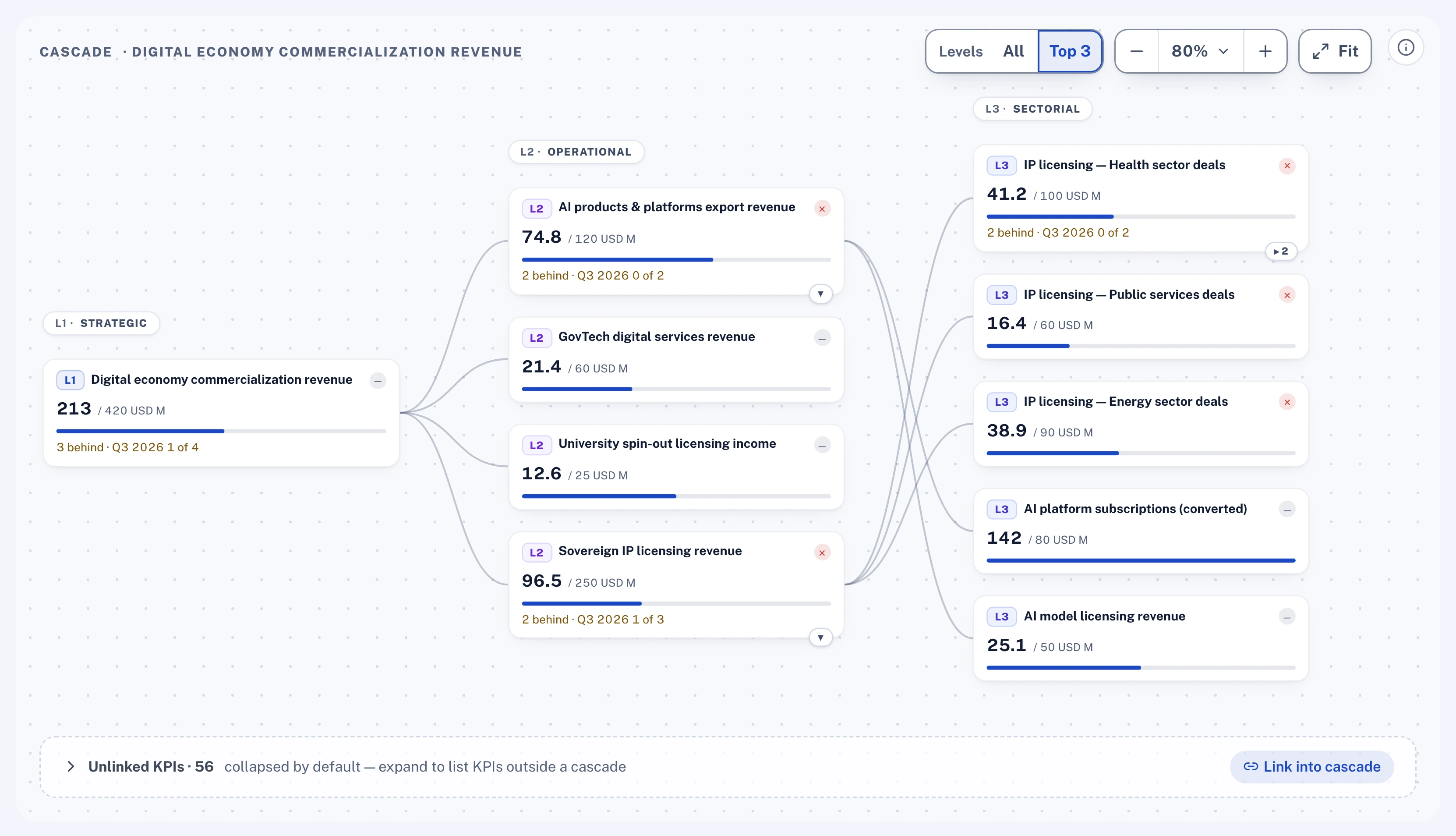
Every initiative names the KPI it is meant to move, and every KPI names the work that moves it. Each cycle, list the initiatives with no KPI and the KPIs with no initiative. The first is spending without a claim. The second is a target nobody is working on. KPI cascades that survive the first bad quarter covers how to keep those links honest.
Separate the SMO from the EPMO, on one model
The two offices answer different questions and should not merge. They should read the same project list. When the SMO keeps its own copy of the portfolio, the two offices argue about whose number is right instead of what to do about it.
| Office | The question it answers | What it produces |
|---|---|---|
| Strategy management office (SMO) | Is the strategy working, and are we funding the right things? | The cascade, approved target changes, the portfolio's alignment, the business review agenda |
| Enterprise PMO (EPMO) | Is the whole portfolio being delivered as planned? | Common standards, stage gates, portfolio roll-ups, capacity and cost across departments |
| Transformation office | Are the few cross-cutting changes landing? | Programme plans, dependencies across departments, benefits tracked to realisation |
| PMO | Is this set of projects on time, on budget and to scope? | Schedules, risk and issue logs, status reports, change requests |
Give the office its authority through the approval routes
An SMO's weight comes from where it sits in the approval routes: changes to targets, money moving between initiatives, initiatives stopped or started. When those decisions pass through a route the office runs, its view is part of the decision. When they happen in a corridor, the office reads about them in the next pack.
Lodestar is an enterprise-grade platform built for strategy management offices and enterprise PMOs to work on one model. The KPI cascade runs up to five levels and links to the initiatives and projects beneath it, changes to KPI targets travel an approval workflow, and the Polaris brief reconciles what seven AI chiefs read across the programme, for a person to decide on.
Questions for your next review
- Which KPI targets changed in the last twelve months, who approved each change, and where is that recorded?
- Which initiatives have no KPI they are meant to move, and how much budget do they hold?
- At our last business review, which decisions were taken, and how much of the time went on status?
- Where does the strategy office's work end and the PMO's begin, and do both read the same project list?
A strategy management office earns its place when the board's question can be answered from the record, without a month of preparation. The pack is a by-product of that work, and the decisions are the work itself.

Hany is a strategy and transformation executive with a technical background in software and AI. He has advised C-suites at a top-three strategy consulting firm (MBB) and independently, and has run transformation programmes of more than USD 1 billion.
Connect on LinkedIn