In short
- A few company objectives, each with an owner, give teams a direction instead of a menu.
- A key result measures a change someone outside the team would notice, never the work itself.
- Every team key result names one company key result, and every project names the key result it moves.
The OKR workshop ends at five. Each team has written three objectives and four key results, and the sheet now has eighty rows. The strategy office reads it that evening. Almost every row is sensible. Taken together, the rows describe what forty teams would like to do next quarter.
The company objectives sit on the first tab. Nobody has drawn a line from a team row to any of them. When the chief executive asks which rows move the revenue objective, the answer is an afternoon of reading.
In the programmes I have worked in, OKRs start as a way to pull everyone towards the same few results, and within two cycles they become a register of team intentions. The method survives. The pull goes.
What goes wrong
OKRs lose their pull through four small slips. Each one is reasonable on the day it happens.
Too many company objectives. When every executive needs a priority on the list, the company ends up with twelve objectives. Twelve objectives give a team permission to work on almost anything, because something on the list will fit.
Key results that count activity. "Launch the new portal" and "run six workshops" are easy to write and easy to score. They measure whether the team did what it planned. They say nothing about whether customers, costs or service changed. A team can hit every one of them and leave the company where it was.
Team OKRs written from the bottom. Teams are asked for their OKRs before the company key results are settled, or they see them and write their own anyway. The link to the company is added afterwards, as a label, and the label is chosen to fit what the team had already planned.
Work that is linked to nothing. Projects and initiatives live in one tracker and OKRs in another. Delivery is reported in one meeting and results in a different one, and nobody can say which projects are meant to move which key result. When a key result stalls, there is no list of work to look at.
Put those together and the company has OKRs at every level and no shared direction. Each team is busy. The company key results move, or fail to move, for reasons nobody can trace.
What good looks like
Alignment in OKRs is mostly plumbing. These five moves keep it working, with or without software.
Keep the company objectives few enough to remember
The test is simple: a team lead should be able to name the company objectives without looking. Each one needs a single owner at the executive table. An objective owned by a committee is owned by nobody. If the list cannot be cut, the strategy has not been chosen yet, and no amount of OKR writing below it will choose it.
Write key results as changes someone outside the team would notice
A key result describes a change in the world: permit decisions in ten days instead of thirty, fewer unplanned outages, a customer rating above four. The work that gets there belongs one level down, as a key initiative. When a draft key result starts with "launch", "deliver" or "implement", move it to the initiative list and ask what it is meant to change.
Cascade by asking, then check by tracing
Publish the company key results first. Ask each team which of them it can move, and by how much, and let the team propose its own key results in answer. Then trace every team key result to one company key result, by name. A team key result that cannot name one is either a sign that the company list is missing something, or a team wish. Both are worth knowing. The first is a decision for the executive table.
Link the work to the key result it should move
Every key initiative and every project should state the key result it exists to move. This is the link that makes OKRs useful in a review. When a key result stalls, the committee opens the list of work behind it and asks whether that work is late, finished without effect, or too small for the result. Work that moves no key result is not always wrong, because some of it keeps the business running. It should be visible as such, and measured by its own KPIs.
Score the key results against a plan for each period
A key result with only a year-end target reads as uncertain all year and is settled in December. Phase it: where should the number be at the end of each quarter, given how the work is planned? Then the April review knows whether April is on course, and a score means the same thing in every team.
An objective owned by a committee is owned by nobody.
Expect the alignment to loosen
Three habits creep back by the second cycle. None of them needs a culprit; each shows up in the links.
Links chosen to fit. A team picks the company key result that best matches what it was going to do anyway. At each review, ask how much of the company key result each team expects to move, and check that the contributions add up to the target.
Key results reworded mid-cycle. A key result that is going badly gets reworded until it reads well. Keep the original wording on record, and treat a change as a decision with a reason and an approver.
Orphans. New team OKRs and new projects appear between cycles with no link. List them every month and either link them or close them.
Give the hierarchy the names your organisation uses
OKRs hold best when they sit in the same structure as the plan, so that the link from a project to a key result is a field kept with the plan, where anyone can follow it. That structure should speak the organisation's own language. A ministry may talk about pillars and initiatives, a company about themes and objectives, and both are pursuing the same discipline.
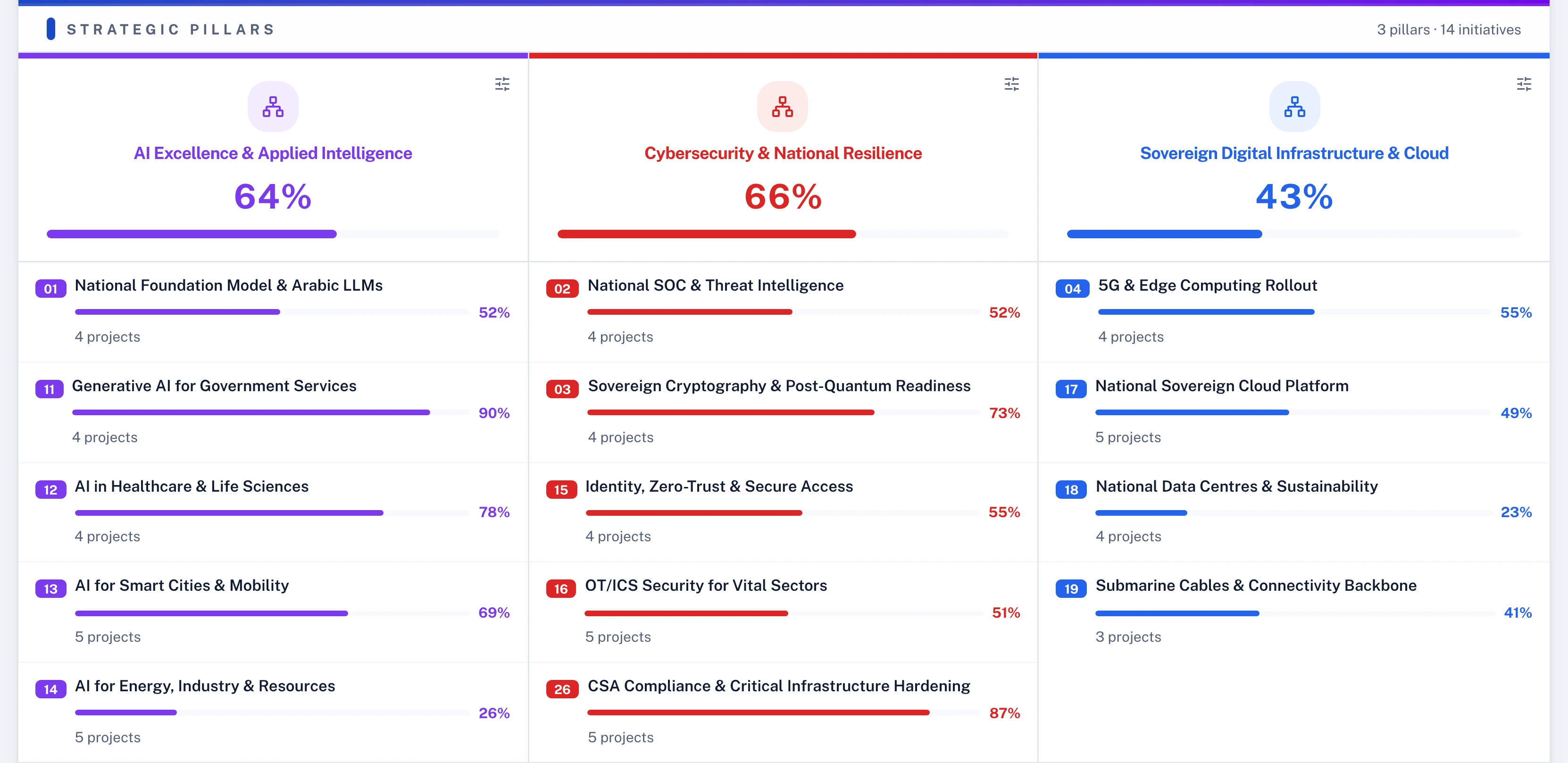
In Lodestar an administrator chooses the structure of the strategy. One starting point is OKR: themes, then objectives, then key initiatives, then projects. The key results sit on each objective, and the objective's page shows their attainment beside its delivery progress. An organisation that prefers pillars, portfolios or value streams names its own levels, up to four strategy levels deep, and the screens and reports use its words.
Why a plan stalls when that link is missing is the subject of why strategy stalls, and what the strategy and KPI model holds is on its own page.
Questions for your next review
- Can each member of the executive team name the company objectives without looking, and who owns each one?
- Which of our key results measure a change outside the team, and which measure work we planned to do?
- For every team key result, which company key result does it move, and by how much?
- Which key initiatives and projects are linked to no key result, and what measures them instead?
- Where should each company key result be at the end of this quarter?
OKRs pull an organisation one way only while every line from a team to the company can be traced. Draw the lines before the quarter starts and keep them current, and the review can spend its time on the results instead of on the list.

Hany is a strategy and transformation executive with a technical background in software and AI. He has advised C-suites at a top-three strategy consulting firm (MBB) and independently, and has run transformation programmes of more than USD 1 billion.
Connect on LinkedIn