In short
- The link between a pillar and a project decays when it lives in a separate document.
- Every project should name its initiative, its pillar and the KPI it is expected to move.
- Work with no link to the strategy belongs on a list that someone reviews.
The quarterly strategy review, nine months after the board approved the strategy. One slide lists the sixty projects under way. A board member points at a data platform project and asks which pillar it serves. The strategy office says the second. The sponsor says the fourth. The project manager, asked afterwards, says the project started before the strategy did and nobody has told him it has a pillar.
Nobody in that room is careless. The strategy document is clear and the project plan is thorough. What is missing is the line between the two.
I have watched this in government and in companies. The strategy is sound, the work is busy, and the two stopped referring to each other some months ago.
What goes wrong
A strategy reaches the work through three translations.
Strategy into initiatives. Done at an offsite, in a slide deck. Each pillar gets a handful of initiatives and each initiative gets a sponsor.
Initiatives into projects. Done by the PMO a few weeks later, in a spreadsheet with a mapping tab. Projects that already exist are fitted under the new initiatives, and some fit better than others.
Projects into weekly work. Done by each team, in a scheduling tool or on a task board. The milestones and tasks mention neither the pillar nor the KPI.
Each translation is done once, by hand, by different people, in a different tool. None of them is maintained. Then the work changes, as it should. A project is rescoped. A new one starts because a minister or a chief executive asked for it. The mapping tab still shows the picture from the offsite.
Within months three things are true. Nobody can say with confidence which pillar a project serves. A KPI moves, or fails to move, and nobody can name the work behind it. And new work arrives with no link at all. The status report cannot show that, because it is organised by project, and an orphan looks like any other row.
The board pack still opens with the pillars. The pages behind it are a list of projects. The reader is left to assume the two are connected.
What good looks like
The fix is structural, and most of it can start in a workshop with the tools you already have.
Keep one model, from pillar to task
Hold the pillars, initiatives, projects and milestones in one structure, with each item pointing to its parent. If the strategy lives in a deck and the projects in a schedule, the link between them is a document, and a document goes stale at the speed the work changes. Make the link a field on the project, kept by the person who owns the project.
Make every project name what it serves
Before a project gets a budget, it states three things: the initiative it belongs to, the pillar above that, and the KPI it is expected to move. A project that cannot answer has told you something useful. Either the strategy has a gap, or the project is not strategic and should be funded and reviewed as something else.
Put orphaned work on a list
Keep three lists and review them: projects with no initiative, KPIs with no work behind them, and initiatives with no projects. Some orphans are legitimate. A regulatory obligation may serve no pillar and still has to be done. Write that down as a decision. The rest is work the strategy did not ask for, or a promise the strategy made that nobody is working on.
Ask the strategy question on a fixed rhythm
Most reviews ask whether each project is on time. Add a review, once a quarter at least, that goes pillar by pillar and asks whether this work is still moving the strategy. Put each KPI next to the projects meant to move it. When every project under a KPI is green and the KPI has not moved, the review has found its agenda.
Record each decision with an owner
A review that changes nothing was a presentation. Each decision gets an owner, a date, and the item in the plan it changes: stop this project, move this one to another initiative, restate this target. Next quarter's review starts by reading that list.
Expect the links to decay again
A mapping exercise fixes the picture for a quarter. Then the same forces return, and three habits are worth looking for from the start.
The convenient pillar. Asked to name a pillar, every project names one. A catch-all initiative appears, called something like "enablers" or "operational excellence", and it fills up. A simple test: if stopping the project would change no forecast under that pillar, the link is decoration.
The KPI named to complete the form. A project claims a KPI it cannot move in its lifetime, or one that ten other projects also claim. Ask each project by how much it expects to move the KPI, and by when. A link with no expected contribution is a label.
The link that outlives the scope. A project is cut back to half its original scope and keeps its pillar, its KPI and its place on the strategy slide. Re-check the link whenever a change request alters scope.
Keep the link where the work is updated
A link that someone has to remember to maintain will be maintained by the careful teams, until the next reorganisation. It holds when it is part of the record the team updates every week.
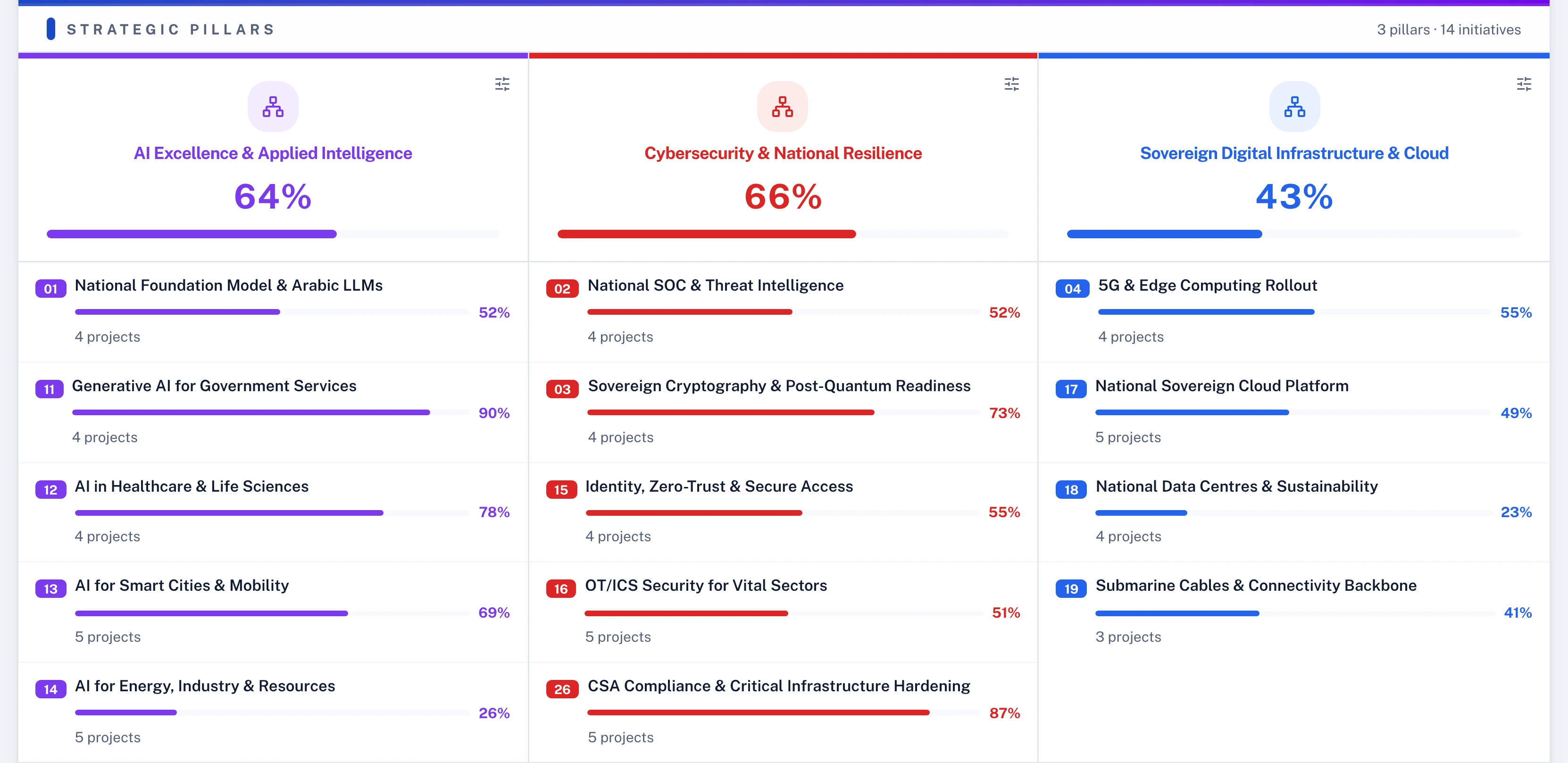
That is the idea Lodestar is built on. Pillars, initiatives, projects, milestones and tasks sit in one model, so a task's path to its pillar is the structure itself, and progress rolls up through every level. Projects with no initiative and KPIs with no link are listed as their own groups, where the review can see them.
The KPI side of this is covered in KPI cascades that hold, and the review itself in portfolio reviews that decide.
Questions for your next review
- For the ten largest projects by budget, which initiative, pillar and KPI does each one serve, and where is that written down?
- Which projects under way belong to no initiative, and who decided they should continue?
- Which strategic KPIs have no project behind them this year?
- When did we last stop, move or re-link a project because of the strategy, and who owned that decision?
A strategy stalls in the three places where it is handed from one document to the next. Keep those links in one model, with an owner for each, and the review can spend its hour on the strategy.

Hany is a strategy and transformation executive with a technical background in software and AI. He has advised C-suites at a top-three strategy consulting firm (MBB) and independently, and has run transformation programmes of more than USD 1 billion.
Connect on LinkedIn