In short
- The PMO asks whether the work is delivered as agreed; the transformation office asks whether the value is coming.
- Write the transformation office's mandate as decision rights, or it becomes a second reporting layer.
- Both offices read one record, so owners report once and the numbers agree.
The chief executive announces the transformation in January and sets up a transformation office to run it, reporting directly to the top. The enterprise PMO has run the project portfolio for years. Its head asks the obvious question at the first joint meeting: what will the new office do that we do not?
Nobody answers it properly, and by June both offices hold a weekly review of the same forty projects. Project managers report twice, in two templates. The transformation office's slide shows the programme amber. The PMO's dashboard shows most of the same projects green. The steering committee spends its first twenty minutes on which number to believe.
Both offices are working hard. They were never told which questions belong to each.
What goes wrong
A transformation office, sometimes called a transformation management office or TMO, is set up to steer a change across the organisation over several years. A PMO, or project management office, sets how projects are run and assures their delivery. On paper the difference is clear. In practice the transformation office is often built as a bigger, more senior PMO, and the trouble follows from that.
It copies the PMO's method. The new office needs to show progress quickly, and status tracking is the fastest thing to stand up. So it asks owners for percentages and colours, the same facts the PMO already collects, and builds its own tracker. Within a quarter there are two records of the same work.
Its mandate is a sentence, not a set of rights. "Drive the transformation" gives the office no specific authority. It cannot stop a project, move a budget or change a sequence without going to the chief executive each time. So it reports, persuades and escalates, and becomes a reporting layer with a senior sponsor.
The value case belongs to nobody. The PMO tracks delivery against plan, which is its job. The transformation office was meant to track whether the value is coming, but its value case lives in the business-case slide from the launch. Nobody links each initiative to a number finance already reports, so the question the sponsor cares most about has no answer.
Nobody planned the end. A transformation office is temporary by design. Without a written hand-over it either dissolves and takes its knowledge with it, or quietly becomes permanent: a second PMO with a bigger title.
Give each office its own question
The two offices look at the same projects and ask different things of them. Writing the difference down is most of the fix.
| PMO | Transformation office | |
|---|---|---|
| Main question | Is approved work delivered as agreed? | Is the value coming, and what should change? |
| Reports to | Usually a chief operating officer or a portfolio board | Usually the chief executive or the transformation sponsor |
| Owns | Methods, gates, the change route, delivery reporting | The value case, the sequence of change, start and stop decisions |
| Measured by | Delivery against plan, slips caught early | Benefits realised against the case |
| Lifespan | Permanent | Temporary, with a planned hand-over |
What good looks like
Five moves, whichever tool either office uses.
Write the mandate as decision rights
List the decisions the transformation office takes on its own, the ones it recommends to the sponsor, and the ones that stay with the PMO or the line. For example: it may re-sequence initiatives within the approved envelope, stop an initiative that fails its value gate, and move budget between initiatives up to a set amount. The PMO keeps the gates and the change route for delivery. Written this way, the operating model is a table of rights that both offices can point to.
Split the reviews by question, not by project
The PMO's weekly review looks at delivery: what slipped, what is blocked, which change requests are waiting. The transformation office's monthly forum looks at value and sequence: which initiatives are on track to deliver their benefit, which should be accelerated, held or stopped. Owners attend the PMO's review. The transformation forum takes the decisions.
Run both offices from one record
Owners should update their work once, in one model that both offices read. The PMO reads delivery from it; the transformation office reads value, with each initiative linked to the benefit and KPI it is meant to move. When both offices quote the same number, the steering committee can spend its time on the decision rather than the reconciliation.
Log every decision with its outcome
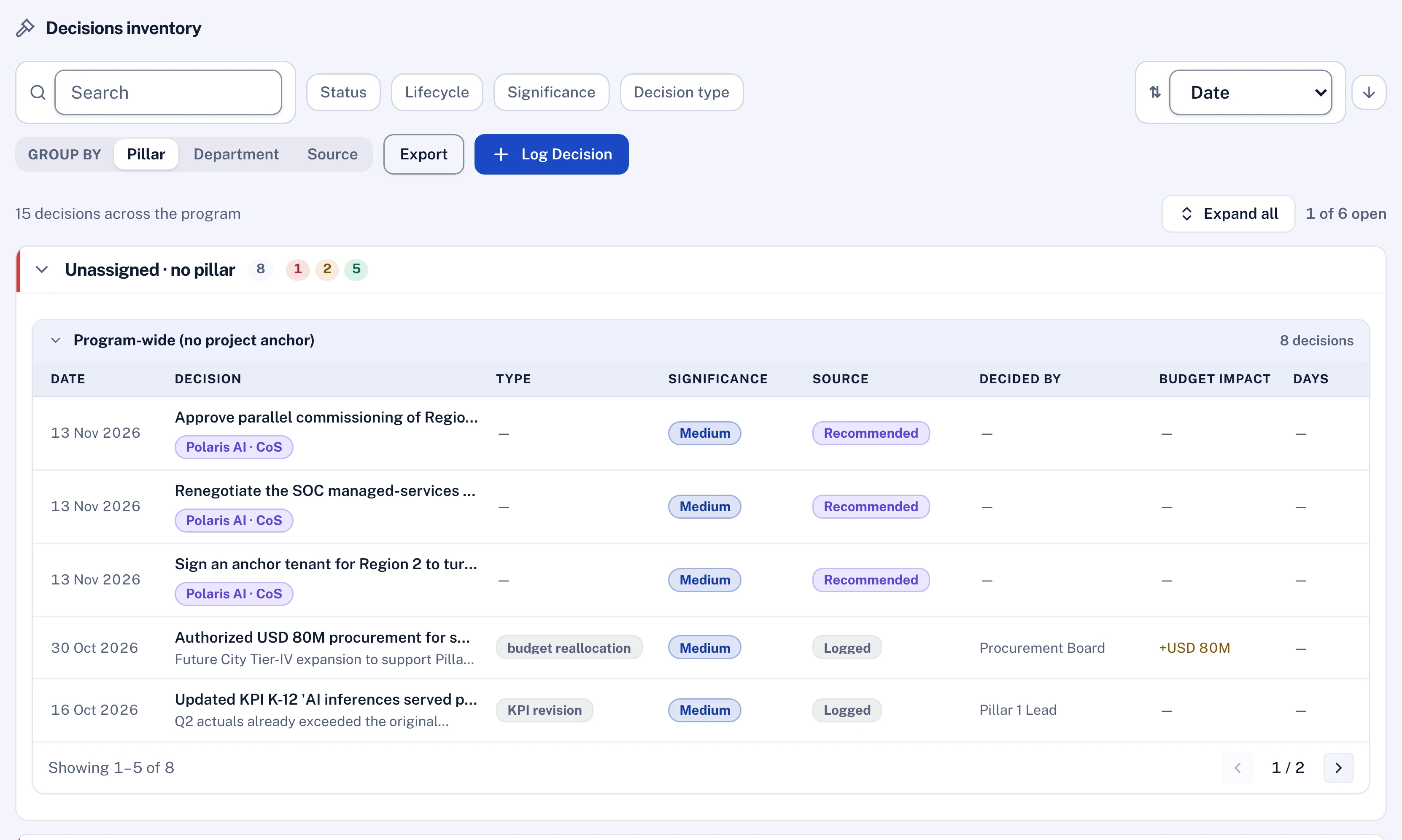
The transformation office's value lies in its decisions, so keep them as records: what was proposed, who decided, when, and what changed as a result. A decision deferred should name the meeting it goes to. A decision taken should be locked, so the record shows what was agreed at the time. In Lodestar, a decision recorded in a governance forum moves from Proposed to Approved, Rejected or Deferred, with who decided and the date stamped; a deferral goes to a named later meeting, and the decision's content locks once its outcome is settled. Both offices read the same model: an owner updates once, and the same figures roll up to the PMO's delivery view and the transformation office's value view, with no double data entry.
Write the hand-over at the start
Decide on day one what the transformation office will hand over when it closes. Each benefit goes to a named owner in the line, who keeps measuring it. The rules and routes it introduced go to the PMO. The record, with its decisions, stays where it is. A transformation office that plans its own end leaves the organisation better run; one that does not leaves either a gap or a second PMO. The software side of this is covered in transformation office software, and the first question to settle for any office is in what a project management office is for.
Questions for your next review
- Which decisions can our transformation office take on its own, and where is that written down?
- Do project owners report the same facts to more than one office?
- For each initiative, which benefit should it move, and who will own that benefit after the transformation office closes?
- When the two offices quote different numbers for the same project, which one is the record?
A PMO and a transformation office can sit side by side for years without friction when each knows its question. The friction comes from two offices asking the same question of two different records.
Short answers
What is the difference between a transformation office and a PMO?
A PMO assures that approved work is delivered as agreed: methods, gates, the change route and delivery reporting. A transformation office owns the value case of a multi-year change and decides what changes, in what order, and what stops. The PMO is usually permanent; the transformation office is usually temporary.
What is a transformation management office (TMO)?
A transformation management office, or TMO, is the team that steers an organisation-wide change for its sponsor, usually the chief executive. It holds the value case, sequences the initiatives, takes start and stop decisions within an agreed mandate, and hands its benefits and rules to the line when it closes.
Can a PMO and a transformation office share one system?
Yes, and they should. When both read one record, owners update once, the PMO reads delivery and the transformation office reads value from the same data. In Lodestar both offices work from one model, and decisions recorded in a governance forum keep who decided and when.

Hany is a strategy and transformation executive with a technical background in software and AI. He has advised C-suites at a top-three strategy consulting firm (MBB) and independently, and has run transformation programmes of more than USD 1 billion.
Connect on LinkedIn