In short
- Hold the value case as a live chain from target to initiative, not a model approved once.
- A gate that never asks about value lets the business case go stale in plain sight.
- Count a benefit when a KPI the business already reports shows it, after go-live.
The transformation office is eighteen months into a four-year programme. Every Monday it sends out the tracker: a spreadsheet of initiatives, owners, milestones and a RAG column. Every month it turns the tracker into a forty-slide deck for the steering committee.
At the latest committee the chief financial officer asks a different question. The programme was approved on a value case with a number on it. How much of that number is on its way, and how much has already arrived? The office can say that most milestones are green. It cannot say what they add up to.
In the programmes I have worked in, this is the moment a transformation office finds out what it has been running. It has been running a record of activity. The value case was approved once and has not been opened since.
What goes wrong in a transformation office
A transformation office, sometimes called a transformation PMO, is set up to steer a change that crosses departments and runs for years. It is given authority over money and priorities, and the tools of a project office. Even when it buys transformation office software, it often sets it up as a better tracker, because a tracker is what the organisation already knows how to feed. Four things then come apart underneath it.
The value case lives outside the plan. The business case was a spreadsheet model, approved by the board, with a target for each lever. The plan was built separately, initiative by initiative. Nothing ties an initiative to the share of the target it was funded to deliver, so when an initiative slips or loses scope, the target does not move. A year on, the office reports the value case it was approved with, while the work beneath it has changed.
Gates check readiness and never value. Initiatives pass through stage gates that ask whether the plan, the team and the budget are ready. Few gates ask whether the benefit still holds. An initiative whose case has weakened passes every gate on time.
Benefits are counted at go-live. The tracker marks a benefit as delivered when the system goes live, because go-live is the last date in the tracker. The benefit itself arrives later, if at all, after the project team has gone. Nobody measures it, so the value on the deck is a sum of go-lives.
The change load is invisible. Each initiative is approved on its own case. The same finance team, the same operations managers and the same few experts are named in several of them. Each plan is feasible alone. Together they are not, and the slip surfaces months later as change fatigue.
Put these together and the office reports activity accurately and value hardly at all. The steering committee releases the next tranche on a picture of effort.
What transformation office software must run
The practices come first. An office can start each move below with what it has, then ask its transformation management software to hold it, so it does not depend on one analyst's spreadsheet.
Hold the value case as a chain from target to initiative
Break the headline target into its levers, and assign each lever to the initiatives that deliver it, with the share each one carries. Every initiative names the KPI that will show its part. When an initiative loses scope, the gap in the target is visible that week, and the steering committee decides whether to fill it or restate the target. A value case that cannot be traced to the work is a forecast nobody owns.
In Lodestar, an administrator sets the levels of the strategy from a preset, or names up to four levels in the organisation's own words, and every initiative and project sits in that one tree. A KPI cascade of up to five levels runs beside it, and a KPI that is not linked to a pillar is shown as unlinked.
Put the value question on every gate
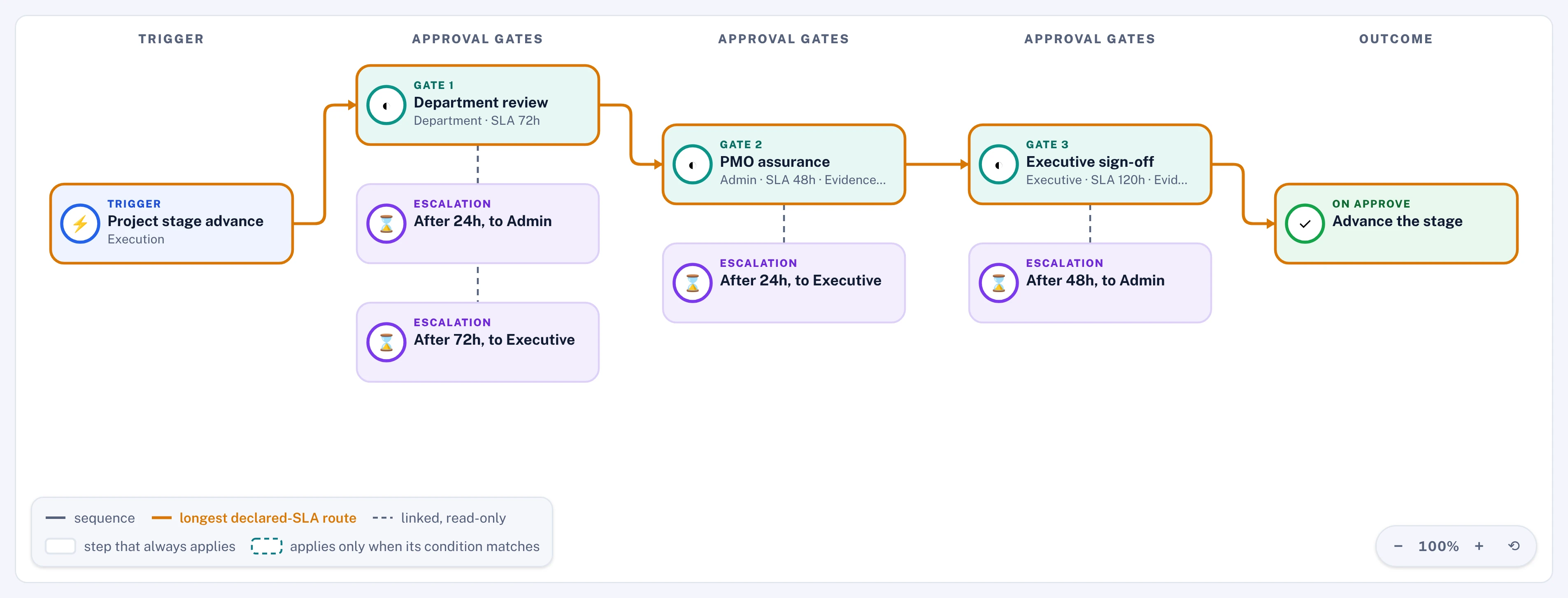
Each gate on an initiative, and on the projects inside it, should ask about value as well as readiness: does the benefit still hold, and who says so? Write the benefits into the charter at the gate into delivery, each with an owner outside the project, a baseline and a target date. A gate that never asks about value lets the business case go stale in plain sight.
In Lodestar, a project moves through lifecycle stages the organisation configures, and advancing a stage can require a gate approval, required forms and completed milestones. Benefits written into an approved charter arrive in the project's benefits register, with the charter recorded as their source.
Count a benefit when a KPI shows it, after go-live
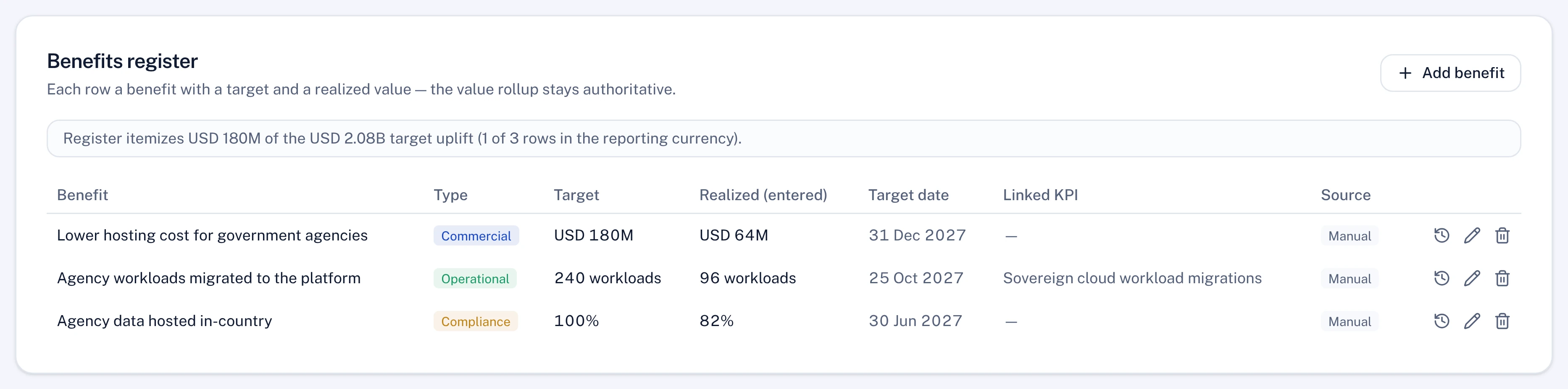
Go-live is the date a capability exists. The benefit is a change in a number the business already reports: cost per transaction, days to issue a permit, revenue per customer. Link each benefit to that KPI, keep measuring after the project closes, and count a benefit as realised only when a review, approved by someone other than its owner, has accepted the reading. I set out who should own that measurement in Delivered, and no benefit.
In Lodestar, each benefit carries a target, a realised value, a target date and the KPI that evidences it, and value tracking sets planned against realised. Values accepted through a governed benefits review are kept period by period, and a later review supersedes them without editing them.
Plan the change load against the people who carry it
Lay every initiative's demand on one calendar, by team and by month, before the next one is approved. Count the day job first. Name the people who sit on more than one critical path, because a transformation slips at the experts it shares. When the load is more than a team can carry, the order of the work becomes a decision for the committee, recorded like any other.
In Lodestar, capacity shows as a heatmap by team and month, unstaffed demand is listed by role, and people who are a single point of failure on the critical path are flagged.
Record each decision against what it changed
A transformation is steered by decisions: a tranche released, an initiative stopped, a target restated, a sequence changed. Record each one with its owner and date, and link it to the initiative or pillar it affects. A year on, the value case should explain itself through those decisions, and each committee should start from the ones still open.
In Lodestar, the decisions log holds decisions minuted in governance meetings, decisions logged by hand and priority moves recommended by the Polaris chiefs, and each can be linked to the project, initiative or pillar it affects. The Polaris Chief of Staff reconciles the chiefs' readings into one brief, and a person decides what is acted on.
A value case that cannot be traced to the work is a forecast nobody owns.
Questions for your next review
- Which initiatives carry which share of the value target, and where is that written down?
- At the last three gates, what was asked about the benefit, and who answered?
- Which benefits reported as delivered are backed by a KPI reading taken after go-live?
- Which teams and named experts appear in more than two active initiatives this quarter?
- Which decisions changed the value case this year, and who took them?
A transformation office earns its mandate by keeping the value case true while the plan changes beneath it. Activity is what it reports along the way, and value is what it was set up to steer.

Hany is a strategy and transformation executive with a technical background in software and AI. He has advised C-suites at a top-three strategy consulting firm (MBB) and independently, and has run transformation programmes of more than USD 1 billion.
Connect on LinkedIn