In short
- Framed as a control tower, the office is read as policing and the executives route around it.
- Let owners present their own work; the office orchestrates the forum and the record.
- Let the record surface issues, so the head of the office is never the messenger.
The new head of the transformation office sends me the draft of the mandate slide. It describes the office as "the control tower for post-merger integration, enterprise programmes and strategic transformation". It says the office "reports portfolio status to a CEO-chaired executive forum". Every word is accurate.
On our call, the head is frank about the ground it will land on. "Neither I nor the organisation has deep experience with this function," they say, "and the other executives will not embrace it automatically." There is no regular executive cadence today, and the discussions that do happen rarely include real challenge. In their words, it is a culture where executives agree in meetings and then go their own way.
The slide is right about what the office will do. It is wrong about how the executives will read it.
What goes wrong
A transformation office is usually announced the way it is designed: from the centre, as a function that watches the portfolio. That framing is natural for the people who build it, and it sets up four failures.
It is read as one more tracker. The biggest risk to a new office is being read, in a phrase I hear from executives, as "yet another tracker I have to fill in". Once that reading sets, updates arrive late and thin, and the office spends its first year chasing them.
The head of the office becomes the messenger. When issues reach the chief executive through the office's weekly risk note, every bad news item carries the head's name. Executives who guard their lanes take it personally, and the head learns to soften the note. Within months the office reports what is safe to report.
The programmes float free of the strategy. When nothing ties each programme to a strategic pillar, the office is read by what it is busy with first. An office launched during an integration is seen as the integration office, and its mandate shrinks to match. Integration should be the first programme on the portfolio, not the office's identity.
The launch is an email. A mandate that arrives as a memo is read once and filed. Nobody has agreed to anything, so nobody feels bound by it.
What good looks like
The same office can be launched as something executives want to be part of. Five moves, all of them about framing and structure rather than software.
Make it the executives' forum, and let them present
Flip the slide. The executives own delivery and present their own work. The office orchestrates: it prepares the forum, keeps the record and follows up. It becomes the place where leaders show the chief executive how they work together toward one strategy, which changes the incentive from reporting to showcasing. When all the owners sit in front of the chief executive together, the dependencies between their programmes come out in the room, without one person having to raise the alarm alone.
| Words that sink the launch | Words that work |
|---|---|
| Tracker, reporting, status chasing | A forum where we work as one team toward one strategy |
| The office polices the executives | Executives own delivery; the office orchestrates |
| A risk flagged by the office | A dependency surfaced by the team, together |
| One more tool to fill in | One portfolio view that saves your team's time |
Give the forum teeth
A forum to shine still needs rules. Three are enough: a one-page charter issued by the chief executive, a charter for each programme with one accountable executive named on it, and a fixed cadence that does not move when diaries get busy. A signed programme charter with a named owner prevents the most common stall, where everyone agrees the scope and each person understood something different.
Draw the golden thread, with one owner and one forum per level
Every programme, plan and piece of work should trace back to a strategic pillar. Give each level one owner and one forum: the pillar to the executive forum, the initiative to its accountable executive, the projects to a director-level forum, the tasks to their teams. Updates then roll up from the plans, and nobody rebuilds status slides for the chief executive. The director-level forum matters more than it looks: issues are resolved and aligned there, before they reach the top.
Let the record surface issues, so nobody is the messenger
Escalate in the forum, not by note, and bring options with every issue. When slips and stale updates show in the shared record, the record is the messenger, not the head of the office. One courtesy keeps it fair: an owner should see an item about their work before it reaches the forum. And keep two measures apart that are often merged: a plan can be on time and still incomplete, so check plan integrity as well as action status.
Launch with a workshop, not an email
Hold a one-to-one with each executive first, to hear what they need from the forum and to secure their support before the room. Then run an executive workshop that confirms the pillars, the initiative owners and the cadence together, so the mandate confirms what they helped shape. Close with a session where each executive names a champion in their function, who will carry the updates to the director-level forum. For the first hundred days, promise a short list the chief executive can check: one consolidated portfolio view, signed charters for the priority programmes, the first executive forum held, and the first cross-programme dependency surfaced and resolved. Agree any financial baseline with finance before promising a figure.
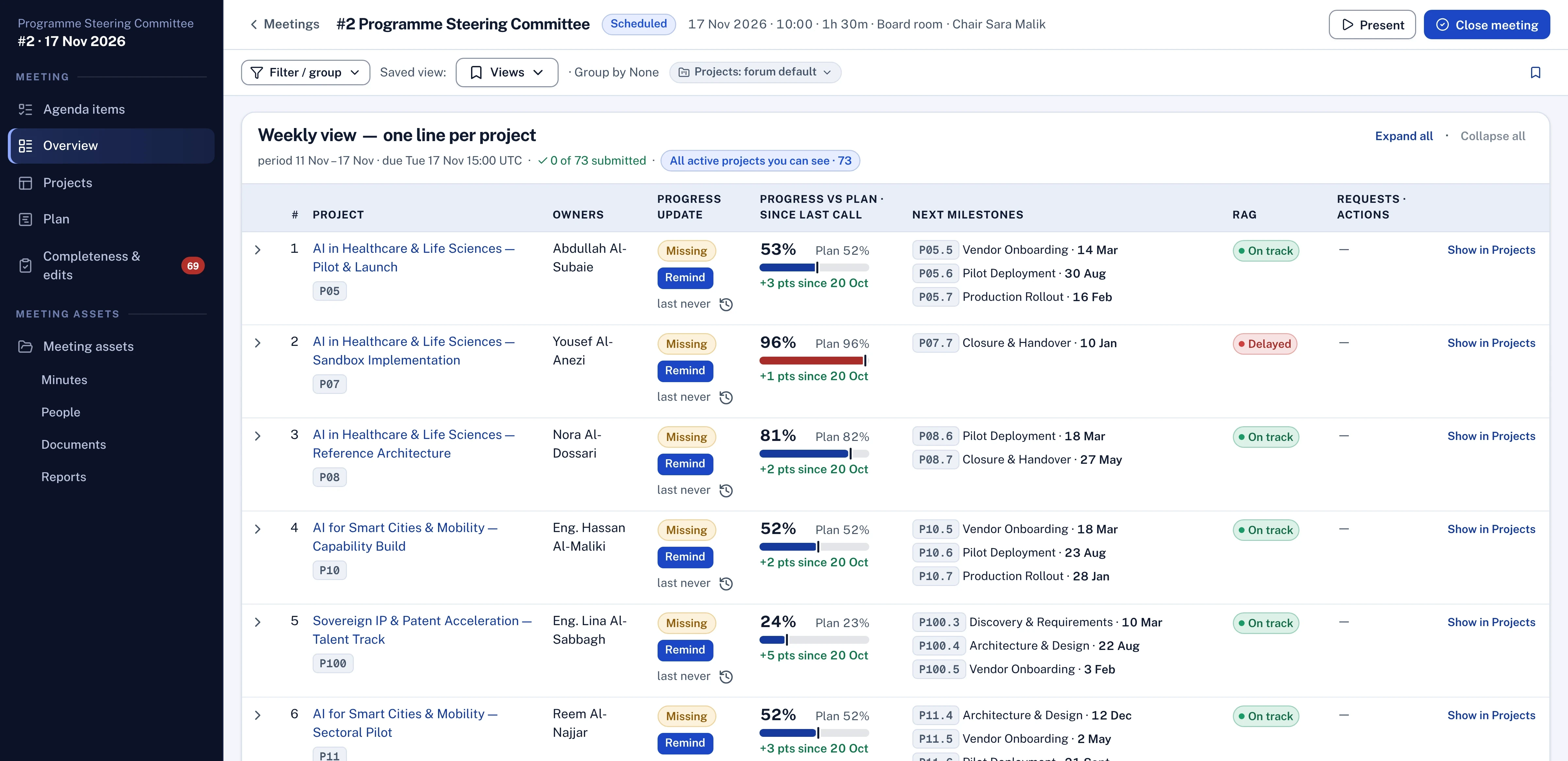
In Lodestar, governance forums and their meetings sit in the same record as the plans. The chair opens a meeting on one line per project, with the owner, whether the update is in and progress since the last call, and decisions are recorded with who decided and when. A minutes agent drafts the minutes from the meeting transcript for a reviewer to approve. Every level works from that one record: a task owner updates once, and the same information rolls up through project, initiative and pillar to the director forum, the executive forum and the chief executive, so nobody keys the same update twice.
Questions for your next review
- Does our transformation office's mandate read as a forum the executives own, or as a tower that watches them?
- Does every programme trace to a strategic pillar, with one accountable executive named on its charter?
- When a programme slips, who carries the news to the chief executive: the record, or a person?
- What will the chief executive be able to check at the end of the office's first hundred days?
A transformation office is judged by whether the executives choose to use it. Launch it as their forum, give it rules that hold, and the reporting follows.

Hany is a strategy and transformation executive with a technical background in software and AI. He has advised C-suites at a top-three strategy consulting firm (MBB) and independently, and has run transformation programmes of more than USD 1 billion.
Connect on LinkedIn