In short
- A cascade copied from a tool's default hierarchy asks the organisation to reorganise for its software.
- Write down how each level rolls up: equal, by budget, by effort or by agreed weights.
- Cascade a key result only where a team owns a real lever on it; elsewhere, align.
The evaluation team likes the OKR tool. Then the configuration workshop begins, and the tool's hierarchy appears on the screen: company, team, individual. The organisation's own structure is a vision, four strategic pillars, objectives under each, programmes, and the projects that deliver them. Its people talk about pillars in one language and programmes in another.
The choice on the table is uncomfortable. Either the organisation reshapes its strategy to fit three levels and learns new words for familiar things, or it keeps its own structure in a spreadsheet beside the tool and reconciles the two every quarter.
Neither was in the business case.
What goes wrong
An OKR cascade is the chain of objectives and key results from the top of the organisation to the teams that move them. Most of the trouble with cascades is not in the idea but in the structure chosen for it.
The tool's hierarchy replaces the organisation's. A fixed set of levels suits the organisation it was designed for. Everyone else bends: pillars become themes nobody uses, programmes disappear, and the strategy document and the OKR tool stop describing the same thing.
Every level gets its own OKRs. When the cascade is applied mechanically, each level writes objectives and key results for the level below. Five levels down, teams are writing key results to satisfy a template, and the original objective is unrecognisable.
Nobody knows how a level rolls up. Is an objective's progress the average of its initiatives? Weighted by budget? By effort? The answer changes the picture. A simple average can show a pillar on track while its largest and most expensive initiative is failing, and no one at the top can tell, because the rule was never written down.
Two vocabularies grow. When the tool's words differ from the organisation's, people translate in their heads. Reports use one set of words, meetings another, and new joiners learn both.
The structure cannot change safely. Strategies are revised. When a level is renamed, merged or removed in a tool that was never designed for it, history breaks: last year's progress no longer adds up to anything.
What good looks like
A cascade should describe how the organisation already decides, in its own words, with rules that anyone can read. Five moves.
Choose the number of levels from the decisions you take
Each level should exist because someone decides something at it: the board sets themes, the executive committee owns objectives, programme boards fund key initiatives, project teams deliver. Two to four strategy levels above the work is usually enough. A level nobody decides anything at is a reporting layer.
Name the levels in your own words, in every language you work in
If the organisation says pillars, use pillars; if it reports in two languages, name each level in both. The concepts of OKRs survive any vocabulary. A key result can be called a KPI, a target or a key result, as long as everyone means the same thing by it.
Write down how each level rolls up
For each level, decide and record how its children add up: every child equal, weighted by budget, weighted by effort, or by weights the owners agree. Different levels can use different rules. A theme might weight its objectives by agreement, while an objective weights its initiatives by budget. Once the rule is written, the progress figure at the top can be explained, and challenged.
Cascade where a team has a lever, align everywhere else
Give a team its own key result only when it owns a real lever on the outcome. Elsewhere, link the team's work to the key result above it, without inventing a new one. The cascade stays short, and every key result at every level is still traceable to the top. The tracing itself is covered in OKRs that pull one way.
A useful test for each proposed team key result: if this team hit its number and every other team missed theirs, would the objective above still move? If yes, the team owns a lever and deserves its own key result. If no, it is contributing to someone else's, and a link says that more honestly than a new key result.
Put the structure under governance
Changing a level should be a decision with a record: who changed it, when, and what moved. A level that still holds live objectives or initiatives should not be deletable until they have been moved, so the history keeps adding up.
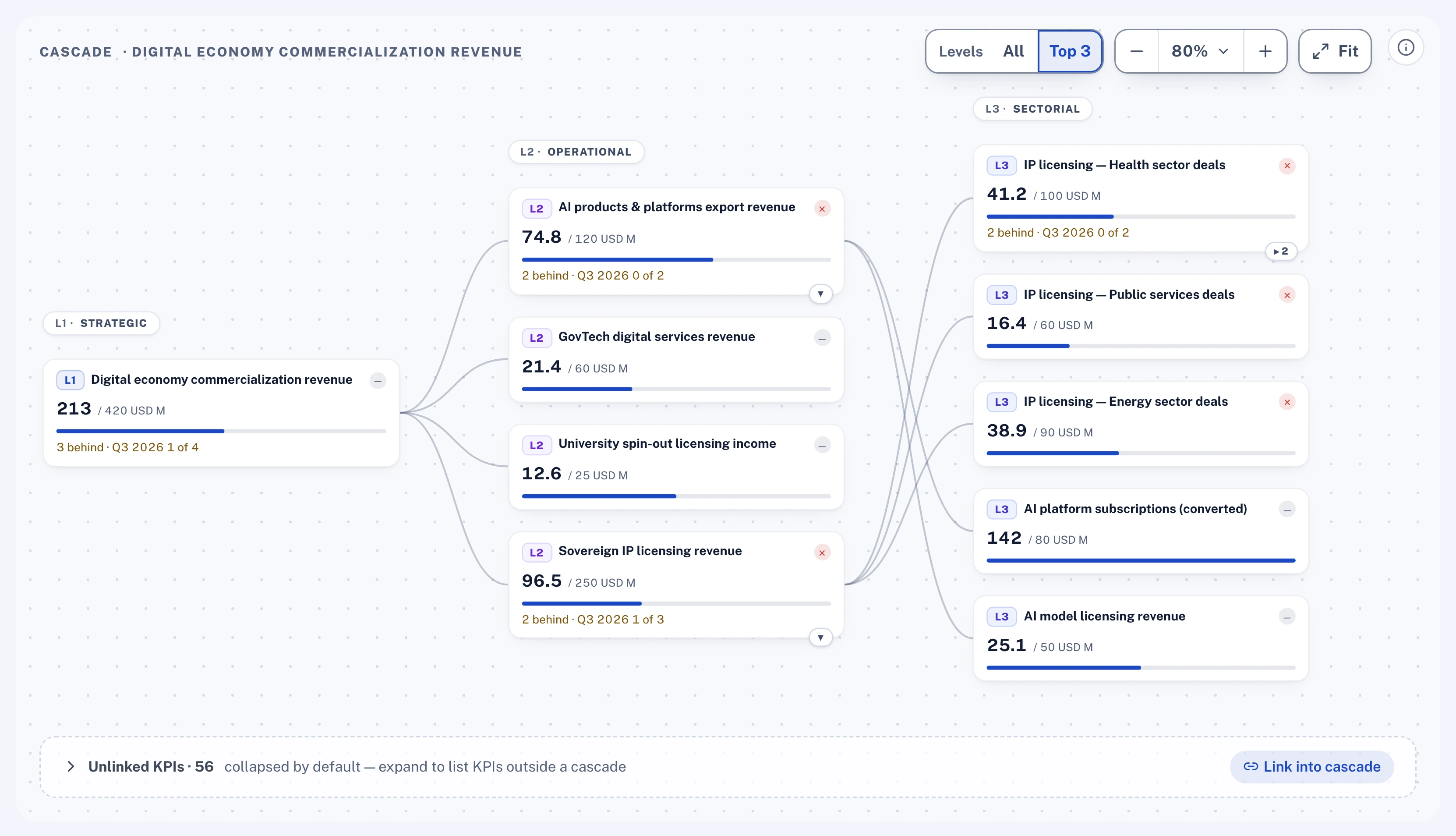
In Lodestar, each workspace can define up to four strategy levels above the work, starting from a ready-made OKR structure, a portfolio structure, value streams or its own. Each level has its own roll-up rule: weighted cascade, agreed weights, budget, effort or a simple average. Concept words such as KPI can be renamed in English and Arabic across the interface, a level still in use cannot be deleted, and every structure change is recorded.
Questions for your next review
- At which levels of our cascade does someone actually take a decision, and which levels only report?
- Do our OKR levels use the same names as our strategy documents, in every language we work in?
- How does each level roll up today, and is that rule written down anywhere?
- If we merged two levels next year, would last year's progress still add up?
An OKR cascade should describe the organisation, not reshape it. Choose the levels, names and rules deliberately, and the cascade becomes the strategy in a form everyone can read.
Short answers
How many levels should an OKR cascade have?
Usually two to four strategy levels above the work, one for each level where someone actually decides: for example themes set by the board, objectives owned by executives and key initiatives funded by programme boards. A level where nobody decides anything adds reporting without adding direction.
Should every team have its own OKRs?
No. Give a team its own key result only when it owns a real lever on the outcome. Otherwise, link the team's work to the key result above it. That keeps the cascade short, while every piece of work stays traceable to a company objective.
Can Lodestar use our own OKR levels and terms?
Yes. Each Lodestar workspace can define up to four strategy levels above the work, starting from a ready-made OKR structure or its own, choose how each level rolls up, and rename concept words such as KPI in English and Arabic across the interface.

Mariia leads commercial and partnerships at Lodestar. Her background is Big Tech and Big Four consulting, where she led large-scale transformations. She holds an MBA from INSEAD.
More from Mariia