In short
- A strategic programme fails at the joins between programmes, where no single plan looks.
- Name the structure in the organisation's own words, and hold every programme in it.
- A roll-up rebuilt by hand each month is a second version of the truth.
The transformation office has five programmes on its wall. Each has a director, a board, a plan and a monthly report. The digital programme reports in one template, the customer programme in another, and the workforce programme from a spreadsheet its own PMO built. Every report is careful. Every director can answer for their own plan.
The executive committee asks a different question. The strategy funded these five programmes to cut the time it takes to open a business, and the measure has not moved in a year. Each director explains, correctly, that their programme is on plan. Nobody in the room owns the answer for the outcome.
That answer is the job of strategic programme management (strategic program management, in most tools' language): running a programme of programmes so that the joins between them hold and the outcome the money was for arrives. Most programme management software is built to run one programme's projects well. A strategic programme needs the layer above it.
What goes wrong
A programme of programmes fails in places a programme tool is not built to look. Four mechanisms account for most of it.
Each programme names things its own way. One calls its top level workstreams, another calls them initiatives, a third puts projects directly under the programme. The strategy is written in a fourth vocabulary. When the roll-up is built, someone maps the four by hand, and the mapping lives in that person's head.
The joins sit between programme boards. The customer programme's new service needs the digital programme's platform and the workforce programme's trained staff. Inside a programme, a director sees a slip and acts. Across programmes, the slip reaches the other side when it is already late. I went through the mechanism project by project in dependencies are the programme. Across programmes it is the same, with two boards between the people who need to talk.
Delivery is measured and the outcome is assumed. Each programme reports milestones met and budget spent. The KPIs and benefits the strategy funded are reported elsewhere, by someone else, on another cycle. Nothing links a delivered milestone to the measure it was meant to move, so a programme can finish on time and leave the outcome where it was.
Every board keeps its own rhythm. Five boards meeting in five different weeks, each with its own pack, means the executive committee sees five snapshots taken on five dates. A decision made at one board reaches the others as a rumour.
Underneath all four sits the roll-up. Every month an analyst rebuilds the strategic picture from five reports: renaming, re-weighting, copying numbers and chasing the missing ones. The rebuild takes a week. By the time it reaches the committee it is a week old, and it holds that analyst's judgement calls, which nobody else sees.
What good strategic programme management looks like
None of these moves needs a new organisation chart. Each programme keeps its director and its board. What changes is what the programmes share.
Name the structure in your own words, and hold it once
Agree the levels the strategy uses, from the top objective down to the project, and give each level the name the organisation already uses: themes and objectives, portfolios and programmes, value streams and workstreams. Then hold every programme in that one structure. If one programme keeps a private vocabulary for the levels, the roll-up becomes a translation exercise every month.
In Lodestar, an administrator configures the strategy hierarchy from a preset (pillars and initiatives, OKR themes and objectives, portfolios and programmes, value streams and workstreams) or as a custom structure of up to four strategy levels with your own names. Each level rolls up by its own rule: weighted by budget, by effort, by set weights, or equally.
Declare the dependencies between programmes, and have both sides accept them
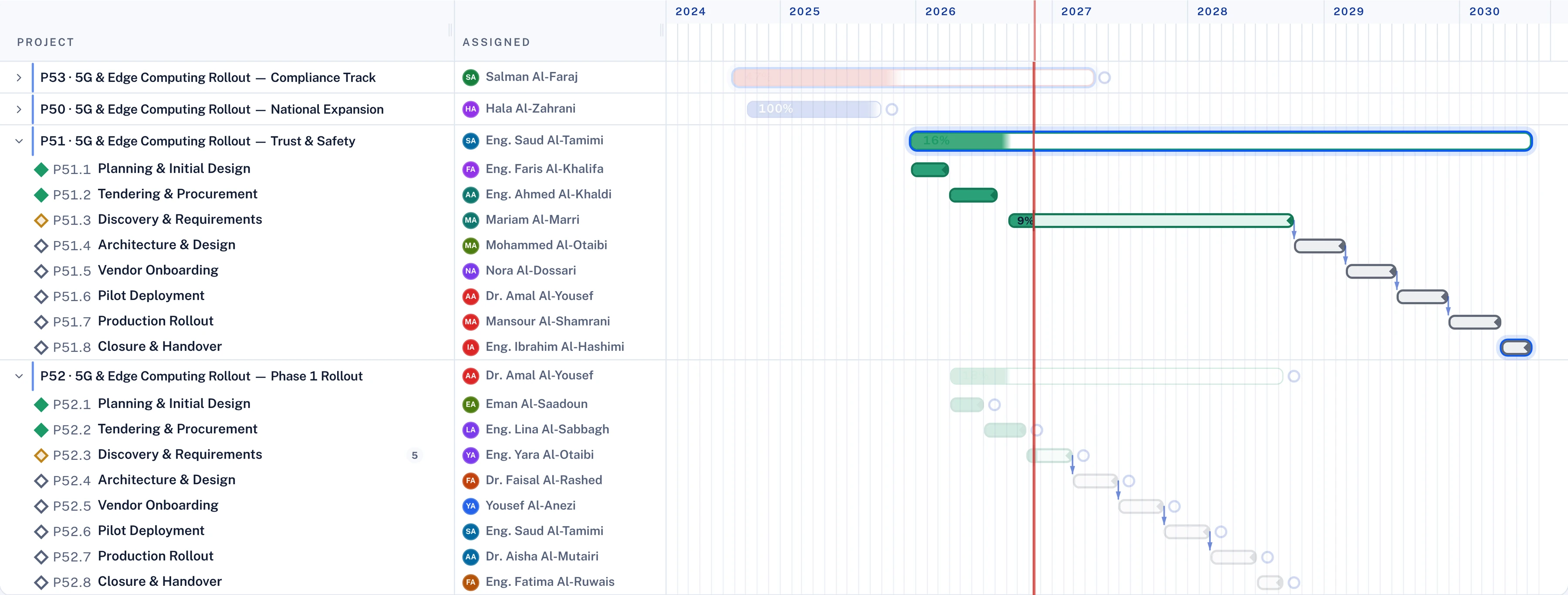
Write down each join where it sits: a milestone in one programme that a milestone in another waits for, with its type and any lag. A join declared on another team's plan is a request until that team accepts it. Once the joins are accepted, compute the critical path across the whole strategic programme, so the joins that decide the end date are in front of the board that can act on them.
In Lodestar, a dependency is its own record between projects, activities and milestones, finish-to-start, start-to-start or finish-to-finish with a lag in days, and one that reaches into another team's project stays a proposal until that team accepts it. The critical path runs across the programme, and the delay simulator shows what a slip moves before anyone commits to it.
Link benefits and KPIs to the work meant to move them
For each outcome the strategic programme was funded for, name the KPI that measures it, and for each KPI the delivery item its progress depends on. Give every project a register of the benefits it promised, each with a target and the KPI that evidences it. Then a slipped milestone shows as a risk to an outcome on the day it slips, and a closing project can be asked what it realised against what it promised.
In Lodestar, each project carries a benefits register with targets, realised values and the linked KPI, and any KPI can be linked to the activity, milestone, task or sub-task it depends on. A milestone KPI linked that way reads At risk when its item is planned to finish after the KPI's due date.
Run one governance rhythm across the programmes
Put the programme boards on one calendar and one standard of pack, and give the decisions between them one route. A scope change that moves another programme's date goes to someone who can see both programmes. A decision taken at one board is recorded where the other boards will read it. The rhythm is what makes a join discussable before it breaks.
In Lodestar, governance forums keep their meetings, minutes and decisions in the same model as the plans, and approval routes for 23 kinds of change, budget and date changes among them, are set in Workflow Studio without code. The person who raises a request can never approve it.
Roll up from the records, and never rebuild it
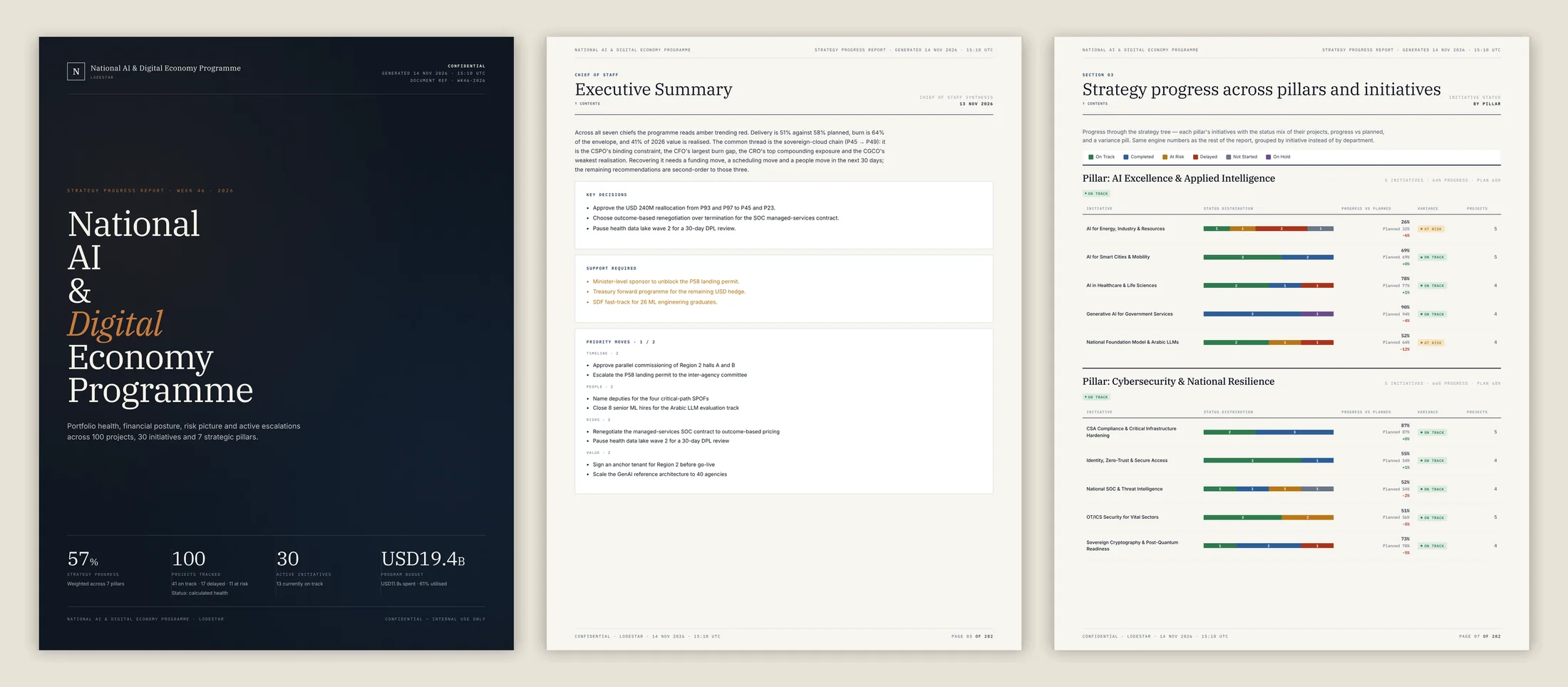
The strategic picture should be a reading of the same records each programme manages, rolled up by rules agreed once. Then the executive committee and every programme board see the same numbers on the same day, and the analyst who used to rebuild the roll-up can spend the week asking why a number moved.
In Lodestar, department and portfolio roll-ups sit on one scale, and the strategy progress report, the KPI scorecard and one-page project deep dives are generated from the live model in PDF, PowerPoint and Word.
Choosing programme management software for the layer above
When you compare programme management software for a strategic programme, test the layer above a single programme. Load two programmes with a dependency between them, move a date in one, and watch whether the other board sees it. Link a KPI to a milestone and slip the milestone. Then ask for the roll-up and see who rebuilds it. Which question each category of tool was built to answer is set out in SPM, PPM and programme management.
Questions for your next review
- Which outcomes was this strategic programme funded for, and which KPI measures each one?
- Which dependencies between our programmes have an owner on each side and a date both sides accepted?
- How long does this month's strategic roll-up take to build, and whose judgement calls are inside it?
- When a decision at one programme board moves another programme's date, who approves it, and where is it recorded?
A strategic programme is judged on the outcome it was funded for, and that outcome lives between the programmes. Run the space between them with the same care as the programmes themselves, or the outcome is left to chance.
Hany is a strategy and transformation executive with a technical background in software and AI. He has advised C-suites at a top-three strategy consulting firm (MBB) and independently, and has run transformation programmes of more than USD 1 billion.
Connect on LinkedIn