In short
- PPM asks whether the projects are done right. SPM asks whether they are the right projects.
- Programme management owns the dependencies and benefits that no single project owns.
- Layers that do not share one model leave the strategy office reconciling them by hand.
The shortlist arrives on a single slide. A project portfolio management (PPM) suite, an OKR tool and a work-management board sit side by side, each with a column of ticks. The strategy office has been asked to pick one before the end of the quarter.
Each vendor has said, in good faith, that it is the answer. The PPM suite calls itself strategic portfolio management. The OKR tool calls itself strategy execution. The board calls itself programme management, and it does have a timeline view.
All three demos went well. The trouble is that they answered three different questions, and nobody in the room had written down which question the office is accountable for.
What goes wrong
The category names have blurred, because every vendor wants the larger label. Underneath the labels, the questions have not changed. There are four, and they sit at different heights in the organisation.
Project portfolio management asks: are we doing the projects right? Schedules, resources and cost across many projects at once. It is the PMO's daily tool. It knows that a project is late. It does not know whether the project still matters.
Programme management asks: are related projects delivering one outcome together? A new licensing service needs a system, a policy change, a training plan and a call-centre script. Each can be on time while the service fails, because the outcome lives in the dependencies between them. A programme owns those dependencies, the benefits and the governance that no single project owns. American buyers search for it as program management. The discipline is the same.
Strategic portfolio management (SPM) asks: are we doing the right projects for the strategy? Which initiatives get the money, which wait and which stop. It weighs alignment and value, makes the trade-offs explicit, and re-plans when the strategy or the budget moves, which happens more often than once a year.
Strategy execution, OKR and KPI management ask: are the targets moving? The measures the board set, their readings and the forecast for each.
The usual failure is a good tool asked the wrong question. A PPM suite asked to show strategic alignment gets a custom field called "pillar", filled in once at intake and never revisited. An OKR tool asked about delivery shows key results with no link to the projects meant to move them. A work-management board asked for programme governance shows tasks, and nothing about who approved the change in scope.
So the organisation buys a second tool to cover the gap, and then a third. Each holds part of the truth, with its own name for the same project. The strategy office becomes the join. Every month someone exports four files and reconciles them by hand before the business review. That is where the office's time goes, and it is where errors enter the board pack.
Match each category to the question it answers
Before the next demo, put the four side by side. The last column is the one vendors skip, and it decides whether the tool can answer its question at all.
| Category | The question it answers | Who owns it | What it needs underneath |
|---|---|---|---|
| Project portfolio management (PPM) | Are we doing the projects right? | The PMO or enterprise PMO (EPMO) | Schedules, resources, cost and status for every project, on one scale |
| Programme management | Are related projects delivering one outcome together? | Programme directors and the transformation office | Dependencies across projects, benefits, and a governed route for scope changes |
| Strategic portfolio management (SPM) | Are we doing the right projects for the strategy? | The strategy management office (SMO) and the investment committee | Every project linked to an initiative and an objective, with its cost and expected value |
| Strategy execution, OKR and KPI management | Are the targets moving? | The SMO and the owner of each target | A KPI cascade with plan, actual and forecast, linked to the work meant to move it |
What good looks like
Write down the question your office answers
A PMO accountable for on-time delivery needs PPM first. A strategy management office asked "is the strategy working?" needs SPM and KPI management first. A transformation office running a handful of cross-cutting outcomes needs programme management first. Put that question at the top of the evaluation sheet and score every demo against it.
Test the joins between the layers
Ask each vendor to take one KPI the board cares about and walk down: the objective, the initiative, the projects, the milestone that is late, and the money spent so far. Then walk back up. Any step that means opening another tool or a spreadsheet is where your analysts will spend their month.
Keep the layers on one model
Separate teams can answer the four questions. Separate data cannot. A project should exist once, with one owner, one schedule, one budget and one link to the strategy. The portfolio view, the programme view and the KPI view are then three ways of reading the same records, and a change in one shows in the others the same day.
Put the decisions on a route
SPM is where money moves between initiatives. Programme management is where scope moves between projects. Both are decisions, and both need an approver who is not the person asking, a record of what was approved, and evidence behind the progress that justified the move. A portfolio view without governance is a picture of choices nobody can trace.
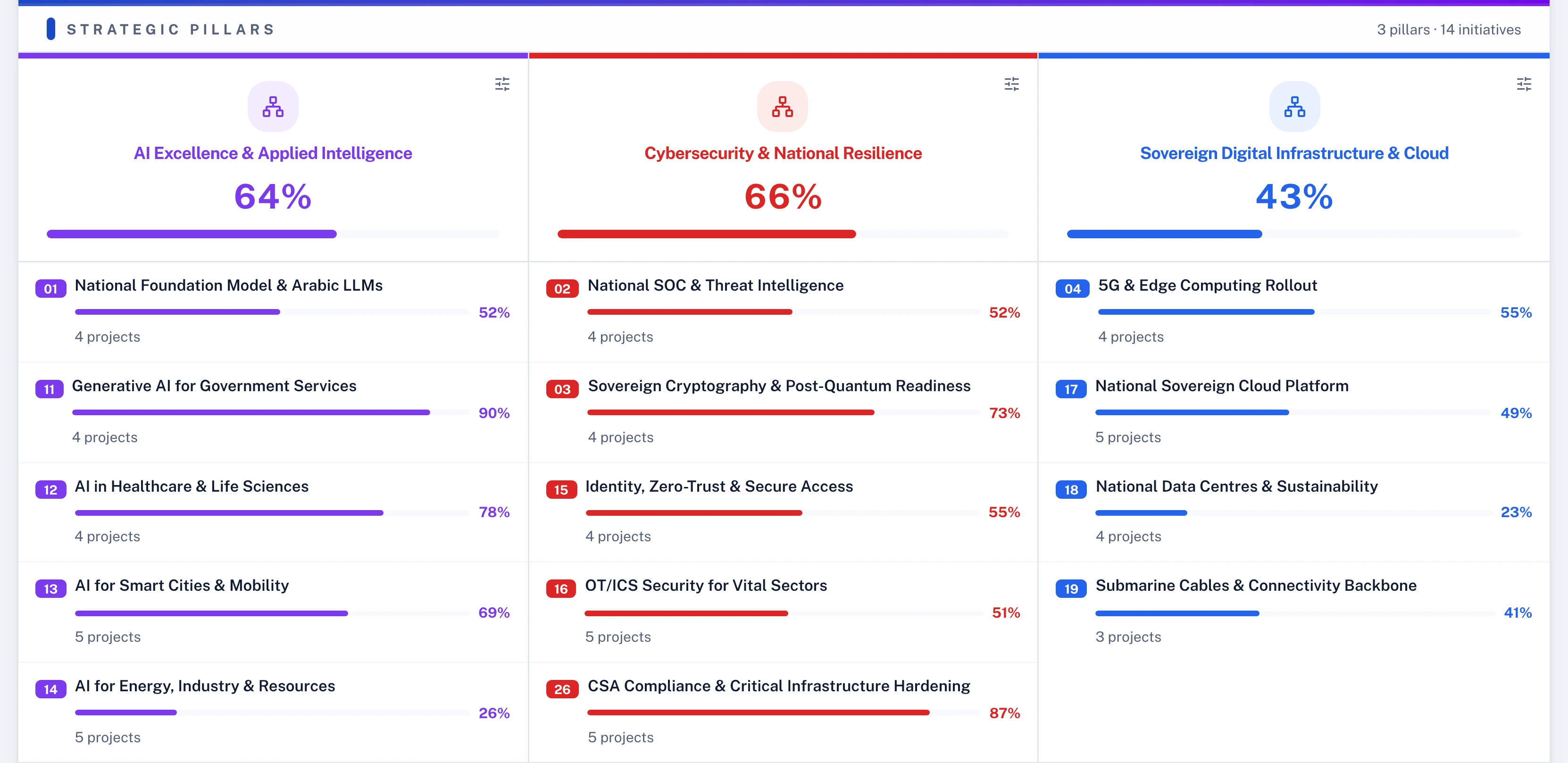
That is how we built Lodestar. Pillars, initiatives, projects, activities and tasks sit on one model, with the KPI cascade linked to the work beneath it, so the portfolio, programme and KPI views read the same records. Changes to budgets, targets and plans travel an approval route, and progress counts only when someone else has approved the evidence behind it.
How to put those joins to a vendor on your own data is the subject of seven tests for strategy execution software. How a portfolio review uses the SPM layer to make a choice is in portfolio reviews that decide.
Questions for your next review
- Which of the four questions is this office accountable for answering to the board, and is that written down?
- For our three most important KPIs, can we name the initiatives and projects meant to move them without opening a spreadsheet?
- How many tools hold a copy of our project list, and who reconciles them each month?
- When money moved between initiatives last quarter, who approved it, and where is that recorded?
The categories will keep borrowing each other's names. The questions stay where they are, and an office that knows which one it answers can see past the label in the first demo.

Hany is a strategy and transformation executive with a technical background in software and AI. He has advised C-suites at a top-three strategy consulting firm (MBB) and independently, and has run transformation programmes of more than USD 1 billion.
Connect on LinkedIn