In short
- Share the model and the definition of done. Leave the delivery method to each entity.
- Delegate authority by value and by entity, and keep a record of every decision taken under it.
- Arabic and English are two views of one number, and the minister's view is one page.
The quarterly review is ten days away. In the centre's office, six analysts are opening attachments. One ministry has sent forty slides. An authority has sent a workbook with a tab for every project. A state company has sent a signed letter with no numbers in it. All three say their programmes are on track.
By the end of the week the team has retyped everything into the centre's own template. The pack that goes to the minister is tidy and consistent. It is also a week old, and nobody in the office can say whether "on track" meant the same thing in any two of the files it was built from.
I have worked inside a centre like that. In the national programmes I have seen, the people are capable and the hours are long, and a large share of those hours goes on format.
What goes wrong
A national programme is delivered by entities the centre does not manage. Ministries, authorities and state companies each have their own delivery office, their own template and their own governance. That is as it should be. The trouble starts where their reports meet.
Each entity defines green for itself. In one, green means no milestone is late. In another, it means the budget is being spent. In a third, it means the project manager is confident. The centre adds these up as if they were one unit.
The centre becomes a translation desk. Its analysts spend the cycle converting formats and chasing missing fields. The time meant for challenge, for asking why a programme is slipping, goes on making the columns line up.
Aggregation removes the judgement. By the time forty slides become one row, the caveats are gone. The row has a colour and a percentage, and no route back to what they rest on.
Two languages become two sets of numbers. The Arabic pack and the English pack are prepared by different hands on different days. Sooner or later they disagree, and a meeting is spent finding out which one is right.
The usual answer is to impose the centre's template on everyone. Entities then keep two sets of books: the one they manage by and the one they send. The centre gains consistency and loses the truth.
What good looks like
The centre's job is to see across entities without running them. Five moves make that possible, and none of them depends on a particular tool.
Share the model and leave the method alone
Agree the structure every entity reports into: pillar, initiative, project, milestone. Agree how progress is weighted on the way up. Below the milestone, let each entity work as it likes. One can run a critical-path schedule and another a board of cards. The centre needs every milestone to mean the same thing, and can leave the task list to the entity.
Agree what done means and what proves it
Write one definition of done for a milestone and apply it to every entity: a named piece of evidence, accepted by someone other than the person who reported it. A signed handover counts. A slide saying the handover happened does not. This is the rule that makes one entity's 60% comparable with another's.
Delegate authority by value and by entity
The centre cannot approve every change and should not try. Set out who decides what. The entity approves changes inside its own envelope. The centre sees changes above a stated value. A committee takes the largest. Write the matrix down, send every change through it, and keep the record of who decided. Delegation without a record is only absence.
Keep one number in two languages
Arabic and English should be two views of the same record. A figure that is typed twice will sooner or later be typed differently. Translate the labels once and let the numbers come from one place.
Give the minister one page
A minister needs to know where the programme stands against plan, which few items need a decision, and who owns each one. That fits on a page. The page must be the top of the same model the entities work in, so that any line on it can be opened down to the milestone and the evidence behind it.
Delegation without a record is only absence.
Expect the shared model to drift
A shared model is agreed once and worn away every quarter. Three kinds of drift are common enough to watch for from the start.
The side template comes back. A new committee asks for its own format, the centre obliges, and the analysts are retyping again. Every extra format should be a view of the model. If it cannot be, refuse it.
The definition of done collects exceptions. One entity argues that its milestones are different and cannot be evidenced in the same way. Sometimes that is true. Record the exception by name, with an end date, or it becomes the rule for everyone.
Delegation turns into silence. Authority is handed to an entity and used, and nobody at the centre looks at how. Read a sample of delegated decisions every quarter. It shows where the thresholds are set wrong, and it reminds everyone that the record is read.
Put the model where the entities work
A model that entities visit once a quarter to upload a report is a template with a login. It holds only when each entity's own office manages its work there, in its own way, and the centre reads the result without having to ask for it.
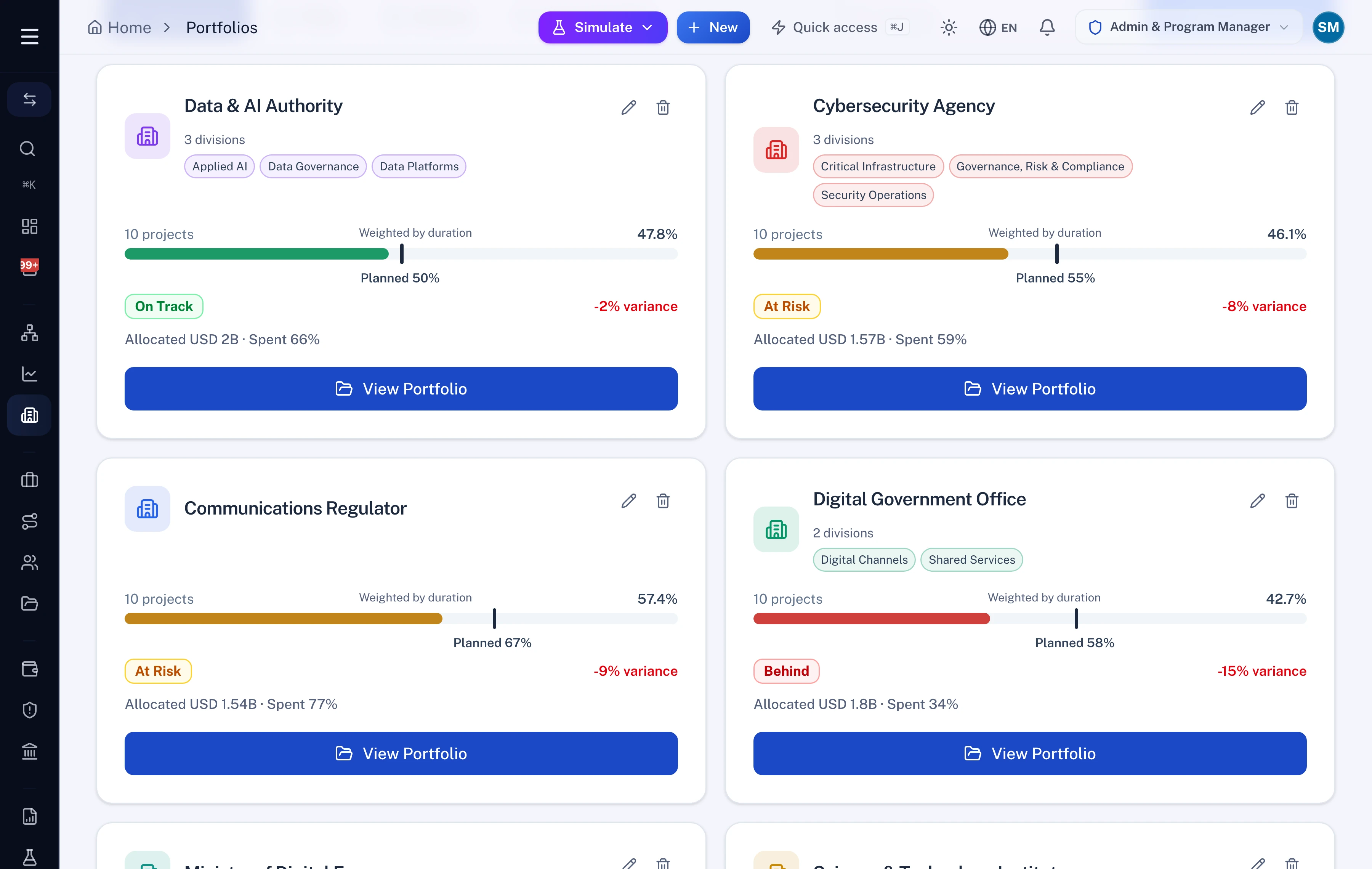
That is how we built Lodestar: one live model from pillar to task, in which each entity sees its own delivery and the centre sees every entity on one scale, in Arabic and English. The national programmes page shows what that looks like.
Who may approve what is a subject of its own, and I take it up in governance is a workflow. How a target passes down through the entities is in KPI cascades that hold.
Questions for your next review
- If two entities both report 70%, can we show that they counted it the same way?
- Which changes did each entity approve under delegated authority last quarter, and where is the record?
- How many days pass between an entity's reporting date and the minister's page, and how much of that time is reformatting?
- Do the Arabic and English packs take their figures from one source, or is each figure typed twice?
- From any line on the minister's page, how many steps does it take to reach the evidence behind it?
The centre is useful only while the entities and the minister both believe its numbers. That begins when all of them are reading the same number, counted one way.

Hany is a strategy and transformation executive with a technical background in software and AI. He has advised C-suites at a top-three strategy consulting firm (MBB) and independently, and has run transformation programmes of more than USD 1 billion.
Connect on LinkedIn