In short
- A key initiative with no budget, owner or plan is a hope, not a portfolio item.
- Read each initiative's delivery beside its key result's forecast: the mismatches are the decisions.
- Re-decide the portfolio every quarter against key-result forecasts, not once a year at budget time.
The quarterly strategy review has two slides that matter. The first, from the strategy team, shows the key results: most of them amber, two green, one red. The second, from the portfolio office, shows the initiatives: most of them green, on budget and on plan.
The chief executive looks from one to the other and asks the obvious question. If the work is on plan, why are the outcomes not moving? And which of these initiatives should we stop? Nobody can answer in the room, because the two slides come from two tools, and nothing on either says which initiative is meant to move which key result.
The strategy and the portfolio were both being managed. They were not being managed together.
What goes wrong
OKRs and strategic portfolio management grew up in different places. OKRs came from teams that wanted focus and stretch. Portfolio management came from finance and the PMO, which wanted control of money and delivery. Many organisations now run both, side by side, and the gap between them is where the strategy gets lost.
Key initiatives are not portfolio items. In the OKR tool, an initiative is a line of text under a key result. In the portfolio, the same work is a project with a budget, a plan, a sponsor and risks, often under a different name. Nobody links the two, so the money cannot be traced to the outcome.
Strategic fit is scored once. At intake, each project is scored for its fit with the strategy, and the score never changes. Two quarters later, the key result it was meant to move is forecast to hit without it, or forecast to miss despite it, and the portfolio does not notice.
The two run on different clocks. OKRs are set and reviewed quarterly. Budgets are set annually. When the quarterly review shows a bet is not working, the money is already committed until next year.
Delivery and outcome are blended, or kept apart. Either the key result's progress is computed from the work, which hides a bet that is delivered but not working, or the two are reported separately and never compared. Both ways, the question "is our money buying the change we want?" goes unanswered.
What good looks like
OKRs and the portfolio are two views of one strategy: what should change, and what the organisation is doing about it. Keep them in one model and read them together. Five moves.
Make every key initiative a portfolio item
Each key initiative should exist in the portfolio with a budget, an owner, a plan, a stage and its risks. If it has none of these, it is a hope rather than an initiative. Once it has them, its progress, its spend and its risks come from the same record the portfolio office already runs.
Link each key result to the initiatives meant to move it
Record which initiatives each key result depends on. Then list the gaps both ways: key results with no work behind them, and work that serves no key result. The first is an objective nobody is pursuing; the second is spend the strategy did not ask for. More on these links in key results and the work behind them.
Read delivery and outlook side by side
For each initiative, put two signals next to each other: is the work on plan, and is its key result forecast to hit? The four combinations each call for a different decision. Both on track: keep going. Delivered, but the outcome is flat: the bet is wrong, rethink it. Outcome moving without the work: something else is driving it, so the funds may be better used elsewhere. Neither moving: escalate.
Re-decide the portfolio every quarter
Hold a portfolio review on the OKR cadence, with the chart above in front of it. Accelerate what is working, rethink what is delivered but not moving its key result, release funds from work whose outcome is moving without it, and escalate what is stuck on both counts. Keep a reserve in the annual budget for these moves, and send each one through the same governed route as any other change.
Read the whole strategy from one record
The strategy view, the portfolio view and each team's view should all read the same entries. An owner updates an initiative once; its progress, spend and risks roll up to the objective, the theme and the board, and its key result's forecast sits beside it. Nobody rebuilds a slide to reconcile the two, because there is nothing to reconcile.
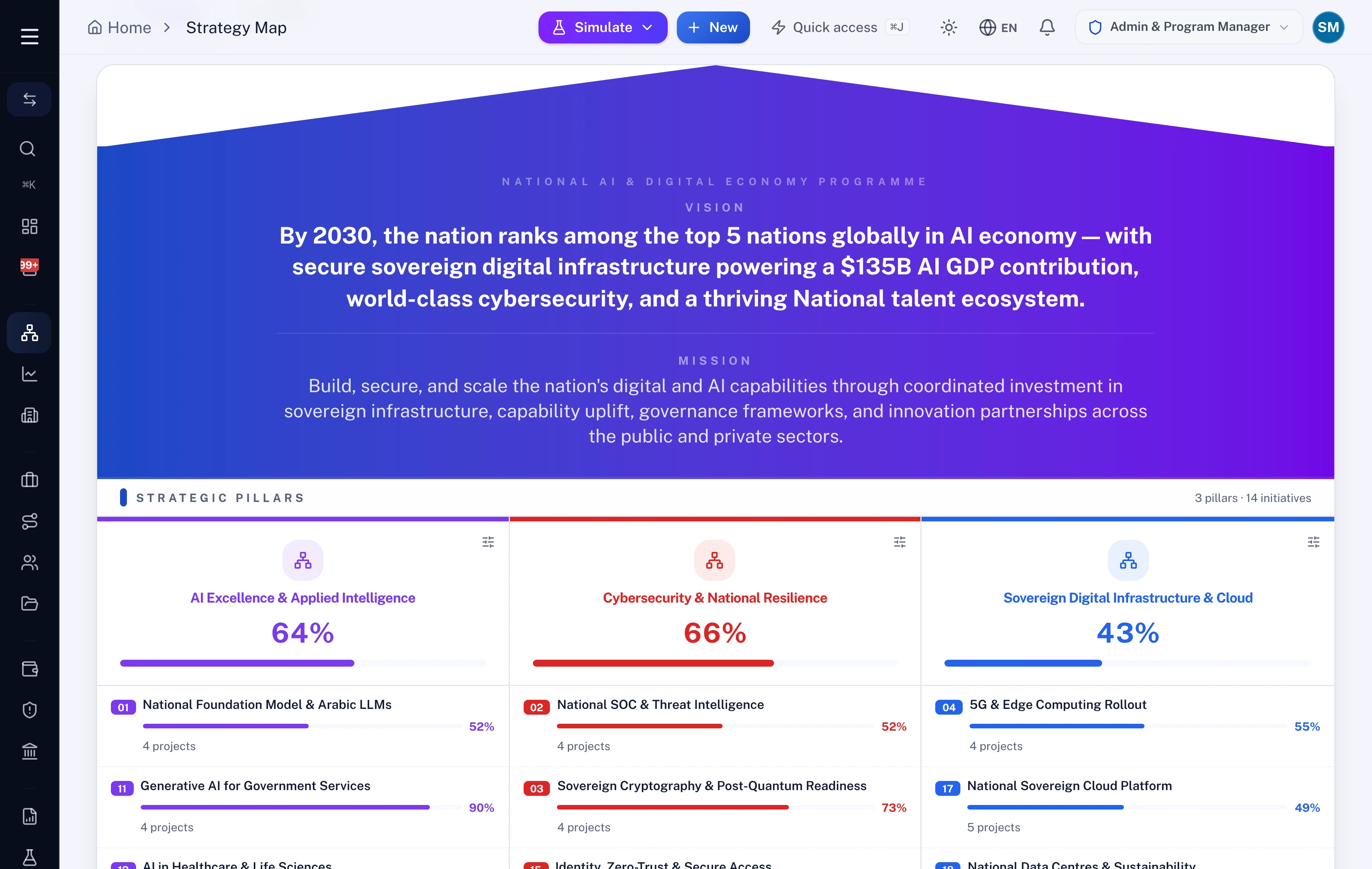
In Lodestar, the strategy levels, the portfolio and the work sit in one live model, so an owner's single update rolls up to every level, with no double entry. Portfolios and departments roll up on one scale, with progress against plan, variance, status and budget. Any KPI or key result can be linked to the work it depends on, and KPIs with no link are listed.
Questions for your next review
- Does every key initiative exist in our portfolio with a budget, an owner and a plan?
- Which key results have no work behind them, and which work serves no key result?
- Which initiatives are delivered on plan while their key result is forecast to miss?
- How much of this year's budget can we still move at the next quarterly review?
OKRs without the portfolio describe the change the organisation wants; the portfolio without OKRs describes what it is busy with. Read together, from one record, they show whether the strategy is working.
Short answers
How do OKRs relate to strategic portfolio management?
OKRs say what should change; strategic portfolio management decides what the organisation funds and delivers to change it. They work together when every key initiative is a portfolio item with a budget, an owner and a plan, linked to the key result it should move, and the portfolio is re-decided each quarter against key-result forecasts.
How do you know if a strategy is working?
Read two signals for each initiative side by side: is the work on plan, and is its key result forecast to hit? Both on track means keep going. Delivered with a flat outcome means rethink the bet. An outcome moving without the work suggests funds could move. Neither moving calls for escalation.
Does Lodestar combine OKRs and portfolio management?
Yes. In Lodestar the strategy levels, the portfolio and the work sit in one live model, so an owner's single update rolls up to every level with no double entry. Portfolios roll up on one scale with progress, variance, status and budget, and any key result can be linked to the work it depends on.

Hany is a strategy and transformation executive with a technical background in software and AI. He has advised C-suites at a top-three strategy consulting firm (MBB) and independently, and has run transformation programmes of more than USD 1 billion.
Connect on LinkedIn