In short
- Agree the handover in the first month and write it into the statement of work.
- A client team that has never run a reporting cycle alone has been handed nothing.
- The partner gains too: visible work, a client who can speak for it, and a live plan for the next phase.
The engagement ends on a Friday. The partner's team presents the closing deck, hands over a shared folder and takes the sponsor to lunch. For a year they designed the operating model and ran the programme office, and by every account they ran it well.
On Monday the client's own office opens the tracker. It is a spreadsheet with forty tabs, colour codes that have no key and formulas that point at files on a laptop that has left the building. The weekly pack is due on Thursday. Nobody who remains has ever built it.
By the end of the quarter the office has a simpler tracker of its own and a reporting rhythm that slips. The operating model is still in the deck. Nobody acted in bad faith. I would look at the contract first: it asked for a design and a year of running it, and it received both.
What goes wrong
The handover fails long before the last day, and for reasons that are built into the usual engagement.
The contract buys documents and a service. The deliverables are the operating model, the playbook and the monthly report. Running the office is a service, and a service stops when the team goes home. Nothing in the statement of work describes the client's ability to carry on, so nobody is working towards it.
The working system lives in the partner's files. The tracker was built by the team, for the team, in the tool it had to hand. Its logic sits in one workbook and in the head of the analyst who wrote it. Handing over the file does not hand over the understanding.
The rules were kept by people. Who approves a change above a certain value, what counts as a finished milestone, when an overdue item goes to the sponsor: the partner's team knew these and applied them by habit. Once the team has gone, each rule survives only as a page in the playbook.
The client team watched. Its members attended the meetings and received the packs. They never chased an owner, built the pack or challenged a green on their own. A reporting rhythm is learned by running it, and the running was the thing the client was paying the partner to do.
The decisions have no memory. Why a project was stopped, why a gate was changed, who agreed the exception: the answers are in mailboxes and in the heads of people who have moved to another client.
The incentives point the same way on both sides. The client wants delivery this quarter and the partner is judged on it, so every hour goes on running the programme. The handover is planned for the final month, which is also the month of closing reports and final invoices.
What good looks like
A good handover is decided in the first month. Four things should be in the client's hands on the last day, and each can be written into the statement of work.
Keep the plan in a system the client owns
From the first week, the plan, the registers and the reports are built in the client's own system of record, under the client's accounts. The partner works there as a user. If the engagement ends early, nothing has to be moved, and nothing depends on a file only its author can read. The test is whether a new joiner on the client side can open the plan and find any project's status without asking the partner.
Write the rules into that system
The approval routes and the definition of done should be settings in the system, so they keep working after the people who designed them have gone. Who approves a budget change above a given value. What evidence closes a milestone. When an overdue approval goes up a level. A rule that lives in a playbook is followed while its author is in the room. Governance is a workflow covers how to write those routes down.
Have the client team run two cycles before the handover
Before the last day, the client's team runs at least two full reporting cycles itself. It collects the updates, challenges them, builds the pack and takes it to the committee. The partner watches the first and stays out of the second. Whatever breaks in those cycles is the real handover list. Schedule them well before the final month, so there is time to fix what they show.
Leave a record of the decisions and the reasons
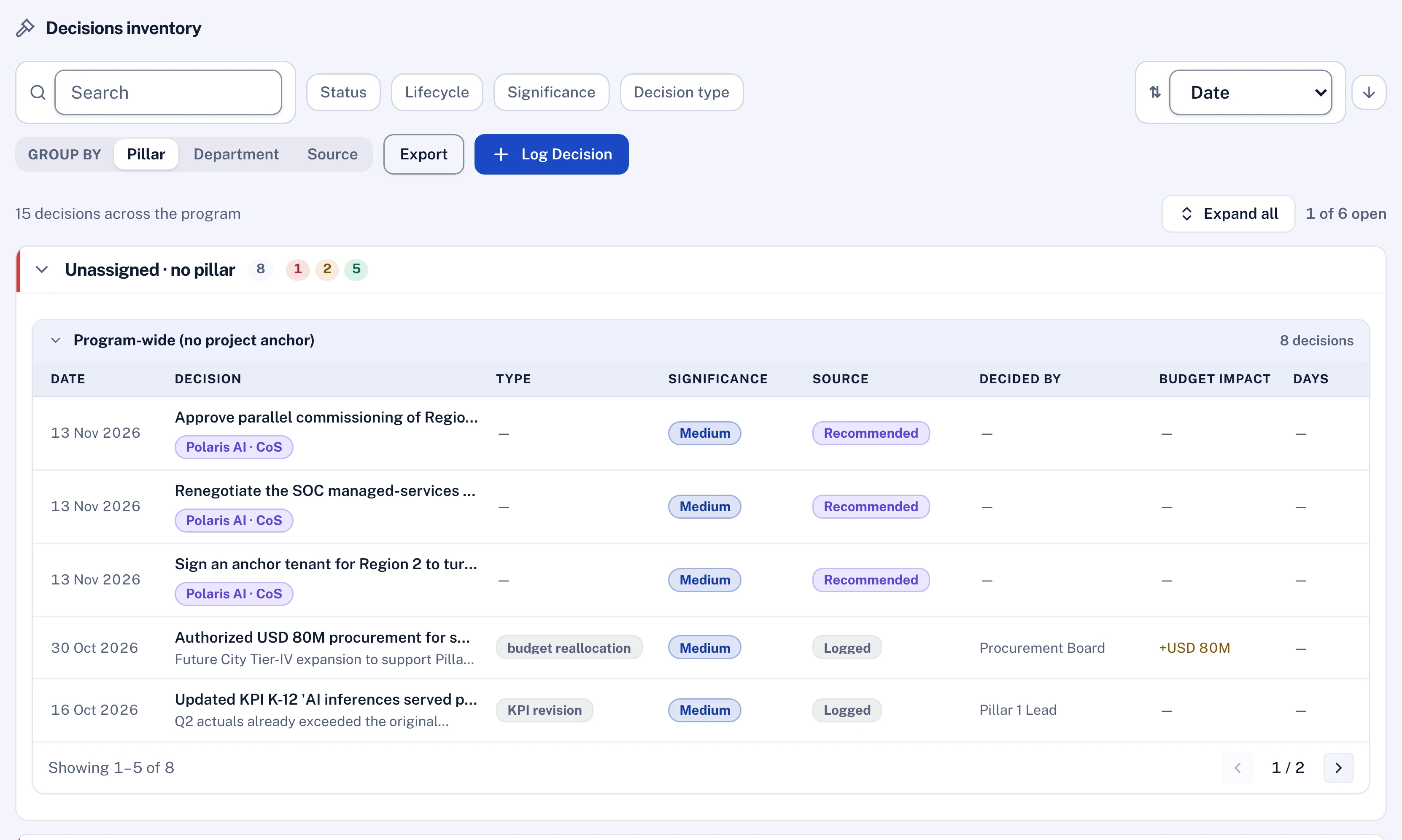
Each decision the programme took should be on the record with its date, who took it, the options set aside and the reason. A year later someone will propose reopening a stopped project. The reason it was stopped should be one search away for whoever is in the chair by then.
A rule that lives in a playbook is followed while its author is in the room.
Ask for it at the start, on both sides
For the client. Put the four items in the statement of work as deliverables with acceptance tests, and tie the final milestone to the second unassisted cycle. Ask at proposal stage where the plan will live and who will own the accounts. Name the people on your side who will take over, and free their time from the first month. A partner cannot hand over to a team that has not been appointed. A system the client team never opens will not help either, which is the subject of A platform nobody opens.
For the partner. Working this way gives up the client's dependence on your files and returns something better. The work is visible to the client every week, which makes its value easier to show. The closing weeks go on advice, with no tracker to untangle. A client who can run alone will say so to others, and when a next phase comes you start from a live plan you already know.
A partner can deliver on Lodestar in this way. The partner sets up the plan, the stage gates and the approval routes in the client's workspace, without code, and runs the engagement there beside the client's team. Decisions are recorded in a decisions log that stays with the client. The partner programme sets out how firms work with us.
Questions for your next review
- Where does the plan live today: in a system we own, or in our partner's files?
- Which approval routes and completion rules would still be applied if the partner's team left tomorrow?
- How many reporting cycles has our own team run from start to finish without help?
- For the last five major decisions, where is the reason recorded?
- What does the contract say must be in our hands on the last day, and how will we test it?
An engagement is judged by the quarter after it ends. Decide in the first month what will still be working then.

Mariia leads commercial and partnerships at Lodestar. Her background is Big Tech and Big Four consulting, where she led large-scale transformations. She holds an MBA from INSEAD.
More from Mariia