In short
- An agent should read with the permissions of the person it works for, and no more.
- Advice cannot be approved. One specific change, shown before and after, can.
- An AI-prepared change still travels the approval route that governs that kind of change.
The demo goes well. Someone asks the assistant which projects will miss their date, and it gives a fair answer in ten seconds. Then the programme director asks what happens next. What happens next is that somebody copies the answer into an email, and the plan stays exactly as it was.
The opposite demo is worse. An agent is connected to the plan through an administrator's account and told to keep it up to date. A week later three dates have moved and a status has changed. Nobody in the room can say who decided.
In the programmes I have worked in, proposals for AI tend to arrive in one of these two shapes. Both fail, and the reasons are related.
What goes wrong
A governed programme runs on a simple rule. Every change has an author, and the changes that matter have an approver who is someone else. Each poor pattern breaks that rule from a different side.
The agent that only chats makes no change. Its answer leaves the system the moment it is given. To act on it, a person has to enter it somewhere by hand. The advice and the action are now two unconnected records, so nobody can later say whether the advice was taken, or whether it worked. A tool whose effect cannot be traced stays a pilot.
The agent that acts unseen makes a change with no author. It usually runs on a shared account with wider rights than any one person holds. So it skips the approval that a project manager making the same change would face. The log says "system". The owner of the record finds out afterwards.
Then people stop trusting the record. An owner whose dates move without warning starts keeping a private copy. The programme now has two versions of the plan, and the agent is tidying the one nobody believes.
A programme office that has tried both can conclude that AI is not ready, when the fault lay in how it was connected.
What good looks like
There is a third pattern, and it borrows from how programmes already govern people. It has five parts.
Give the agent the asker's eyes
The agent reads with the permissions of the person it is working for, and no more. The same question from a project manager and from the finance director should return different answers, because they are allowed to see different things. An agent must never be a wider door into the data than the screens are.
Ask for one change, shown before and after
A paragraph of advice cannot be approved. A change can. The agent should name the record, the field, the value now and the value proposed, with its reasoning beside it. Keep each proposal small enough to judge in a minute.
Put a person's name on it
Nothing changes until a person approves. The change is then made in that person's name, with that person's rights. If they could not have made it by hand, the agent cannot make it for them.
Send it down the usual route
A budget change prepared by an agent is still a budget change. If your rules send it to the finance director above a certain amount, it goes there. The agent shortens the preparation. The approval takes as long as your governance says it should.
Record it, then check whether it worked
Keep what was proposed, who approved it and what was applied, in a log nobody can edit. Some weeks later, compare what the change was meant to achieve with what happened. An agent whose advice is never checked against the outcome cannot earn more trust.
A paragraph of advice cannot be approved. A change can.
Follow one slipped date through all three
Take a plain case. A contractor's report shows that a milestone will be three weeks late.
With the chat-only assistant, the owner asks what the delay means and gets a sound paragraph. On Thursday the plan still shows the old date, because nobody typed the new one in.
With the unseen agent, the date moves overnight and two dependent milestones move with it. The programme director learns of it from the dashboard.
With the governed pattern, the owner uploads the report. The agent proposes the new date and shows the two milestones it would move. The owner approves. A date change on that milestone needs the programme director's approval, so it waits there and takes effect when the director signs. A month later the review asks whether the new date held.
Watch for approval turning into habit
The governed pattern has its own way of decaying, and it starts with the person who signs.
Too many cards. Forty proposals a day get forty approvals and no reading. Fewer, larger proposals get judged. A change approved two seconds after it appeared was not read, and that is worth counting.
Proposals that grow. "Update the plan", with thirty changes inside, cannot be judged in a minute. Send it back and ask for the changes one at a time.
The shared account returns. Someone gives the agent a standing permission "to save time". That is the unseen agent again, with paperwork.
A log nobody opens. Recording every change is worth little if no review reads the record. Put last quarter's AI-prepared changes on the agenda, with what each was meant to achieve.
Make the signature part of the system
A pattern that depends on each team connecting its agent carefully will be kept by some and skipped by others. The reading rights, the proposal, the signature and the route have to be how the system works.
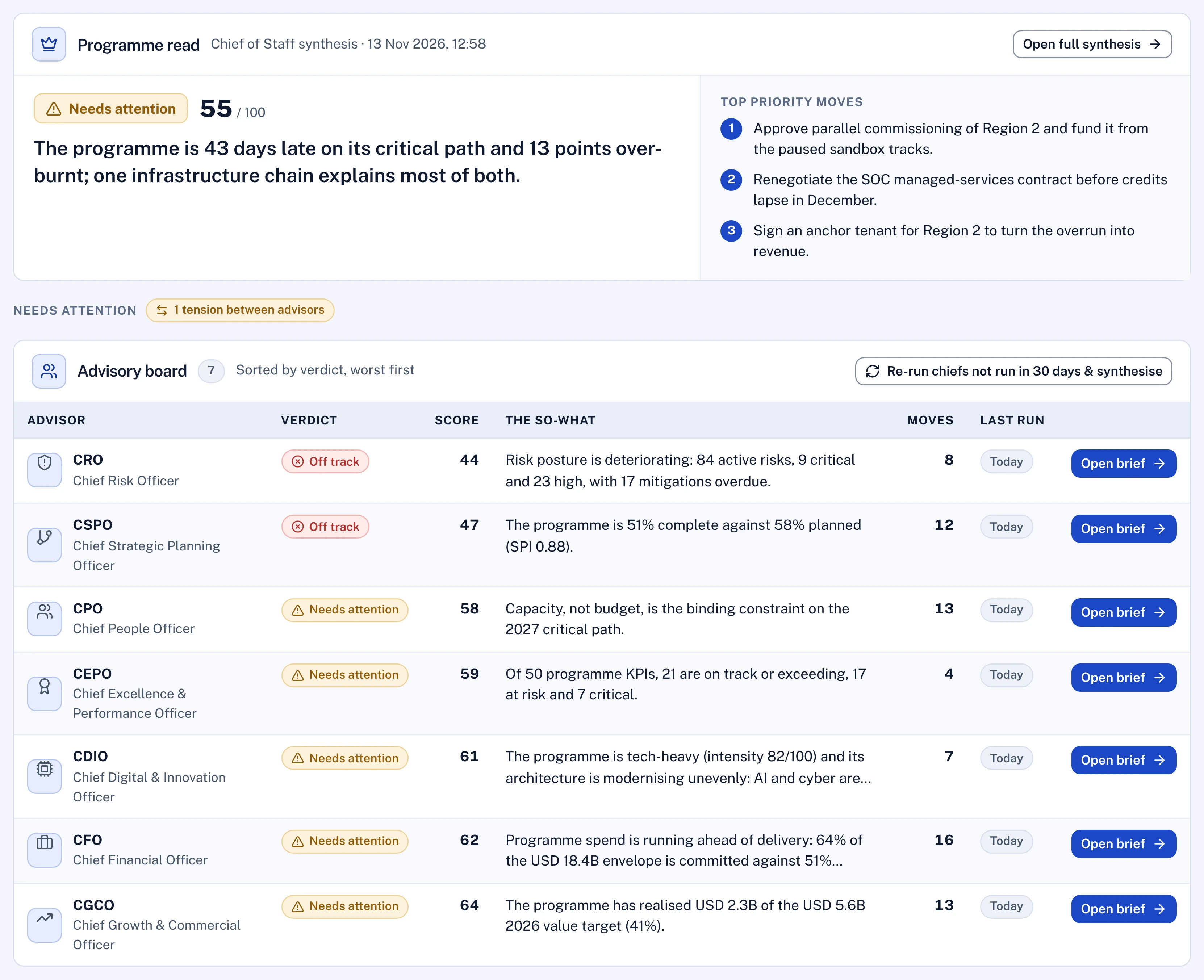
That is the pattern Lodestar follows. Seven AI chiefs read the programme each cycle and a Chief of Staff reconciles them into one brief. The Polaris assistant proposes each change as a card showing before and after, and nothing changes until the person presses Apply. The change is made with that person's own permissions, and still goes for approval if a workflow governs it.
There is more on the approval route in Governance is a workflow, and on the collecting an agent can take over in What a PMO should stop doing by hand.
Questions for your next review
- For each AI tool in the programme today, which record does it change, and who approves that change?
- Which account do our agents run under, and can it see or do more than the person using it?
- If an AI-prepared change went over a delegation of authority limit, what would stop it?
- Can we list last quarter's AI recommendations, who approved each one, and whether it worked?
An agent that proposes is slower than an agent left alone, by the length of one approval. That approval is what lets you stand behind the result in front of a board.

Hany is a strategy and transformation executive with a technical background in software and AI. He has advised C-suites at a top-three strategy consulting firm (MBB) and independently, and has run transformation programmes of more than USD 1 billion.
Connect on LinkedIn