In short
- Set an agent's autonomy for each task, in writing, and never for the office as a whole.
- The agent assembles the evidence. A named person owns the rating and the decision.
- Decide where the freed hours go before they arrive, or they go back into the pack.
The weekly pack used to take the programme office two days. Now an agent collects the updates from the owners, reads the reports they attach and has a draft on the director's desk by Tuesday lunchtime. Every project arrives with a paragraph and a colour already filled in.
On Thursday the steering committee asks why one of last month's greens has slipped. The project manager says the agent wrote the status. The PMO says the project manager approved it. Nobody in the room can ask the agent.
Two questions now come up in almost every transformation office I speak to. What should we do with the hours the agent gives back? And whose call is a status that an agent drafted? In my view they are one question, and the second half has to be answered first.
What goes wrong
Most offices hand work to an agent in one block. "The agent does the reporting" sounds like one decision. It is closer to ten, each with a different answer.
Trust is set for the office, not for the task. Chasing an update and rating a project both sit under "reporting", so they get the same level of autonomy. The first is clerical. The second is a judgement the board steers by. One setting for both either wastes the agent on the clerical work or hands it the judgement.
The draft anchors the owner. A project manager who receives a green already written is being asked to edit, and editing is a smaller act than judging. Changing the colour needs a reason and probably a conversation. Keeping it needs a click. The rating that reaches the room is the agent's, with the owner's name underneath.
The check reads the answer first. When the agent that drafted the rating also checks the evidence, it is marking its own work. Even a separate check that starts from the claimed figure reads the files with the answer in front of it, and support for a number you already hold is always easier to find than evidence against it.
The hours are spent before anyone decides how. Freed time does not stay free. Without a decision it fills with more of the old work: a longer pack, a second dashboard, a report for a sponsor who asked once. The office becomes faster at the thing it meant to do less of.
Put the four together and the office produces more reporting, sooner, with less of it owned by anyone. When a green turns out wrong, there is a draft, an approval click and a log entry, and no person who made the call.
What good looks like
Five moves, set once and reviewed each quarter.
Set the level for each task, in writing
Use three levels and give every routine task exactly one. At draft, the agent writes and a person edits and sends. At propose, the agent prepares one change to the record and a person applies it. At apply on approval, the prepared change goes down the approval route that governs that kind of change, and takes effect when the named approver signs. Some tasks get no level at all.
| Task | Agent's level | Whose name is on it |
|---|---|---|
| Collect weekly updates | Propose the record update from the owner's reply | The project owner |
| Draft meeting minutes | Draft | The reviewer who approves them |
| Assemble the board pack | Draft, from the record | The head of the PMO |
| Check evidence against a claim | Report what supports it and what does not | The approver |
| Move a milestone date | Apply on approval | The owner, then the approver the route names |
| Rate a project's status | None | The project owner |
| Pause or stop a project | None | The steering committee |
Move a task up a level only when the record shows the lower level working: proposals applied without edits, and outcomes that held. Move it down the first time a change goes through that nobody read.
Let the agent assemble the evidence
This is where most of the freed hours come from, and it is safe to hand over. The agent gathers the reports filed, the evidence attached, the dates moved and the spend recorded, and sets them against each claim: what supports it, what does not, what is missing. The owner reads that before rating. The work of assembling goes. The work of judging stays where it was.
Keep the rating and the decision with a named person
The status colour, the forecast and the recommendation to the committee belong to the owner, written after the evidence and never pre-filled. Ask for one sentence of reason beside each rating. A colour with a reason can be challenged; one without can only be accepted. When the committee decides, the minute names the person who decided, never "the PMO" or "the system".
Check the claim without showing it
Where the agent checks a reported figure, let it work out its own figure from the files before it sees the owner's. Then put the two side by side for the approver. Agreement tells the approver little. Disagreement is the useful output, because it shows exactly where to look.
Decide where the hours go before they arrive
Write down what the office will do with the time, and what it will stop producing. In my view the hours belong in two places. The first is decisions: every item on the committee's agenda arriving with the options, the trade-off and a recommendation from a named person. The second is people: sponsors who have gone quiet, middle managers carrying three changes at once, project managers who need coaching more than chasing.
An agent can tell you which team has missed three updates. It cannot sit with that team and find out why.
Watch the levels creep
The draft becomes the rating. If owners almost never change a drafted colour, they have stopped rating. Count how often they do.
A level moves up for one busy month. A standing approval "just this once", and the agent is applying changes nobody reads. Changes to the table of levels deserve the same review as the table.
Keep the split where the evidence lives
A split kept by discipline alone holds in careful teams and lapses in busy ones, so it belongs in the system that holds the evidence.
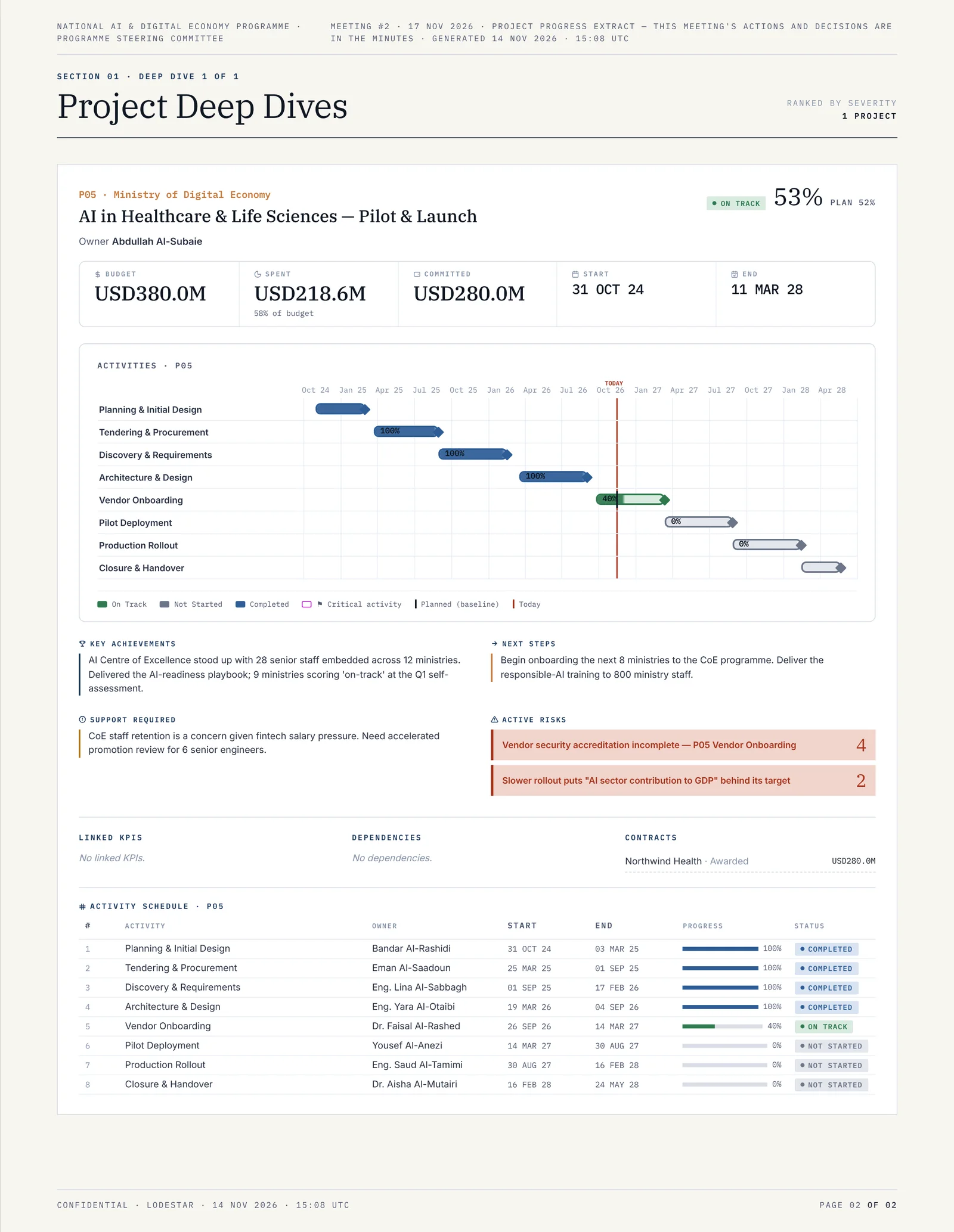
In Lodestar, the strategy progress report, the KPI scorecard and the one-page project deep dives are generated from the live model and export to PDF, PowerPoint and Word, so nobody retypes the pack. When an owner submits a KPI reading with its files, Polaris reads the evidence before it sees the reported figure, tells the approver what supports the claim and what does not, and never approves.
The approval side of this pattern is in Agents that act, and the person who signs.
Questions for your next review
- For each task we have given an agent, what level is it at, and who decided that?
- In the last pack, how many status ratings did an owner change from the agent's draft?
- When a reported figure is checked, does the check see the figure first?
- Which hours has the agent freed this quarter, and what did we spend them on?
- For the last three committee decisions, whose name is in the minute?
An agent can give a transformation office back a large part of its week. Whether that becomes better decisions or a longer pack depends on a choice the office makes before the hours arrive.

Hany is a strategy and transformation executive with a technical background in software and AI. He has advised C-suites at a top-three strategy consulting firm (MBB) and independently, and has run transformation programmes of more than USD 1 billion.
Connect on LinkedIn