In short
- An OKR tool shows whether goals align. It cannot say which work moves a result unless the work sits beside it.
- Hold key results, KPIs, projects, budget and risks in one model, and link each piece of work to its result.
- Test any tool on one real objective: its key results, its projects, its spend and its risks, answered live.
At the start of the year the strategy office bought an OKR tool to manage its objectives and key results (OKRs). Every team wrote its key results beneath the company objectives, and the alignment tree on the town-hall slide looked the way a strategy should.
Now it is the mid-year review. One key result, the time it takes to bring a new customer on board, has not moved since January. The chief operating officer asks which projects were meant to move it, how late they are, and what they have cost. The projects sit in the portfolio tool of the project management office (PMO). The spend sits in a finance spreadsheet, the risks in a third team's register.
The answer arrives four days later, as a spreadsheet built by hand. By then the review has moved on.
What goes wrong
OKR software is built to do one job well. It helps an organisation write its OKRs, link team goals to company goals and check in on progress each week. The health measures, the key performance indicators (KPIs), usually stay on the scorecard where they were. A strategy PMO, the office that runs the strategy's portfolio, is asked a wider question: which work moves which result, at what cost, and with what risk. Four gaps open between the two.
The links stop at the key result. An OKR tool links goals to goals. The work lives somewhere else, so the link from a project to a result is a name typed into a comment or a column in a mapping sheet. Nobody owns that sheet.
Two progress numbers, kept by different people. The key result carries a weekly confidence score that its owner types in. The projects carry a status that the PMO reports each month. When they disagree, nobody can tell why, because the two never sit on one page.
The money and the risks are missing. When a key result is off track, the useful decisions are about budget, people and risk. None of those lives in the OKR tool. The review ends with an action to look into it.
Changes leave no trace. A key result that is going badly can be reworded, or its target lowered, in a few clicks, with no approver and no record of the original. By year end, the result promised and the result scored may be different numbers.
Together these turn the strategy office into the integration layer, and the time meant for steering the strategy goes on assembling it. More discipline inside the OKR tool does not help, because the gap sits between the tools.
What good looks like
The right choice depends on what the office has to answer for. Five moves settle it, and each can start before any software is bought.
Write down the questions the office must answer
List the questions the executive committee put to the strategy office in the last two quarters. If they are about focus (are the teams aligned, are the results moving), OKR software is enough, and quicker to roll out. If they are about the work behind the results (which projects, how late, how much spent, what is at risk), the office needs strategy execution software that holds the work as well. Most offices are asked both, and planned only for the first.
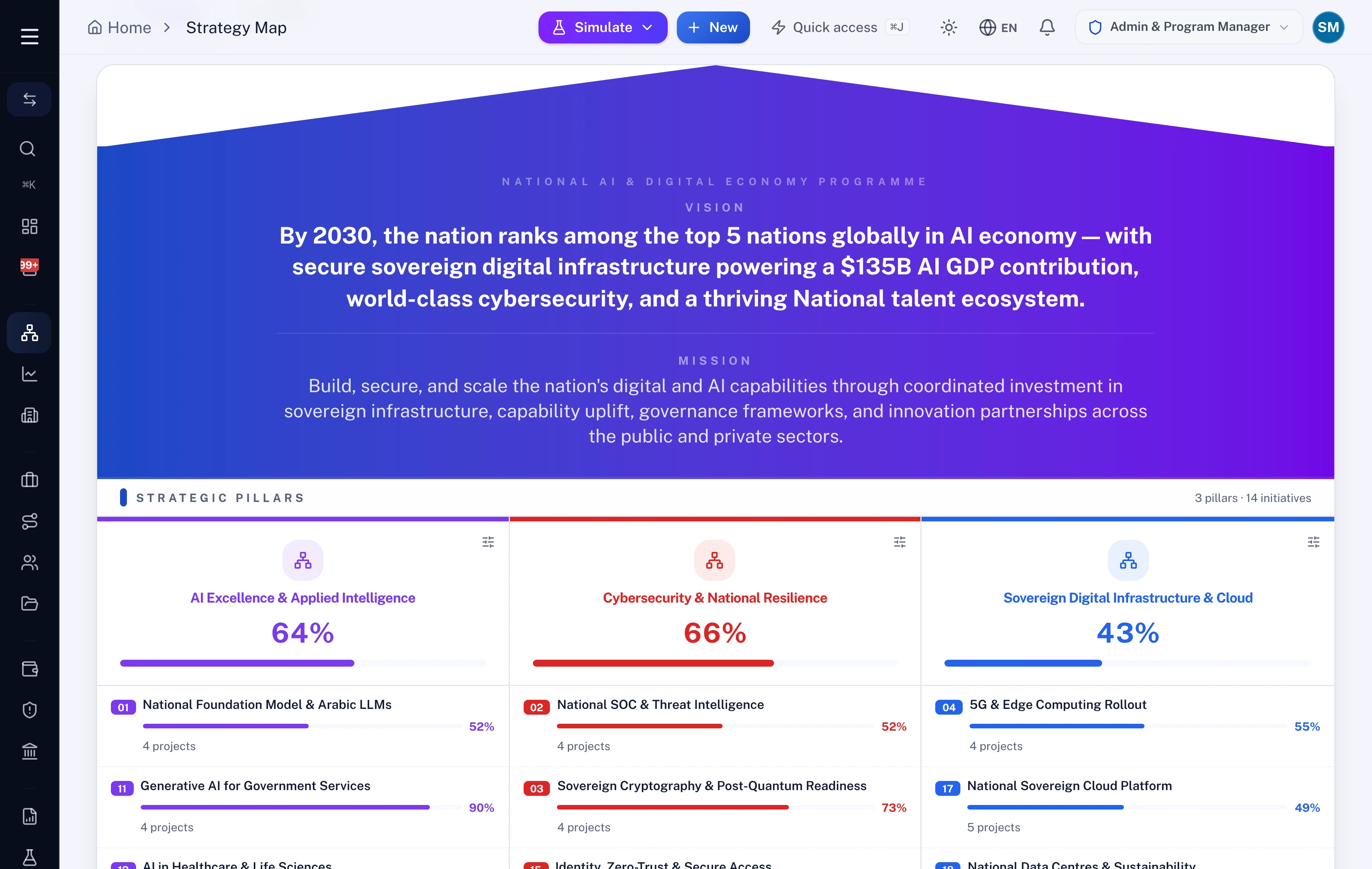
In Lodestar, an administrator chooses the structure of the strategy, and one starting point is OKR: themes, then objectives, then key initiatives, then projects. An organisation that plans in pillars or portfolios names up to four strategy levels of its own instead.
Hold key results, KPIs and the work in one model
A key result is a measure attached to an objective, and it says whether something is changing. A KPI keeps something healthy, and it can sit at any level. The key initiatives, projects, milestones, budget lines and risks sit beneath, in the same structure. In one model, a key result and the work behind it appear on one page without anyone assembling them.
In Lodestar, key results are KPIs set on the objective itself, and KPIs can sit at any level and cascade down to the team, as the strategy and KPI model shows. The projects beneath carry their own budget, contracts, risks and issues in the same model.
Link each key result to the work meant to move it
Every key initiative and project should name the key result it exists to move, as a field kept with the plan. When a key result stalls, the review opens the work behind it and asks whether it is late, finished without effect, or too small for the result. OKRs that pull the whole organisation one way covers how to draw those links when the cycle is set.
In Lodestar, any KPI can be linked to one activity, milestone, task or sub-task, and its forecast then takes its pace from that item. A milestone KPI whose linked item is planned to finish after the KPI's due date reads At risk before either date has passed.
Show attainment beside delivery, and never blend them
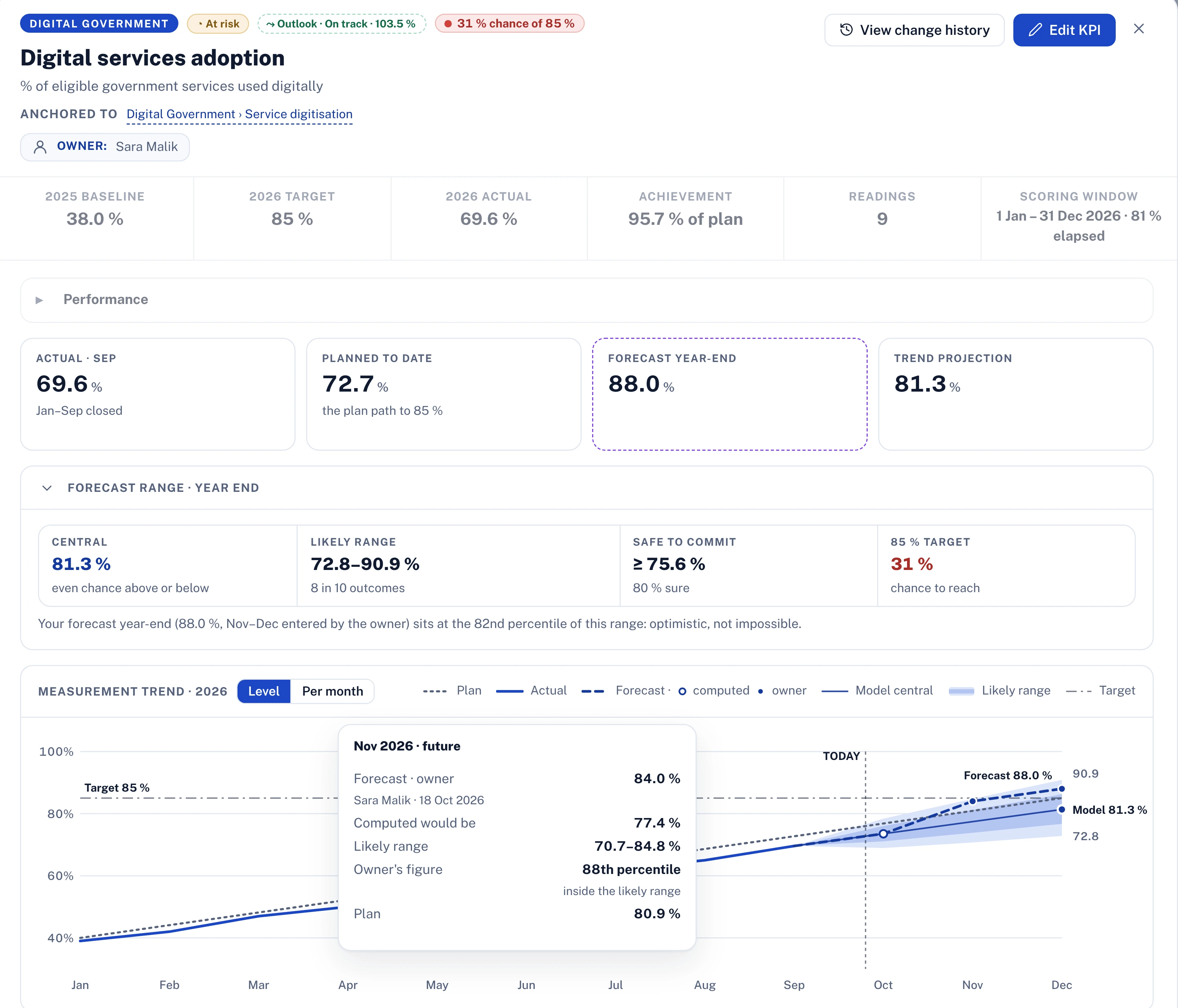
Delivery progress says whether the work was done. Attainment says whether the result moved. Averaged into one score, nearly finished work and a flat result make a comfortable middle figure that describes neither. Show the two side by side, score each key result against a plan for the period, and treat a gap that lasts two reviews as a decision for the objective's owner.
In Lodestar, the objective's page shows key-result attainment beside delivery progress, and attainment is never folded into the progress figure. Each KPI carries its plan, actual and forecast, so a key result is judged against where it should be this quarter.
Put target changes and readings under approval
A key result's target is a commitment. Lowering it mid-cycle is a decision, with a reason and an approver who is not the owner, and the original stays on record. A reading that moves a key result should point to the evidence behind it, so the review argues about the result and not the number.
In Lodestar, a change to a KPI's target, value or forecast can be sent through an approval route set in Workflow Studio, and the person who raises a request can never approve it. KPI readings can be verified file by file.
Test OKR software and a strategy execution platform on your own data
A demonstration on the vendor's data shows the happy path. Take one real company objective instead, with its key results, the projects meant to move them, their budget lines and their largest risks, and ask each vendor to load it. Then ask three questions live, as an ordinary user:
- Which pieces of work move this key result, and which of them are late?
- How much has been spent on that work, against how far the result has moved?
- If we lower this target, who has to approve it, and where is the original kept?
A tool that answers only the first, from a mapping sheet, is an OKR tool, and may still be the right buy. One that answers all three from its own records is a strategy execution platform. More tests of this kind are in Seven tests for strategy execution software.
Questions for your next review
- Which questions from the executive committee last quarter could the strategy office not answer from its own records?
- For each company key result, which projects are meant to move it, and where is that link kept?
- When a key result and the work behind it disagree, who brings the decision, and to which meeting?
- Who approved the last change to a key result's target, and is the original still on record?
An OKR tool tells an organisation where it is pointing. Steering it takes the work, the money and the risks on the same page as the result they are meant to move.

Mariia leads commercial and partnerships at Lodestar. Her background is Big Tech and Big Four consulting, where she led large-scale transformations. She holds an MBA from INSEAD.
More from Mariia