In short
- An AI that reads one project cannot see the dependency that sinks it.
- Most links between projects sit in notes, documents and contracts, not in the schedule.
- A found link is a proposal for the owners of both ends, priced in days.
The project manager has had the AI features for a month and likes them. The assistant turns a meeting transcript into actions, drafts the weekly update and suggests risks from the plan. The data migration project has never looked better organised.
Six weeks later the migration stops. It needs the new hosting contract, and the hosting contract sits in another project, owned by procurement, which reported a vendor dispute in its progress note two months ago. The note was there for anyone to read. The migration plan had no link to it, so the assistant inside the migration plan had nothing to read.
Both projects were well run. The programme slipped in the space between them.
That is the gap in most AI in project management today. The tools are built for one team working one plan, and they help that team. A programme manager answers for something else: twenty or ninety plans, the joins between them, and what a slip in one does to the rest.
What goes wrong
The AI does what it was designed to do. The design starts from the wrong unit.
It reads one plan. An assistant inside a project tool works on the project it was opened in. Ask it about the migration, and it reads the migration's tasks, dates and risks. The hosting contract is out of its reach, because it belongs to a different plan and often a different team's permissions.
It reads what has been declared. Even a portfolio view only shows the dependencies someone entered. In the programmes I have worked in, most of the links that mattered were never entered. They were written in a progress note, implied by a shared supplier, held in one specialist's diary, or buried in a contract clause about a hand-over date. A schedule holds the links people thought of at planning time. The links that bite are usually the ones found later.
It prices nothing. When an assistant does spot a risk, it reports a sentence: "the migration may depend on the hosting contract". Nobody can act on that. The programme manager needs to know how many days it costs the end date, which other work moves with it, and whose time is stretched on other projects.
The finding has nowhere to go. A link between two projects has two owners. The migration manager cannot change procurement's plan, and procurement does not read the migration's risk log. So the finding stays in one person's chat window, and the dependency is discovered the usual way, when the work stops.
The result is AI that makes each project tidier and leaves the programme's main risk where it was: in the joins.
What good looks like
Using AI well in programme management means changing what it reads and where its findings go. Five moves, none of which depend on a particular product.
Point the AI at the programme, under the reader's own permissions
The useful question for a programme manager is never about one project. It is "what in the whole programme could move my end date?" The AI has to read every project to answer it. It should still read only what the person asking is allowed to see, so a department head gets an answer about their department and the programme director gets the whole estate. An AI with wider access than its user is a leak, however helpful it is.
Have it read the text, not only the schedule
The links that matter live in words: progress notes, meeting minutes, documents attached to deliverables, risk descriptions, contract terms. Reading all of that every week is the work no analyst has time for, and the work a model is good at. Ask it to list the dependencies it finds that the plan does not hold, with the sentence that suggests each one.
Price every finding in days and in people
A finding earns attention when it has a cost. Run each suspected link through the schedule: how many days it adds to the programme end, or whether float absorbs it, which downstream work moves, and whose assignments stretch into weeks they have already given to other projects. A link that costs nothing can wait. One that crosses the committed date goes to the next steering committee with its number.
Send the link to the owners of both ends
A dependency between two projects is an agreement between two people. Make the AI's finding a proposal that both can see, and let the owner of the other project accept it into their plan. The person who found it should not be able to write it into someone else's schedule alone. Once accepted, it is a real link, and the critical path and the delay simulations use it from then on. I wrote more about managing these joins in dependencies are the programme.
Let a dismissal stand until the facts change
Many findings will be wrong, or right and harmless. Dismiss them with a reason. A good tool keeps that decision and raises the finding again only if its situation gets worse, so the team is not asked the same question every week. A finding that is real but has nothing to do with the schedule, such as a shared supplier under financial stress, belongs in the risk register instead.
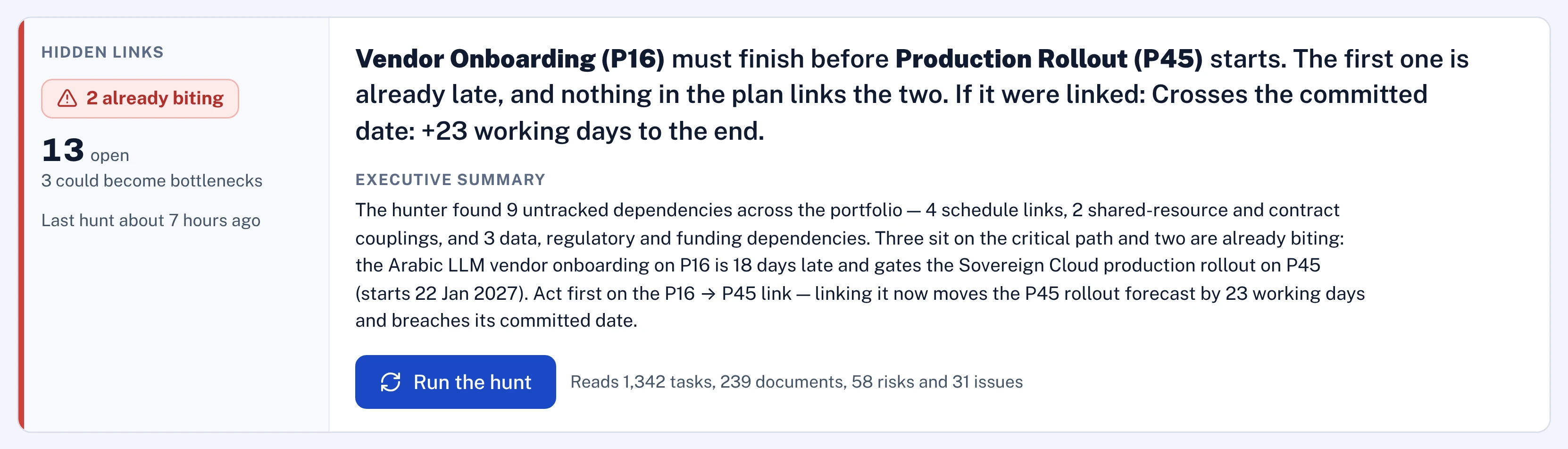
In Lodestar, the Dependency Hunter in Polaris reads every activity with its tasks, documents and deliverables, open risks and issues, progress-report notes and the resource, contract and budget links, and lists the dependencies nobody declared with the days each adds to the programme end. Confirming one creates a suggested link to harden later; a finding dismissed with a reason returns only if its situation worsens.
Questions for your next review
- Which of our projects could stop because of work in another project, and is each of those links in the plan?
- When someone finds an undeclared dependency, who has to agree before it goes into the other project's schedule?
- For the three riskiest links between projects, how many days would each add to the programme end?
- Does our AI read only the project it was opened in, or the programme, within each person's access?
AI makes a project team faster at running its own plan. A programme is decided in the joins between plans, so that is where its AI has to look.

Hany is a strategy and transformation executive with a technical background in software and AI. He has advised C-suites at a top-three strategy consulting firm (MBB) and independently, and has run transformation programmes of more than USD 1 billion.
Connect on LinkedIn